How to Remove Dependencies in a Gantt Chart: 5 Steps [2026]
Dependencies can keep a Gantt chart realistic, but they can also create unnecessary delays. One outdated link may move several tasks, distort your delivery date, or make a simple schedule look impossible. Worse, deleting the wrong relationship can hide a genuine project constraint.
But here’s the truth: removing a dependency is usually simple when you know which task relationship needs to change. You need to identify the link, check its impact, remove it safely, and review the schedule afterward.
This guide shows you how to remove a dependency in a Gantt chart using five practical steps. You’ll also learn when to unlink tasks, when to change the dependency type, and how to prevent accidental schedule problems.
How to Remove a Dependency in a Gantt Chart: 5 Steps
To remove a dependency in a Gantt chart, select the linked task relationship, delete or unlink the connection, then review all affected dates and constraints. The exact control may be called Remove dependency, Delete link, Unlink tasks, or Clear predecessor.
Here’s the safest five-step process:
-
Identify the dependency you want to remove.
Find the predecessor and successor tasks connected by the dependency line. A predecessor influences another task, while a successor depends on that earlier task.
For example, “Approve design” may currently control the start of “Begin development.” Confirm that this is the relationship you intend to change.
-
Check why the dependency exists.
Ask whether the link represents a real business, technical, or approval requirement. Removing a connection simply because it creates a delay can produce an unrealistic schedule.
For instance, development may genuinely require an approved design. However, a separate testing task might begin with a draft prototype, making that link unnecessary.
-
Open the task relationship controls.
Click the dependency line, predecessor field, successor field, or task settings menu. Some applications let you right-click the connector and choose a removal command.
Other tools place dependencies in a details panel. Look for labels such as Predecessors, Successors, Links, or Relationships.
-
Remove or unlink the relationship.
Choose the command that clears the connection. Avoid deleting either task unless you also intend to remove the planned work itself.
If the tool asks whether you want to remove one link or all links, select only the relationship that no longer applies.
-
Review the schedule after the change.
Check task dates, duration, milestones, critical-path indicators, assigned people, and downstream activities. Removing one dependency can allow a later task to start earlier.
For example, removing “Prepare training room” as a predecessor may move “Deliver training” forward by three days. Confirm that the room is still available before accepting the new schedule.
Quick method for most Gantt chart tools
In many project applications, you can remove a link by selecting the successor task and clearing its predecessor field. You may also select the connector between two task bars and press Delete.
If the dates do not change, another constraint may still control the task. Check for a manually fixed start date, a deadline, a calendar restriction, or another predecessor.
What changes after you remove a dependency?
The successor task may become available earlier, but its schedule does not automatically become realistic. The tool may recalculate dates without understanding staffing, equipment, approvals, or operational limits.
Think of the dependency as a gate. Removing the gate opens a route, but you still need to confirm that the route is usable.
Understand Dependency Types Before Unlinking Tasks
Most Gantt charts use four common dependency types. Knowing the relationship helps you decide whether to remove it or replace it with a more accurate one.
- Finish-to-start: The second task starts after the first task finishes. “Complete requirements” may come before “Start implementation.”
- Start-to-start: The second task starts after the first task starts. “Begin installation” may allow “Start equipment testing.”
- Finish-to-finish: The second task finishes after the first task finishes. “Complete editing” may need to align with “Complete quality review.”
- Start-to-finish: The second task finishes after the first task starts. This relationship is less common and often supports shift handovers.
Here’s why this matters: the problem may be the dependency type rather than the dependency itself. A finish-to-start link may delay work that could begin during an earlier phase.
Imagine a website project. The team may not need to wait for every page to finish before starting accessibility testing. A start-to-start relationship could reflect the workflow more accurately.
Remove the link or change the relationship?
Remove a dependency when the two tasks can proceed independently. Change the dependency type when the tasks remain connected but can overlap.
Remove the link when:
- The tasks belong to separate workstreams.
- The original requirement no longer exists.
- The relationship was added accidentally.
- The successor has another reliable readiness condition.
Change the link when:
- Both tasks can progress at the same time.
- The successor needs an early phase, rather than full completion.
- A partial handoff is enough to begin work.
- The current relationship exaggerates the waiting period.
Use lead and lag carefully
Some tools let you add lead or lag to a dependency. A lag creates waiting time, while a lead allows the successor to overlap with the predecessor.
For example, a two-day lag after painting may represent drying time. A one-day lead may allow packaging to begin before the entire production run finishes.
These settings can be useful, but they should represent a real operating condition. Otherwise, removing the dependency may be clearer and easier to maintain.
When Should You Remove a Task Dependency?
You should remove a task link when it no longer represents how work happens. The strongest signal is a change in responsibility, sequence, approval policy, or technical design.
But here’s the truth: schedule pressure alone is not a good reason. A dependency may be inconvenient because it reflects a genuine risk.
Good reasons to remove a link
The tasks are independent. A marketing brief and an internal security review may happen at the same time. Linking them can create an artificial delay.
The work has been split into smaller parts. A team may initially connect “Complete product design” to “Start testing.” Later, the team creates separate component designs that can enter testing earlier.
The responsible team changed its process. A previous approval step may no longer be required after a policy update.
The relationship was entered incorrectly. A coordinator may accidentally connect the wrong predecessor to a task. Removing the error prevents misleading dates.
Reasons to keep the dependency
Keep the link when the successor genuinely cannot begin without the predecessor. This includes legal approval, physical access, safety clearance, technical integration, and confirmed handover requirements.
For example, a construction crew should not begin electrical installation before the required structural work is complete. Removing that relationship may create a dangerous plan.
A practical decision test
Ask one question: What specifically allows the successor to begin if this link disappears?
A strong answer names a condition, such as a partial design, an available environment, a separate team, or an approved workaround. “The deadline is close” does not explain readiness.
How to Remove Dependencies Without Breaking the Schedule
Removing a link changes the logic of your plan. A short review prevents hidden problems and gives your team confidence in the revised dates.
Review the critical path
The critical path shows activities that directly influence the planned completion date. Removing a dependency may shorten that path or move another sequence into a more important position.
For example, removing a link from a three-day review task may expose a five-day procurement task as the new schedule driver.
Inspect downstream tasks
Look beyond the task you edited. Check every later activity that may move because the successor can now start sooner.
A change to “Finish prototype” could affect testing, training, launch preparation, and customer communications. Review the full chain rather than only the next task.
Confirm capacity and calendars
An earlier date does not guarantee earlier delivery. The assigned person may be unavailable, or the required equipment may already support another activity.
Compare the revised dates with working hours, holidays, shift schedules, and team capacity. This catches optimistic changes before they reach stakeholders.
Record the reason for the change
Add a short planning note explaining why the dependency was removed. Mention the new readiness condition and the person who confirmed it.
For example: “Removed design approval link after the engineering team confirmed component-level testing can begin with approved modules.”
Communicate the impact
Tell affected contributors when their work may now start. A schedule update can create an unexpected request for earlier reviews, materials, or staffing.
A quick message prevents a common problem: the chart shows an earlier date, but the people responsible have not prepared for it.
Examples of Removing Gantt Chart Dependencies
Concrete examples make the decision easier. The right action depends on why the relationship exists and what readiness looks like.
Example 1: Product development
A team links “Finish all interface designs” to “Start usability testing.” The team later agrees to test each completed screen as it becomes available.
The original finish-to-start link is too restrictive. The team can remove it and create smaller design-to-test relationships for each screen.
Example 2: Event planning
An event plan links “Confirm catering” to “Send attendee reminders.” The communications team can send reminders before the menu is finalized.
Removing the link allows earlier communication. The team should still add a separate reminder for dietary details once catering is confirmed.
Example 3: Software release
A release plan links “Complete all test cases” to “Prepare support training.” Support training can begin with stable features while edge-case testing continues.
The team may remove the full dependency and connect training to a smaller readiness milestone. This preserves control without forcing unnecessary waiting.
Example 4: Construction work
A project links “Complete interior painting” to “Install lighting fixtures.” If fixtures must remain protected from paint, the link may be valid.
Removing it without checking site conditions could cause rework. In this case, the dependency should remain unless the work method changes.
Solution for Managing Flexible Gantt Dependencies: ONES.com
Value Proposition
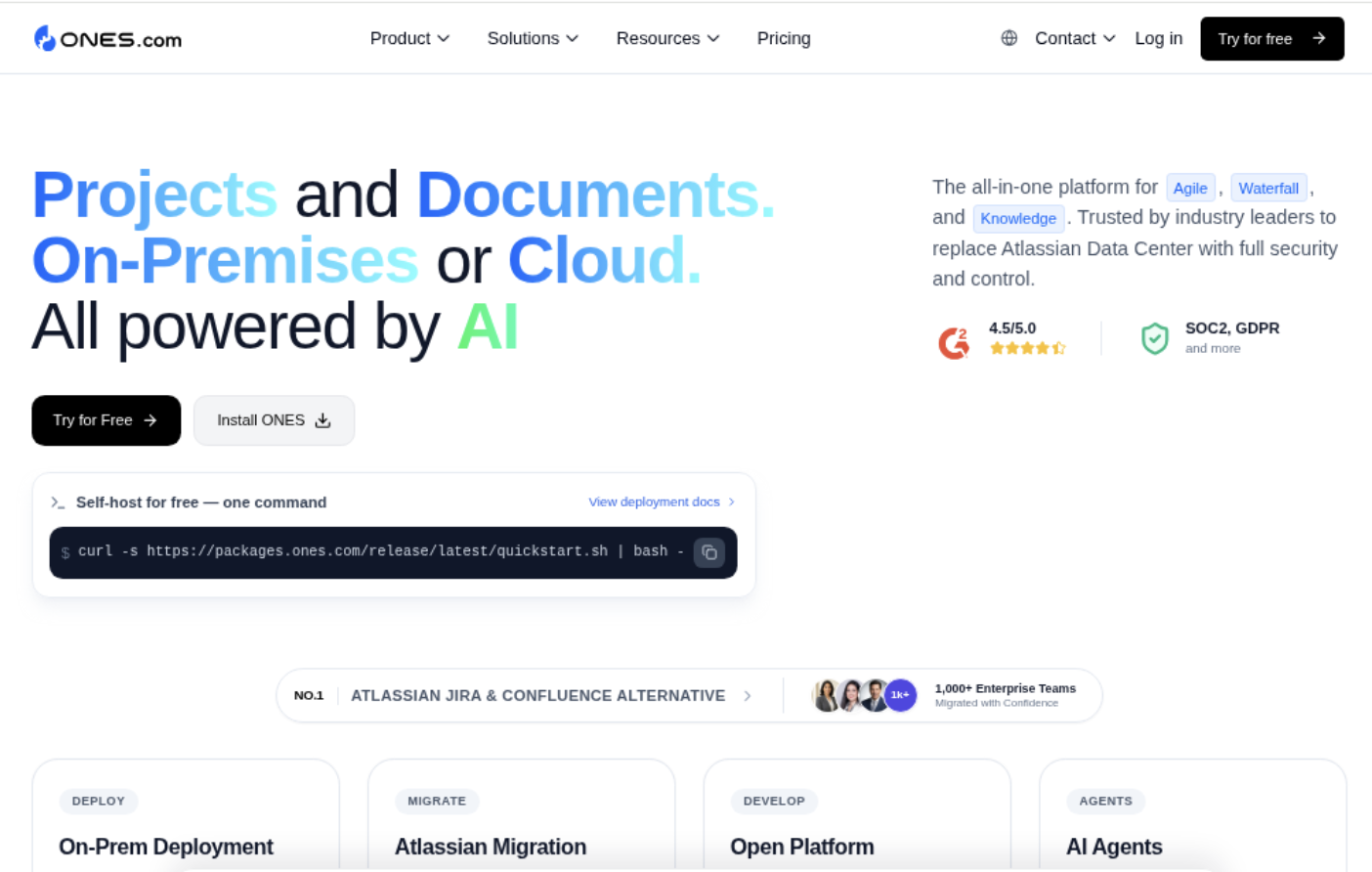
ONES.com combines project management and knowledge management in one platform. ONES Project supports Jira-compatible workflows, Gantt planning, custom fields, reporting, sprint management, and automation.
For teams adjusting schedules frequently, the platform keeps task relationships, responsibilities, and planning context connected. ONES Project is also available as a Jira alternative with cloud and self-hosted deployment options.
Core Capabilities
- Unclear task relationships → Gantt dependencies in ONES Project → Visual links help you inspect predecessor and successor relationships before removing them.
- Accidental schedule changes → Custom workflows and fields → You can capture dependency reasons, approval states, and readiness conditions alongside tasks.
- Hidden schedule impact → Built-in reporting → Reports help you review changes across milestones, work items, ownership, and planned delivery dates.
- Repeated manual updates → Automation → Rules can notify responsible people when a relationship changes or a task becomes ready.
- Rigid planning structures → Custom workflows → Teams can adapt approval, development, testing, and release stages to their operating model.
- Disconnected planning knowledge → ONES Wiki → Teams can keep planning guidance, dependency rules, and process explanations near their project work.
- Plugin-heavy project administration → Native project features → Built-in capabilities can reduce the need for multiple add-ons supporting common planning tasks.
- Restricted deployment requirements → Four deployment options → You can choose Cloud, On-Premise, Private Cloud, or Air-gapped deployment.
- Migration concerns for Jira teams → Jira-compatible workflows → Teams familiar with Jira can preserve recognizable planning patterns while evaluating another platform.
Application Scenarios
Product teams with overlapping development and testing: A product manager can separate broad release dependencies into smaller component milestones. Testers receive earlier visibility without losing traceability.
Regulated organizations with restricted networks: An air-gapped deployment can support project planning where external connectivity is limited. The team can maintain dependency logic within its controlled environment.
Growing teams replacing several tools: A team can manage project work in ONES Project and related guidance in ONES Wiki. This reduces the need to search across disconnected workspaces.
ONES.com offers a free plan for up to 30 seats. The platform provides full feature parity between its cloud and self-hosted versions, helping teams select deployment according to operational needs.
Common Challenges When Removing Dependencies
Challenge: The task still does not move
Problem: You removed one relationship, but the successor keeps its original date.
Solution: Check for additional predecessors, fixed-date constraints, deadlines, calendars, and resource availability. Another scheduling rule may still control the task.
Challenge: Removing the link creates an unrealistic start date
Problem: The chart allows work to begin before people, materials, or approvals are ready.
Solution: Define the actual readiness condition. Restore the dependency, add a milestone, or use a more accurate relationship type.
Challenge: Team members do not understand the change
Problem: People continue following the old sequence after the chart changes.
Solution: Explain what changed, why it changed, and which tasks now have new dates. Ask owners to confirm their availability.
Challenge: Too many links make planning difficult
Problem: The chart contains relationships for every small interaction. Removing one link does not simplify the overall schedule.
Solution: Keep dependencies for genuine handoffs, approvals, safety conditions, and technical requirements. Avoid linking tasks merely because they appear in the same phase.
Challenge: A removed dependency returns later
Problem: Someone recreates the relationship because the underlying process remains unclear.
Solution: Record the agreed workflow and readiness rule. A short explanation in the task details or team knowledge area can prevent repeated confusion.
FAQs About Removing Gantt Chart Dependencies
Can I remove a dependency without deleting the task?
Yes. Removing a dependency usually deletes only the relationship between two tasks. The tasks, durations, assignments, and other relationships should remain. Select the connector or clear the predecessor field rather than deleting the task itself. Afterward, inspect the successor date and any downstream activities that may have moved.
Why does removing a dependency change several task dates?
A dependency controls the timing of later work. When you remove it, the scheduling engine may allow the successor to start earlier. That change can move its successors, milestones, and the planned finish date. Review the entire affected chain, especially activities on or near the critical path.
Should I delete a dependency or change its type?
Delete the relationship when the tasks can proceed independently. Change its type when the tasks still depend on one another but can overlap. For example, testing may begin after development starts rather than after development finishes. A start-to-start link may represent that process more accurately.
How can I tell whether a dependency is necessary?
Ask what condition makes the successor ready to begin. If the answer requires a completed approval, handoff, physical activity, or technical result, keep the relationship. If another team, partial output, or independent work area makes the task ready, the link may be unnecessary or too restrictive.
Can removing a dependency shorten the critical path?
It can. The successor may start earlier, reducing the length of one sequence. However, another sequence may then become the main schedule driver. Recalculate or review critical-path indicators after the change, and confirm that the earlier dates match actual team capacity.
Conclusion
Removing a Gantt chart dependency takes only a few clicks, but the planning decision deserves care. Identify the relationship, understand why it exists, remove or revise it, and review the schedule afterward.
The safest approach connects every task date to a real readiness condition. When work can overlap, use a better dependency type. When tasks are genuinely independent, remove the link and communicate the impact.
That process solves the immediate scheduling problem while preventing a larger one. Your Gantt chart becomes easier to understand, more flexible to update, and more trustworthy for everyday project decisions.