How to Make a Gantt Chart in Jira: A Step-by-Step Guide
Jira is excellent for tracking issues, sprints, and releases, yet planning work across dates and dependencies can feel surprisingly difficult. You may need a Gantt chart to see which tasks start first, where milestones land, and whether one delay will affect the entire launch.
The challenge is that Jira does not provide a full native Gantt chart experience in every setup. You may end up switching between issue views, manually checking dates, or relying on several add-ons. That creates extra maintenance and makes schedule changes harder to spot.
But here’s the solution: you can build a practical Gantt-style plan by preparing Jira issues, assigning dates, connecting dependencies, and choosing the right timeline view or app. This guide walks you through each step, including what Jira can do natively and when another project management platform may fit better.
How to Make a Gantt Chart in Jira
To make a Gantt chart in Jira, create issues for your work, add start and due dates, organize them into epics or parent tasks, link dependencies, and display the schedule through a timeline feature or Gantt chart app. The exact process depends on your Jira edition and the tools enabled in your workspace.
Here’s why preparation matters: a Gantt chart only becomes useful when each task has reliable timing, ownership, and relationships. A list of issue titles alone cannot show whether your release is achievable.
1. Define the project scope
Start by writing down the outcome you need to deliver. For example, a mobile app launch may include design, backend development, testing, compliance review, marketing preparation, and release activities.
Keep the scope specific enough to schedule. “Build the product” is too broad for a meaningful chart. “Complete payment screen designs” or “Finish payment gateway testing” gives you a trackable unit of work.
You can group the scope into several levels:
- Project: the complete initiative, such as a mobile app launch.
- Epic or workstream: a large area, such as checkout, analytics, or quality assurance.
- Task or story: a deliverable that someone can complete and verify.
- Subtask: a smaller action needed to finish a task.
Try to keep task sizes consistent. A task expected to take two days should not sit beside another issue that represents an entire quarter.
2. Create the Jira project and issue hierarchy
Open the appropriate Jira project and choose an issue structure that matches your planning method. A company-managed project often gives you more control over workflows, fields, and issue types. A team-managed project can be quicker to configure.
Create epics for major workstreams, then add tasks or stories beneath them. For example:
- Epic: Checkout experience.
- Task: Design the checkout flow.
- Task: Build address validation.
- Task: Connect payment processing.
- Task: Complete checkout acceptance testing.
Use subtasks when a single deliverable has several tightly connected activities. For instance, “Prepare acceptance testing” could include writing test cases, preparing test accounts, running tests, and resolving defects.
Let me explain: hierarchy makes the chart easier to read. You can collapse a workstream when you want a high-level view, then expand it when you need task-level detail.
3. Add start dates and due dates
Open each schedule-related issue and add the dates your Jira setup supports. A due date tells Jira when work should finish. A start date tells the timeline when work should begin.
If your project does not include a start-date field, add one through the project’s field configuration or use the date controls provided by your timeline app. Avoid estimating duration only from a due date when the task may span several weeks.
Use realistic dates that account for:
- Review and approval time.
- Availability of the assigned person or team.
- Public holidays and planned leave.
- Testing, rework, and defect resolution.
- Waiting time between dependent activities.
For example, suppose design is scheduled from April 1 to April 5. Development may begin on April 8 after a review meeting, rather than immediately on April 5.
When you change a date, check every connected issue. A small delay in an approval task can move development, testing, training, and launch preparation.
4. Assign ownership and estimate effort
Assign each issue to the person or team responsible for moving it forward. Then add an effort estimate using story points, time estimates, or the method your team already understands.
Dates and ownership answer different questions. The dates show when work should happen. The assignee shows who is accountable. The estimate shows how much capacity the work may require.
Consider this example:
| Task | Schedule | Owner | Estimate |
|---|---|---|---|
| Design checkout flow | April 1–5 | Product design | 5 working days |
| Build payment processing | April 8–19 | Engineering | 10 working days |
| Run acceptance testing | April 22–26 | Quality assurance | 5 working days |
This information helps you find overloaded teams before the schedule becomes urgent. If the same engineer owns five tasks during one week, the chart should prompt a capacity discussion.
5. Link dependencies between issues
Dependencies show the order in which work must happen. In Jira, you can link issues with relationships such as “blocks,” “is blocked by,” “relates to,” or other configured link types.
A common dependency chain looks like this:
- Design the checkout flow.
- Review and approve the design.
- Build the checkout components.
- Connect the payment service.
- Run acceptance testing.
- Release the updated checkout.
Use a blocking relationship when the next activity cannot begin until the earlier one is complete. Use a related relationship when two issues are connected but can progress independently.
Here’s why: a Gantt view becomes powerful when it shows cause and effect. If “Connect the payment service” is blocked by an unfinished API task, the schedule can reveal the risk immediately.
6. Add milestones
Milestones represent important points with little or no duration. Examples include design approval, code freeze, regulatory sign-off, beta launch, and public release.
Create a dedicated issue type for milestones if your project configuration supports it. Otherwise, use a task with a single target date and a clear label such as milestone.
Good milestones are outcome-focused. “Release candidate approved” is more useful than “Week 8,” because it explains what the team must achieve.
Place milestones at decision points. A release milestone, for example, should follow testing, defect review, operational readiness, and final approval.
7. Open a timeline or Gantt chart view
Jira editions and configurations differ, so the menu may vary. Look for a timeline, roadmap, plans, or scheduling view within the project. If your setup does not offer the required controls, install a Gantt chart app through the Atlassian Marketplace after reviewing its permissions and pricing.
In the timeline view, configure the display around the information your audience needs:
- Show epics for an executive overview.
- Show tasks and dependencies for delivery planning.
- Display milestones for steering meetings.
- Group work by team, component, or epic.
- Set the time scale to weeks for active delivery.
- Use months or quarters for portfolio planning.
The best part? You do not need every issue visible at once. A project sponsor may need milestones and workstreams, while an engineering lead may need individual tasks and blocking links.
8. Validate the schedule
Before sharing the chart, inspect it for gaps and conflicts. Check whether tasks overlap appropriately, whether dependencies point in the right direction, and whether the final milestone includes enough contingency.
Ask these practical questions:
- Does every major deliverable have an owner?
- Does every task have a start date, due date, or clear scheduling rule?
- Are blocked tasks connected to the work that controls them?
- Are milestones tied to real acceptance criteria?
- Does the plan exceed the team’s available capacity?
- Is testing scheduled before the release date?
Do a short review with the people doing the work. A planner may assume that development begins after design approval, while the engineering team knows that an environment setup task must happen first.
9. Keep the chart current
A Gantt chart loses value when it becomes a static snapshot. Ask owners to update status, dates, estimates, and blockers during regular planning or review sessions.
Set a simple maintenance rhythm. For example, the team can update issues before a weekly delivery meeting, then review changes during the meeting.
Record the reason for major date changes in the issue activity or comments. “Moved because security review requires an additional test cycle” gives stakeholders useful context.
What Jira Can and Cannot Do Natively
Jira is designed around issue tracking and agile delivery. Depending on your plan and configuration, you may have timeline or roadmap capabilities that display issues across dates, group work by hierarchy, and show relationships.
Those features can be enough for a small project. A five-person team planning a six-week website update may only need epics, dates, and a few milestones.
However, advanced Gantt planning often requires more. You may need baselines, critical path analysis, automatic scheduling, cross-project dependencies, resource planning, or richer reporting.
But here’s the truth: the right setup depends on the planning depth you need. Start with native Jira features when they cover your workflow. Consider an app or another platform when manual scheduling creates repeated work.
Timeline view versus full Gantt planning
| Capability | Basic timeline | Full Gantt planning |
|---|---|---|
| Issue dates | Usually available | Available with richer scheduling controls |
| Hierarchy | Epics and tasks | Multiple levels with roll-up dates |
| Dependencies | May be limited | Often displayed and managed directly |
| Critical path | Usually limited | Common in dedicated planning tools |
| Baselines | May be unavailable | Useful for comparing planned and actual dates |
| Resource planning | Often basic | More detailed capacity and workload views |
Use a timeline when you need a visual schedule connected to Jira issues. Use dedicated Gantt functionality when schedule logic itself is central to delivery.
How to Structure Jira Issues for a Reliable Schedule
A chart reflects the quality of its issues. If one issue contains design, development, testing, and launch preparation, its date range hides important handoffs.
Break work down at the point where ownership, timing, or approval changes. For example, create separate issues for “Prepare test plan” and “Run acceptance testing” because different people may own them and the second depends on the first.
Here’s a practical rule: if an activity can finish while another activity continues, give it a separate issue. This makes parallel work visible.
Use a clear naming pattern
Write issue names so someone can understand them without opening every detail. “Approve onboarding copy” is clearer than “Onboarding task 3.” Include the outcome, area, or audience when helpful.
You can use labels for cross-cutting categories such as launch-critical, external-dependency, or regulatory-review. Keep the label set small enough for consistent use.
Separate work from waiting
Some schedule periods represent active work. Others represent waiting for an approval, vendor response, environment, or external team.
Track meaningful waiting periods explicitly when they affect the final date. For example, “Await legal approval” may need its own issue because it creates a genuine dependency and risk.
Use estimates carefully
An estimate should describe expected effort or duration according to your team’s method. A task that takes two hours of active work may still span three calendar days if it depends on a review queue.
Keep effort and elapsed time separate when your Jira configuration allows it. This distinction gives you a more realistic view of capacity and schedule risk.
How to Manage Dependencies and Critical Dates
Dependencies are often where project schedules fail. A team can finish its own tasks on time and still miss the launch because another activity was assumed rather than connected.
Create links for external relationships too. A product release may depend on a vendor certification, a security review, or an operations change. Add those activities to the plan when they can affect delivery.
You might be wondering: how do you identify the critical path? Trace the longest chain of dependent activities leading to the final milestone. Any delay along that chain can delay the outcome unless you shorten another activity or change the sequence.
Example of a critical dependency chain
- Security review starts after the staging environment is ready.
- Staging becomes available after deployment configuration is complete.
- Deployment configuration depends on the infrastructure approval.
- The public release cannot happen until security issues are resolved.
If infrastructure approval moves by three days, the delay may affect every step after it. The chart gives you a place to discuss mitigation, such as starting an earlier review or preparing a temporary test environment.
Build contingency into high-risk work
Contingency protects the final milestone from predictable uncertainty. Add time around tasks with external approvals, complex integrations, unfamiliar technology, or a history of rework.
Do not add the same large buffer to every task. Focus on the activities with the greatest uncertainty and the fewest alternatives.
Ways to Improve Gantt Planning in Jira
A useful schedule should support decisions rather than become another administrative burden. Keep the first version simple, then add detail when a real planning problem requires it.
Review the chart at the right level
Use a high-level view for leadership meetings. Show epics, milestones, major dependencies, and release dates. Avoid displaying hundreds of subtasks that make the schedule difficult to scan.
Use a detailed view during delivery reviews. Show task owners, blockers, dates, estimates, and the next handoff.
Compare planned and actual dates
At the end of each milestone, compare the original expectation with the actual result. If testing repeatedly takes twice as long as planned, update future estimates instead of treating every delay as a surprise.
Automate repeatable updates
Jira automation can help with routine actions, such as changing an issue status when a linked task is complete, notifying an owner about an approaching due date, or adding a label when a milestone is at risk.
Automation should reduce repetitive coordination. Keep the rules easy to understand, and review them when workflows change.
Project Planning Solution: ONES.com

Value Proposition
ONES.com combines project management and knowledge management in one platform, with AI assistance through ONES Assistant. ONES Project is the project management product and can serve as a Jira alternative for teams that need structured planning, dependencies, reporting, and deployment flexibility.
ONES Project and ONES Wiki are sold separately. You can choose the product that matches your planning and knowledge needs.
Core Capabilities
- Scattered planning details → Unified project workspace → Keep issues, milestones, status information, and planning conversations connected in one project environment.
- Complex issue tracking → Jira-compatible workflows → Move familiar agile processes into a platform that supports issue types, statuses, sprint management, and workflow configuration.
- Manual schedule maintenance → Custom workflows and fields → Capture start dates, risk indicators, approval states, or planning categories that match your delivery method.
- Limited schedule visibility → Built-in reporting → Review progress, workload, issue status, and delivery trends without assembling every view manually.
- Plugin-heavy processes → Native planning capabilities → Reduce reliance on multiple add-ons when your team needs project tracking, reporting, custom fields, and automation together.
- Restricted deployment requirements → Four deployment options → Choose Cloud, On-Premise, Private Cloud, or Air-gapped deployment according to your organization’s environment.
- Inconsistent functionality across environments → Full feature parity → Use the same core capabilities across cloud and self-hosted versions, supporting teams with stricter infrastructure requirements.
- Disconnected project knowledge → ONES Wiki option → Add a knowledge management workspace when planning guidance, procedures, and project context need a dedicated home.
Application Scenarios
Software release planning: A product team can organize epics for design, engineering, quality assurance, and operations. Custom workflows can represent review gates, while reporting helps the team monitor progress toward release milestones.
Regulated delivery: A team working in a restricted environment may choose an on-premise, private cloud, or air-gapped deployment. The planning process can retain structured issue tracking while meeting infrastructure requirements.
Cross-functional rollout: A company launching an internal system can connect technical tasks, training activities, approval steps, and rollout milestones. ONES Wiki can be added separately when teams need a dedicated knowledge base.
ONES.com is worth considering when you want Jira-compatible project workflows with native planning and deployment choices. Compare the available capabilities with your current Jira setup, required controls, and migration effort before making a decision.
Common Challenges When Building a Jira Gantt Chart
Challenge: Jira does not show the schedule you need
Solution: Check whether your project has a timeline or roadmap feature enabled. If you need advanced scheduling, evaluate a Gantt app or a platform with deeper native planning controls.
Challenge: Dates become inaccurate quickly
Solution: Set a recurring schedule review. Ask owners to update dates and blockers before the meeting, then record the reason for significant changes.
Challenge: Dependencies are missing
Solution: Review every major milestone and ask what must happen first. Link those relationships directly in Jira instead of relying on meeting memory.
Challenge: The chart contains too much detail
Solution: Create separate views for different audiences. Leadership may need workstreams and milestones, while delivery teams need task-level planning.
Challenge: One team is overloaded
Solution: Compare task timing with team capacity. Move lower-priority work, adjust dates, divide responsibilities, or change the delivery sequence before the overload causes delays.
FAQs
Can I create a Gantt chart directly in Jira?
It depends on your Jira edition, project configuration, and enabled features. Some Jira setups include timeline or roadmap views that provide Gantt-style planning. For advanced features such as critical path analysis, baselines, or detailed resource planning, you may need a Marketplace app or another project management platform.
What Jira fields are needed for a Gantt chart?
At minimum, you typically need issue names, hierarchy, owners, start dates, due dates, and statuses. Dependencies and milestones make the chart much more useful. Effort estimates can add capacity insight, while labels or components help you group work by team, product area, or risk.
How should I show dependencies in Jira?
Use Jira issue links such as “blocks” and “is blocked by” when one activity controls another. Add external activities when they can affect your release, such as vendor approval or security review. A dependency should explain a real relationship, rather than simply connect two related topics.
Can a Gantt chart replace a Jira board?
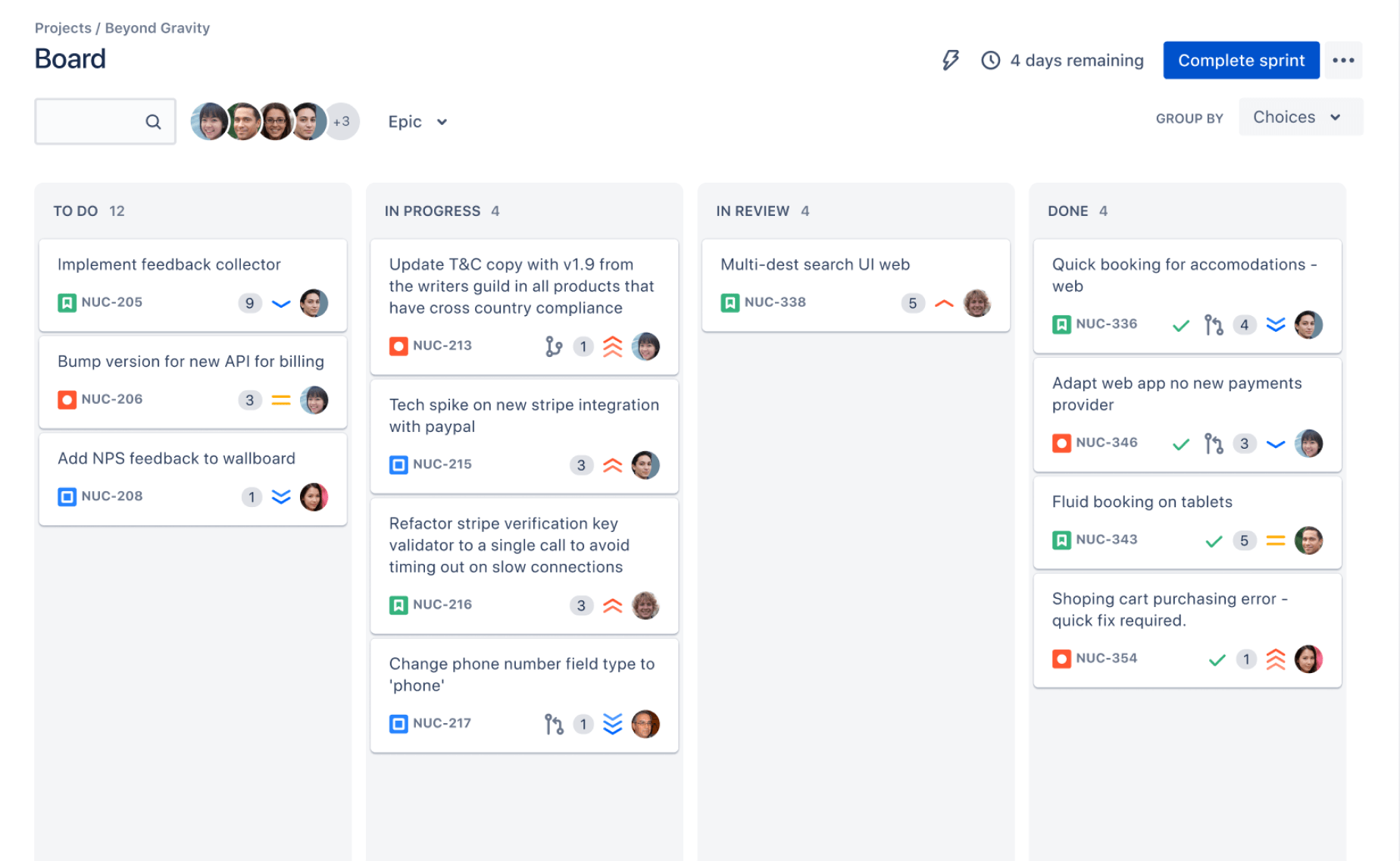
No single view handles every planning need. A board is useful for managing work through statuses such as To Do, In Progress, and Done. A Gantt chart is useful for seeing timing, overlap, milestones, and dependencies. Many teams use both views because they answer different delivery questions.
When should I use a Jira alternative?
Consider a Jira alternative when schedule planning requires repeated add-ons, manual date coordination, limited deployment choices, or reporting gaps. Compare workflow support, migration effort, integrations, security requirements, and self-hosted options before switching. A small project may need only a Jira timeline, while a complex program may benefit from broader native planning capabilities.
Conclusion
To build a Gantt chart in Jira, organize your work into a clear hierarchy, add realistic dates, assign ownership, connect dependencies, mark milestones, and review the timeline regularly. Start with Jira’s native timeline or roadmap features, then consider a dedicated app when your planning needs become more advanced.
But here’s the key takeaway: the chart is only as reliable as the project information behind it. Clear issues, honest estimates, visible dependencies, and regular updates turn a timeline into a useful delivery tool.
If Jira creates too much manual scheduling work, evaluate a platform such as ONES.com and its project management product, ONES Project. The right choice should make planning easier to maintain while supporting the workflows, reporting, and deployment model your team actually needs.