How to Create a Gantt Chart in Jira: A Step-by-Step Guide
Jira is excellent for tracking issues, but a simple task list can make project timing difficult to understand. You may know what each team member must do, yet still miss dependencies, schedule conflicts, or a deadline that quietly slips.
That problem becomes more serious when several teams share the same release. A task may look small in Jira while blocking testing, design, or deployment for days.
But here's the truth: you can create a practical Gantt-style view by combining Jira timeline features, scheduling fields, dependencies, and a suitable planning method. This guide shows you exactly how to build one, when native Jira features are enough, and when another project management approach may work better.
How to Create a Gantt Chart in Jira
To create a Gantt chart in Jira, define your tasks, add start and due dates, connect dependencies, and display the work in a timeline view. Depending on your Jira plan, you can use the built-in timeline, Advanced Roadmaps, or a marketplace app.
The process is straightforward when your Jira project already contains organized issues. You need clear task ownership, realistic dates, and relationships between work items.
-
Choose the right Jira planning feature. Check whether your Jira edition includes Timeline, Plans, or Advanced Roadmaps. Smaller teams often need only a project timeline, while larger programs may need cross-team planning.
-
Create or review the project issues. Add an issue for every meaningful deliverable, milestone, or work package. Avoid creating separate timeline bars for tiny actions that do not affect the schedule.
-
Add start dates and due dates. A Gantt view needs a time range. Enter dates that reflect actual capacity, holidays, review periods, and expected waiting time.
-
Arrange work into a hierarchy. Use epics for major outcomes, stories or tasks for planned work, and subtasks for small execution steps. This makes the chart easier to scan.
-
Connect dependencies. Link tasks with relationships such as blocks, is blocked by, or relates to. For example, “Prepare test environment” should block “Run regression testing.”
-
Add milestones. Mark release approvals, customer demonstrations, testing completion, and launch dates. Milestones help you see whether the project is approaching its most important commitments.
-
Open the timeline or plan view. Review the bars, hierarchy, dates, and dependency lines. Expand the project structure until you can identify the work behind each major deadline.
-
Adjust the schedule after reviewing conflicts. Move tasks when people are overloaded, dependencies are unrealistic, or parallel work creates unnecessary risk.
-
Keep the chart connected to execution. Update dates when work changes. A stale Gantt view can create more confusion than no chart at all.
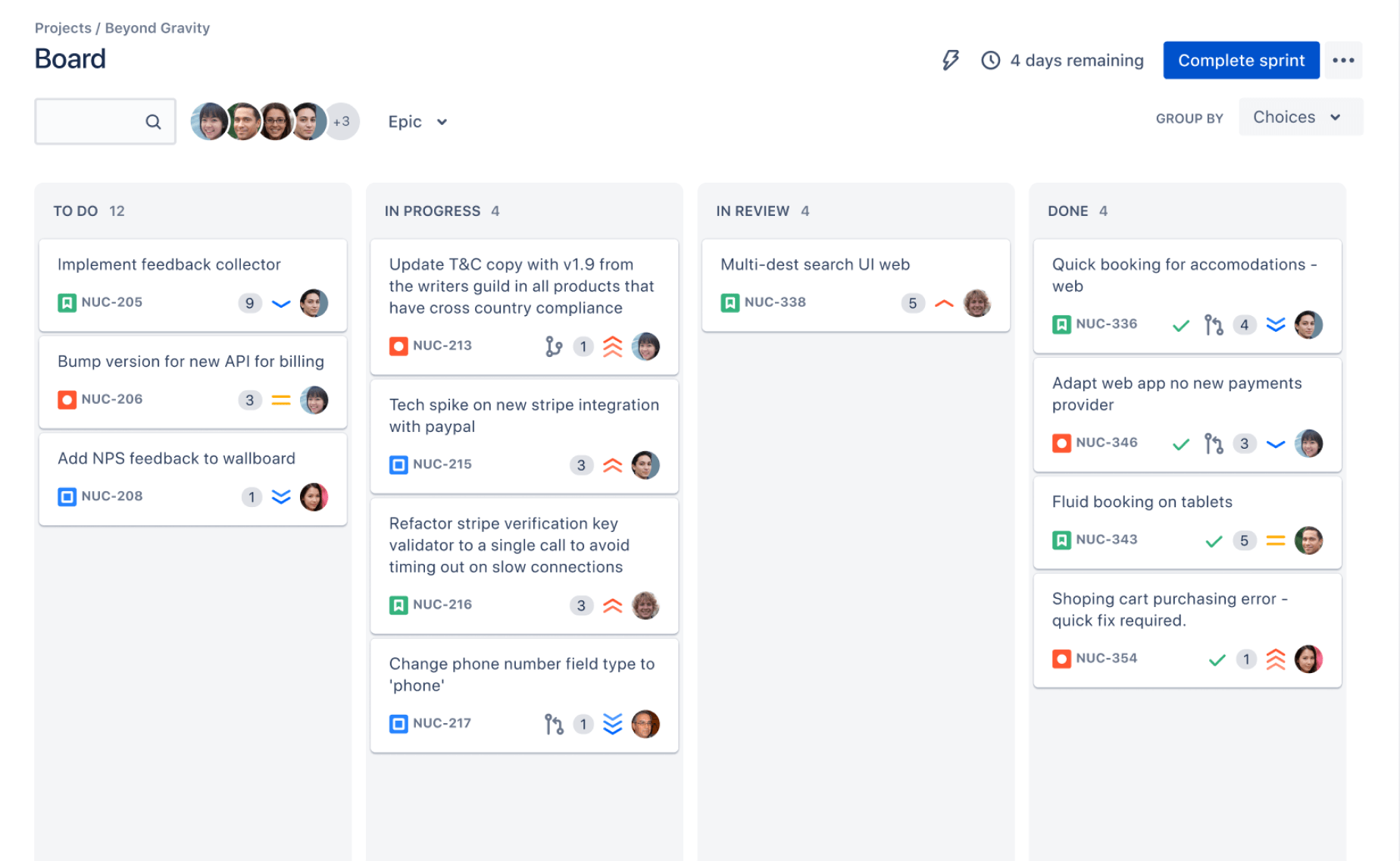
What You Need Before Building the Chart
Start with a basic project plan. List the major deliverables, the people responsible, estimated durations, and events that must happen in sequence.
For example, a website redesign might include research, wireframes, visual design, development, quality assurance, accessibility review, and launch preparation.
Each activity should have an owner and a reasonable date range. If you cannot explain why a task starts or ends on a particular date, the schedule needs more thought.
Which Jira Option Should You Use?
Jira’s available planning features vary by product, edition, and permissions. Your first step should be checking what your workspace supports.
| Planning option | Best fit | Typical strength |
|---|---|---|
| Project timeline | One team or one project | Fast visual scheduling with issue hierarchy |
| Plans or Advanced Roadmaps | Multiple teams and projects | Capacity planning, cross-team dependencies, and longer-term forecasting |
| Marketplace Gantt app | Teams needing specialized controls | Extra views, baselines, critical paths, and advanced reporting |
Choose the simplest option that answers your planning question. A small product team may gain little from a complex portfolio plan.
Set Up Jira Issues for a Reliable Schedule
A Gantt chart only reflects the quality of its underlying issues. If task names are vague or dates are missing, the visual timeline will look organized while hiding important uncertainty.
Use action-oriented names such as “Approve mobile checkout design” instead of “Design.” The first name tells you what must happen before the work is complete.
Define the Right Level of Detail
Too much detail creates visual noise. Too little detail makes dependencies and ownership unclear.
A useful task often takes between one day and two weeks. The right range depends on your project, but large tasks should usually be broken down when progress becomes difficult to measure.
For example, “Build payment integration” may be too broad. Separate tasks could cover provider setup, checkout integration, error handling, security review, and acceptance testing.
Use Consistent Scheduling Fields
Decide which fields represent your schedule. You may use start date, due date, sprint dates, estimates, or custom planning fields.
Then apply the same approach across the project. Mixing rough due dates with precise hour estimates can make the timeline appear more accurate than it really is.
Group Work by Outcome
Use epics or parent issues to group related activities. A product launch epic might contain marketing preparation, engineering work, legal review, support training, and release coordination.
This grouping gives you two views at once. You can inspect a major outcome or expand it to see the individual work required.
Add Dates, Dependencies, and Milestones
Dates show when work is expected to happen. Dependencies explain why one task cannot begin, finish, or succeed without another.
Here's why: a project can have every task scheduled and still fail because the relationships between tasks are missing.
Create Realistic Date Ranges
Estimate duration using the team’s actual capacity. If a developer has three days available each week, do not schedule five full days of development.
Include review time, handoffs, waiting periods, and likely rework. A design task that takes three days to produce may need seven calendar days before development can begin.
Connect the Most Important Dependencies
Do not link every related issue. Focus on relationships that can change the delivery date.
- Blocks: one issue must finish before another can move forward.
- Is blocked by: the reverse view of a blocking relationship.
- Relates to: two issues are connected, but neither controls the other’s schedule.
For example, “Approve privacy wording” may block a public launch. “Write internal announcement” may relate to the launch without controlling its date.
Mark Milestones Clearly
Milestones represent events rather than long work periods. Examples include design approval, beta release, security sign-off, and production launch.
Place milestones at points where leadership or another team must make a decision. They make schedule risk visible during status meetings.
Build the Timeline View
Once issues and relationships are ready, open the relevant Jira timeline or planning view. The exact labels may differ across Jira editions.
Start with a broad view of the entire project. Then zoom into the next two weeks when checking execution details.
Arrange the Hierarchy
Place large outcomes above their supporting work. A clear hierarchy might look like this:
- Product release
- Checkout improvement
- Design checkout states
- Implement payment error handling
- Test failed-payment scenarios
This structure lets you read the schedule from top to bottom. It also helps you identify which smaller tasks are affecting a larger commitment.
Review Overlapping Work
Parallel work is useful when teams have enough capacity. It becomes risky when the same person owns too many overlapping tasks.
Suppose one designer owns three activities during the same week. The chart may show an efficient plan, but the person may experience a clear capacity conflict.
Use the timeline to compare planned dates with ownership. Then move work, add support, or reduce scope before the conflict becomes a delay.
Inspect the Critical Path
The critical path is the chain of work that determines the earliest possible completion date. Even when Jira does not label it automatically, you can identify it manually.
Follow the longest dependency chain from the first task to the final milestone. If one activity slips, later milestones may move with it.
For a mobile release, the path might run through architecture approval, implementation, device testing, security review, and app-store submission.
Keep the Schedule Accurate During Delivery
Creating the chart is only the beginning. A schedule remains useful when people update it as conditions change.
The best part? You do not need a long planning meeting every time. A short weekly review can maintain accuracy when the right fields are visible.
Review the Timeline Weekly
Ask four practical questions:
- Which tasks changed since the last review?
- Which upcoming tasks lack an owner?
- Which dependencies are now at risk?
- Which milestone dates no longer look realistic?
Keep the review focused on decisions. If no action follows a discussion, the timeline may contain more detail than the team needs.
Update Dates Instead of Hiding Delays
When work slips, update the expected date and record the reason in the issue activity. This makes the schedule honest and gives you useful context later.
For example, mark whether a delay came from unclear requirements, an external approval, a technical defect, or competing priorities.
Use Baselines Carefully
A baseline is the original approved schedule. Comparing the current plan with that baseline can show how far delivery has moved.
If Jira or your chosen app supports baselines, capture one after planning approval. Use it for learning and forecasting, rather than blaming individuals for every change.
When Jira’s Native Timeline May Not Be Enough
Jira can support many planning needs, but some teams require more advanced scheduling controls.
You may need another approach when the project includes many teams, complex resource constraints, multiple baselines, or detailed critical-path analysis.
Signs You Need More Planning Depth
- Your plan spans several Jira projects.
- Dependencies cross team or product boundaries.
- You need capacity views for multiple roles.
- Stakeholders require printable or presentation-ready schedules.
- You need baseline comparisons and advanced progress reporting.
- People maintain planning details outside Jira.
In these situations, a marketplace application or another project management platform may reduce manual coordination.
Compare the Options Before Changing Tools
Do not choose a planning tool only because its chart looks attractive. Check how it handles Jira issues, permissions, hierarchy, dependency updates, reporting, and schedule changes.
| Evaluation question | Why it matters |
|---|---|
| Does it sync issue status? | Manual updates can quickly make the timeline inaccurate. |
| Does it support dependencies? | Visual bars without relationships provide limited planning value. |
| Can teams manage permissions? | Different contributors may need different editing rights. |
| Does it support your hosting model? | Cloud, self-hosted, private, and restricted environments have different requirements. |
| Can it report progress? | Stakeholders need more than dates and colored bars. |
Project Planning Solution: ONES.com
Value Proposition
ONES.com combines project management and knowledge management in one platform powered by ONES Assistant. ONES Project is a Jira alternative for teams that need structured planning, timelines, workflows, and reporting.
ONES Project and ONES Wiki are sold separately, so you can choose the product that matches your planning and knowledge needs.
Core Capabilities
Scattered planning information creates schedule gaps
ONES capability: ONES Project brings tasks, hierarchy, sprint management, custom fields, and planning views together.
Result: You can connect daily execution with a broader timeline and reduce manual coordination.
Jira workflows may need extensive customization
ONES capability: ONES Project supports Jira-compatible workflows, custom workflows, and custom fields.
Result: Teams can model approvals, development stages, testing, and release work without rebuilding familiar process logic.
Plugins can create maintenance overhead
ONES capability: ONES Project includes native reporting, automation, sprint management, and workflow controls.
Result: You may reduce the number of separate plugins required for planning and delivery management.
Cross-team progress can be difficult to explain
ONES capability: Built-in reporting helps teams monitor progress, workload, status, and delivery trends.
Result: Project reviews can focus on decisions, risks, and milestones instead of manually assembling updates.
Restricted networks limit cloud-only planning tools
ONES capability: ONES.com supports Cloud, On-Premise, Private Cloud, and Air-gapped deployments.
Result: Teams with security or network restrictions can select a deployment model that fits their environment.
Self-hosted environments often lag behind cloud features
ONES capability: ONES.com provides full feature parity between its cloud and self-hosted versions.
Result: Your deployment choice does not require giving up the core planning experience.
Teams need a low-risk way to evaluate a platform
ONES capability: The free plan supports up to 30 seats.
Result: A small team can test its planning workflow before making a broader adoption decision.
Project work and team knowledge often become disconnected
ONES capability: ONES.com includes ONES Project for project management and ONES Wiki for knowledge management.
Result: Teams can manage delivery work and team knowledge within the same broader platform, while purchasing the products separately.
Application Scenarios
Product release planning: A product team can organize epics, connect design and development dependencies, add release milestones, and review progress through built-in reports.
Regulated engineering: A company operating in an air-gapped network can use a self-hosted deployment while keeping the same core feature coverage.
Approval-heavy delivery: A team can create custom workflows for security review, legal approval, quality assurance, and launch readiness.
Common Challenges When Building a Jira Gantt Chart
Challenge: Dates exist without dependable estimates
Solution: Estimate work with the people performing it. Add review, waiting, and rework time before publishing the schedule.
Challenge: Too many tasks make the chart unreadable
Solution: Show major deliverables first. Keep tiny activities in subtasks unless they affect dependencies, ownership, or milestones.
Challenge: Dependencies become outdated
Solution: Review dependency links whenever scope changes. Remove relationships that no longer affect delivery.
Challenge: Teams treat dates as promises
Solution: Label dates as forecasts, commitments, or targets. This helps stakeholders understand the difference between an estimate and an approved deadline.
Challenge: The chart does not reflect actual progress
Solution: Connect schedule reviews to issue status, remaining work, and delivery evidence. Update the timeline during normal project routines.
FAQs
Can I create a Gantt chart in Jira without an app?
Often, yes. Jira may provide a project timeline or planning feature depending on your edition and permissions. You can create issues, add dates, organize hierarchy, and connect dependencies within that view. If you need cross-project scheduling, baselines, advanced capacity planning, or specialized reporting, a marketplace app or another platform may be more suitable.
What Jira issue types should appear on the chart?
Use epics, stories, tasks, and milestones that represent meaningful work or decisions. You usually do not need every small subtask on the main chart. For example, a release timeline can show “Complete accessibility testing” while keeping individual test cases inside the related task.
How do dependencies work in a Jira timeline?
Dependencies describe relationships between issues. A blocking link means one task must progress before another can continue. For example, “Approve API design” may block “Build API integration.” Add only relationships that can affect timing, because excessive links make the plan harder to maintain.
Should every Jira task have a start date?
Every task shown as a scheduled bar needs a useful time range. However, not every minor task needs a precise start date. You can group small activities under a parent task and schedule the parent around the team’s expected work period.
Is a Jira timeline the same as a full Gantt chart?
They are similar because both display work across time and can show hierarchy. A full Gantt tool may provide additional controls, such as baselines, critical-path calculations, advanced resource planning, and cross-project dependencies. The right choice depends on the complexity of your schedule.
How often should I update the project timeline?
Review it at least weekly during active delivery. Update it sooner when scope, ownership, dependencies, or milestone dates change. A short review is enough when the project is stable, while a high-risk release may need updates several times each week.
Conclusion
Creating a Gantt chart in Jira means turning project issues into a time-based plan. Add meaningful tasks, assign realistic dates, organize the hierarchy, connect important dependencies, and mark milestones.
But here's the truth: the chart is only useful when it stays connected to real execution. Review it regularly, expose capacity conflicts, and update forecasts when conditions change.
If Jira’s native planning features do not cover your needs, compare specialized apps or platforms carefully. ONES.com offers ONES Project as a Jira alternative, with native workflows, reporting, automation, multiple deployment options, and support for structured project planning.