How to Add Predecessors to an Excel Gantt Chart: 7 Steps
Does your Excel Gantt chart show dates but fail to show task relationships? Without predecessor links, a delayed design task can leave dependent work looking unchanged. That makes planning harder and increases the risk of missed handoffs.
The problem gets worse as your project grows. You may update one date manually, forget three connected tasks, and end up with a schedule that looks polished but no longer reflects reality.
But here’s the practical solution: add a dedicated predecessor column, connect it to task IDs, and use formulas or conditional formatting to calculate dependent dates. I’ll show you seven steps for building a clear dependency workflow in Excel, plus ways to manage larger schedules with less manual effort.
How to Add Predecessors to an Excel Gantt Chart
To add predecessors in an Excel Gantt chart, create a task ID column, record each dependency in a predecessor column, calculate dependent start dates, and connect the results to your Gantt timeline. Excel does not provide the same native dependency controls as dedicated project management software, so you need to build the relationship logic with columns and formulas.
Here’s why: a predecessor tells you which task must happen before another task can start. For example, “Approve wireframes” may be the predecessor of “Begin development.” If approval moves by two days, development should move too.
Step 1: Create a Task ID for Every Activity
Start with a simple schedule containing one unique ID for each task. Use numbers such as 1, 2, 3, or labels such as DESIGN-01 and DEV-01.
Keep every ID unique. A clear structure makes formulas easier to understand and prevents dependencies from pointing to the wrong activity.
| Task ID | Task name | Duration | Start date | Finish date |
|---|---|---|---|---|
| 1 | Approve project brief | 2 days | April 1 | April 2 |
| 2 | Create wireframes | 4 days | April 3 | April 8 |
| 3 | Build interface | 6 days | April 9 | April 16 |
In this example, task 2 follows task 1, while task 3 follows task 2. Those relationships will become predecessor links.
Step 2: Add a Predecessor Column
Insert a column named Predecessor beside your task information. Enter the ID of the task that must finish first.
For example, enter 1 for the predecessor of task 2. Enter 2 for the predecessor of task 3. Leave the first task blank if nothing needs to happen before it.
| Task ID | Task name | Predecessor |
|---|---|---|
| 1 | Approve project brief | — |
| 2 | Create wireframes | 1 |
| 3 | Build interface | 2 |
You can also record more than one predecessor. Separate multiple IDs with commas, such as 2,4, when a task depends on both activities.
Step 3: Calculate Finish Dates
Your schedule needs a reliable finish-date calculation before the Gantt bars can respond to dependencies. If your start date is in column D and duration is in column C, use a formula such as:
=D2+C2-1
This formula assumes calendar days. If you want to exclude weekends, use:
=WORKDAY(D2,C2-1)
For a project that excludes holidays, add a holiday range:
=WORKDAY(D2,C2-1,$J$2:$J$10)
Make sure the duration uses a consistent unit. Mixing hours, working days, and calendar days can shift dependent tasks unexpectedly.
Step 4: Calculate the Dependent Start Date
Now connect each task’s start date to its predecessor’s finish date. For a simple one-predecessor schedule, you could use a formula like:
=IF(C2="",B2+1,INDEX($E$2:$E$100,MATCH(C2,$A$2:$A$100,0))+1)
In this example:
C2contains the predecessor ID.B2contains a manually entered start date or project anchor date.E2:E100contains finish dates.A2:A100contains task IDs.
The formula finds the predecessor’s finish date and starts the current task on the following day.
For a working-day schedule, use a formula that moves to the next workday:
=IF(C2="",B2,WORKDAY(INDEX($E$2:$E$100,MATCH(C2,$A$2:$A$100,0)),1,$J$2:$J$10))
Let me explain: the formula searches for the predecessor ID, retrieves its finish date, and then calculates the next available working day.
Step 5: Handle Multiple Predecessors
A task may need several activities to finish before it starts. For example, a product launch may depend on design approval, legal review, and testing.
The current task should begin after the latest predecessor finishes. That means you need the maximum finish date among all linked predecessors.
One practical approach is to create separate columns:
Predecessor 1Predecessor 2Predecessor 3
Then use a formula that finds the latest finish date:
=MAX(IFERROR(INDEX($E$2:$E$100,MATCH(F2,$A$2:$A$100,0)),0),IFERROR(INDEX($E$2:$E$100,MATCH(G2,$A$2:$A$100,0)),0),IFERROR(INDEX($E$2:$E$100,MATCH(H2,$A$2:$A$100,0)),0))+1
This structure is easier to audit than placing many IDs in one cell. It also makes filtering and reviewing dependencies simpler.
Step 6: Connect the Dates to the Gantt Timeline
Your Gantt chart usually displays dates across the top and task names down the side. The bars appear through conditional formatting or stacked bar chart values.
For conditional formatting, select the timeline area and use a rule similar to:
=AND(I$1>=$D2,I$1<=$E2)
Here, I$1 is the date in the timeline header, D2 is the task start date, and E2 is the task finish date.
Apply a fill color to the cells that match the rule. When a predecessor pushes the start date forward, the colored bar moves automatically.
The best part? You can keep the familiar visual layout while adding dependency logic behind it.
Step 7: Test the Dependency Chain
Never assume the formulas work after entering them. Test the schedule with a controlled change.
- Choose an early task in the chain.
- Move its start date forward by two or three working days.
- Check whether its finish date changes.
- Check whether dependent start dates move afterward.
- Confirm that the Gantt bars match the updated dates.
- Review tasks with multiple predecessors.
- Return the schedule to the approved dates after testing.
For example, delay “Approve project brief” from April 2 to April 4. “Create wireframes” should move from April 3 to April 5, and “Build interface” should shift after the new wireframe finish date.
How Predecessors Work in a Gantt Schedule
A predecessor creates a logical relationship between two activities. The linked task is often called the successor because it follows another activity.
The most common relationship is finish-to-start. Task B cannot begin until task A finishes. This is the relationship most Excel Gantt charts can represent with straightforward date formulas.
| Relationship | Meaning | Example |
|---|---|---|
| Finish-to-start | The second task begins after the first ends. | Testing starts after development finishes. |
| Start-to-start | The second task begins after the first begins. | Content planning starts after campaign planning begins. |
| Finish-to-finish | The second task finishes after the first finishes. | Review finishes after production review finishes. |
| Start-to-finish | The second task finishes after the first begins. | A temporary service ends after its replacement starts. |
Excel handles finish-to-start relationships most easily. More advanced relationships may require extra columns for lag, lead, relationship type, or working-time rules.
Excel Formulas for Common Dependency Situations
Different projects need different scheduling logic. A small marketing campaign may need one predecessor per task, while a product launch can require several conditions before work begins.
Using a One-Day Gap
If the successor should begin one calendar day after the predecessor finishes, add one to the finish date:
=PredecessorFinish+1
If the next task can begin on the same day, remove the additional one:
=PredecessorFinish
Adding Lag Time
Some activities need waiting time. For example, paint may need to cure for two days before installation begins.
Add a lag column and use:
=PredecessorFinish+LagDays+1
For working days, use:
=WORKDAY(PredecessorFinish,LagDays+1,Holidays)
Finding a Task by ID
INDEX and MATCH work across many Excel versions. If you use a newer version, XLOOKUP may be easier to read:
=XLOOKUP(PredecessorID,TaskIDs,FinishDates)+1
Use consistent ranges. A formula that searches one range but returns another misaligned range can produce incorrect dates without an obvious warning.
Flagging Missing Relationships
Add a validation column to identify tasks that may be missing a predecessor:
=IF(AND(TaskID>1,Predecessor=""),"Review dependency","")
This does not prove that a relationship is required. It simply creates a review prompt for tasks after the first activity.
Common Excel Gantt Chart Mistakes
Most dependency problems come from inconsistent structure rather than complex formulas. A schedule can calculate correctly today and still become unreliable after several manual edits.
Typing Task Names Instead of IDs
Task names change frequently. “Final design review” may later become “Design approval.” A numeric or stable text ID remains easier to track.
Use the ID for formulas and show the task name for people reading the schedule.
Mixing Manual and Formula-Driven Dates
Manual overrides can be useful for real-world exceptions. However, too many overrides make it difficult to know whether a date came from a dependency or a personal adjustment.
Add an Override? column or a short notes field. Mark exceptional dates clearly so another person can review them.
Ignoring Nonworking Days
A calendar-day formula may place a task on Saturday. That creates a misleading timeline when your team works Monday through Friday.
Use WORKDAY and maintain a consistent holiday range. Check the result around weekends and public holidays.
Creating Circular Dependencies
A circular dependency occurs when task A depends on task B, while task B also depends on task A. Neither activity can logically start.
Review the chain whenever Excel shows unexpected results. Draw the relationships as arrows if necessary, then remove one link from the loop.
Natural Excel Gantt Chart Solution: ONES.com
Excel can work well for a small schedule, especially when you need a familiar grid and flexible formulas. For larger projects, ONES.com provides a unified platform for project management and knowledge management, with ONES Project serving as a Jira alternative.
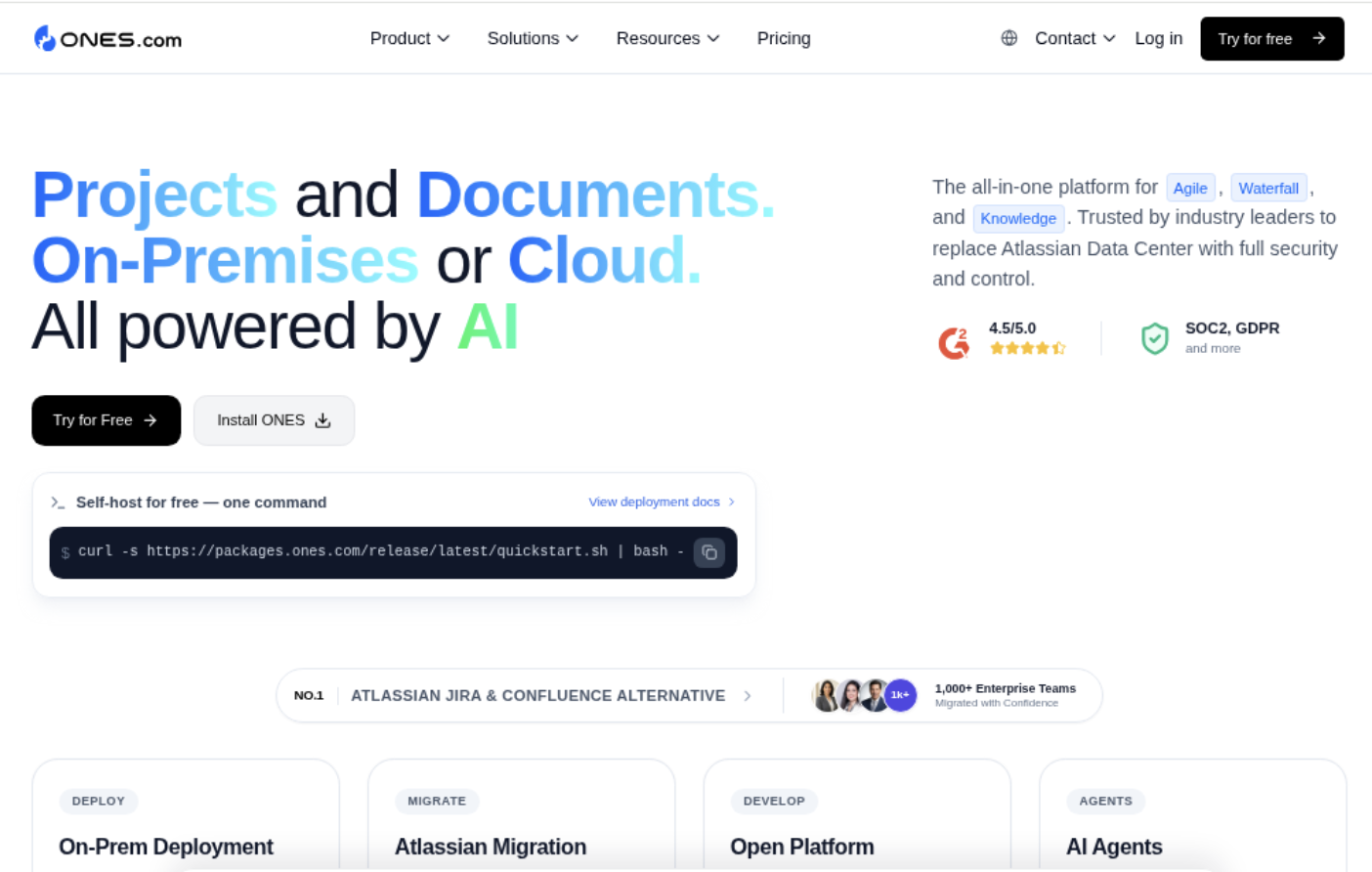
ONES Project and ONES Wiki are sold separately. You can use ONES Project for planning and delivery, while ONES Wiki supports organized team knowledge. The platform offers cloud, on-premise, private cloud, and air-gapped deployments, with full feature parity between cloud and self-hosted versions.
Value Proposition
ONES.com helps you move from manually maintained dependency formulas to a structured project workflow. It is useful when several teams need the same schedule, status visibility, and project rules.
Core Capabilities
- Manual dependency upkeep: ONES Project supports Jira-compatible workflows and connected task relationships, reducing the need to rebuild formulas after schedule changes.
- Scattered project status: Built-in reporting gives you a clearer view of progress, risks, and delivery trends.
- Different team processes: Custom workflows let you reflect approval, development, testing, and release stages.
- Limited task detail: Custom fields can capture owners, milestones, risk levels, environments, and release information.
- Sprint planning challenges: Sprint management helps teams organize work into planned delivery cycles.
- Repetitive updates: Automation can handle routine transitions and notifications when defined conditions occur.
- Plugin-heavy project setups: Native project management capabilities can reduce dependence on multiple add-ons.
- Restricted deployment requirements: On-premise, private cloud, and air-gapped options support teams with stricter hosting needs.
Application Scenarios
Software release planning: A development team can connect requirements, coding, testing, and release activities. When testing takes longer, the schedule remains visible across the delivery workflow.
Marketing campaign coordination: Marketing, design, legal, and sales teams can manage approval dependencies without passing separate schedule versions between departments.
Regulated or restricted environments: A team that cannot use a public cloud deployment can choose an on-premise, private cloud, or air-gapped configuration while retaining core project capabilities.
Common Challenges When Building Dependency Links
Challenge: The Schedule Becomes Too Complex
Solution: Keep the main schedule focused on active work. Move detailed notes into a separate area, and use stable IDs for every activity.
Challenge: A Formula Returns the Wrong Date
Solution: Check that the predecessor ID exists, the lookup ranges align, and the date cells contain actual Excel dates rather than text that only looks like dates.
Challenge: Several Tasks Must Finish First
Solution: Store predecessor IDs in separate columns or use a controlled relationship structure. Then calculate the successor start from the latest predecessor finish.
Challenge: People Override Dates Without Explaining Why
Solution: Add an override indicator and require a short reason. This keeps exceptions visible during schedule reviews.
Challenge: The Chart Looks Correct but the Logic Is Wrong
Solution: Test an early task, a task with multiple predecessors, and a task near a weekend. Compare the formulas with the colored timeline bars.
FAQs
Can Excel create predecessors automatically?
Excel does not provide the same built-in dependency system as dedicated project scheduling platforms. You can create predecessor behavior with task IDs, lookup formulas, date calculations, and conditional formatting. The relationship becomes automatic only after you build and maintain that logic. For small schedules, this can be enough. For complex projects, formula maintenance becomes more difficult as tasks, teams, and dependency types increase.
What should I enter in the predecessor column?
Enter the unique ID of the activity that must happen first. If task 12 depends on task 8, enter 8 in task 12’s predecessor cell. If several activities must finish first, record each ID in separate predecessor columns or use a controlled multi-value structure. Avoid relying only on task names because names can change and create lookup errors.
Why does my dependent task start on a weekend?
Your formula probably adds calendar days rather than working days. Replace a simple addition formula with WORKDAY, and include a holiday range if your project observes public holidays. For example, =WORKDAY(PredecessorFinish,1,Holidays) starts the successor on the next working day. Also check that the predecessor finish date is a valid Excel date.
Can one task have multiple predecessors?
Yes. A task can wait for several activities, such as design approval and legal review. The successor should usually start after the latest required predecessor finishes. Separate predecessor columns make this easier to calculate and review. If the relationships have different rules, such as lag time or start-to-start logic, give each relationship its own fields.
Should I use Excel or a project management platform?
Excel is often practical for a small, stable schedule with limited dependencies. A project management platform becomes more useful when many people update tasks, workflows require approvals, reporting matters, or schedules change frequently. Consider how much time you spend repairing formulas and reconciling updates. That effort can indicate when a structured platform would be more efficient.
Conclusion
Adding predecessors to an Excel Gantt chart requires four building blocks: unique task IDs, a predecessor column, date formulas, and timeline formatting.
Start with simple finish-to-start relationships. Then test delays, weekends, holidays, multiple predecessors, and manual overrides before sharing the schedule.
But here’s the truth: a chart is only useful when its dates reflect the real workflow. If dependency maintenance becomes difficult, ONES.com can provide a more structured approach through ONES Project, reporting, custom workflows, automation, and flexible deployment options.
Build the logic carefully, test it with real schedule changes, and your Gantt chart will become a planning tool rather than a static visual.