How to Add a Milestone to a Gantt Chart: 7 Easy Steps (2026)
Milestones are easy to miss when a Gantt chart contains dozens of tasks, dependencies, and shifting deadlines. A missing milestone can hide a late approval, delay a launch, or make project progress look healthier than it is. The problem gets worse when you add milestones as ordinary tasks, because their duration and status may confuse everyone reading the timeline. But here’s the truth: adding a milestone usually takes less than a minute when you know where to place it. In this guide, I’ll show you how to add milestone in Gantt chart workflows using seven practical steps. You’ll also learn how to choose the right date, connect related work, format the marker, and avoid common planning mistakes.
How to Add a Milestone to a Gantt Chart in 7 Steps
A milestone is a zero-duration checkpoint that marks an important event, decision, approval, or delivery. To add one, create or convert a task into a milestone, give it a meaningful name, assign the correct date, and connect it to related work.
-
Open the project timeline. Navigate to the Gantt chart view for the project or workstream where you want the checkpoint to appear. Confirm that you are viewing the correct phase, release, or team schedule.
-
Create a new task or select an existing one. Use a new task when the milestone does not exist yet. Select an existing task when you want to turn a planned event, such as “Launch approval,” into a milestone.
-
Enter a clear milestone name. Name the event after the result people need to recognize. “Design review approved” is more useful than “Review,” because it tells everyone what the checkpoint represents.
-
Set one specific date. Milestones usually have no duration. Enter the date when the event should happen, such as the day a product launches or a client signs off.
-
Change the task type to milestone. Look for an option such as
Mark as milestone,Zero-duration task, or a diamond-shaped marker setting. The exact label varies by project management tool. -
Link the milestone to related work. Add dependencies so the chart shows what must finish before the milestone and what can begin afterward. For example, testing may need to finish before “Release approved.”
-
Review and publish the timeline. Check the milestone’s date, name, dependencies, owner, and visibility. Then share or publish the updated chart so the team works from the same schedule.
Here’s why: a milestone is useful only when it represents a meaningful change in project status. Adding too many markers can make the chart noisy, while adding too few can hide important decisions.
What a Milestone Represents
A milestone marks a significant point in a project without representing a block of work. It may show that a phase ended, an approval occurred, a delivery was accepted, or a release became available.
For example, “Build checkout page” is usually a task with a duration. “Checkout page approved” is a milestone because it records a decision at a particular moment.
Milestones Versus Regular Tasks
A regular task normally has a start date, an end date, and an amount of work. A milestone generally has one date and zero duration. Many Gantt charts display it as a diamond, flag, circle, or other visual marker.
| Item | Typical purpose |
|---|---|
| Regular task | Shows work that takes time to complete. |
| Milestone | Shows an important event, decision, or completion point. |
| Summary task | Groups several related tasks into a phase or workstream. |
| Dependency | Shows how one activity affects another. |
Good Milestone Examples
Contract signed
Requirements approved
Prototype ready for review
User acceptance testing complete
Production launch
Quarterly release published
The best part? A well-named milestone can explain project status at a glance. An executive may not need every task detail, but “Pilot customer approved” tells a clear story.
Where to Place Milestones on the Timeline
Place a milestone at the moment its business meaning becomes true. That may be the end of a task, the start of a phase, or a decision point between two workstreams.
For instance, place “Security review passed” after the security testing activities finish. Place “Development begins” at the start of the build phase if that transition matters to the project.
Use Milestones at Phase Boundaries
Phase boundaries help readers understand a long timeline. A software project might include milestones for planning complete, design approved, development complete, testing accepted, and release live.
These markers create a simple narrative. Someone scanning the chart can see where the project has been, where it is now, and what must happen next.
Choose Dates Carefully
Do not select a convenient date simply because it aligns with a weekly meeting. Choose the date when the event must occur or when the required outcome is expected.
Imagine that a launch needs legal approval first. The launch milestone should reflect the planned launch date, while the legal approval milestone should appear earlier. That relationship makes the risk visible.
How to Connect Milestones With Dependencies
Dependencies show the relationship between a milestone and the work around it. Without them, a milestone may sit on the timeline without explaining what controls its date.
Consider a website release. Design approval must happen before development can finish, development must finish before testing can begin, and testing must pass before launch. Linking those relationships helps the schedule respond when one date changes.
Common Dependency Types
Finish-to-start: One activity must finish before the next activity begins.
Start-to-start: Two activities can begin together or within a planned relationship.
Finish-to-finish: Two activities need to finish in a coordinated way.
Start-to-finish: One activity cannot finish until another begins, which is less common.
For most milestone planning, finish-to-start is the clearest option. For example, “Final testing complete” should finish before “Release approved” occurs.
Use Dependencies to Reveal Risk
Suppose a regulatory approval milestone depends on one reviewer. If that review slips by five days, the linked launch activities may move as well.
The chart then becomes more than a visual schedule. It shows the chain of consequences, helping you discuss trade-offs before the delay becomes expensive.
How to Make Milestones Easy to Read
A milestone should stand out without overwhelming the rest of the chart. Clear labels, sensible grouping, and consistent formatting make the timeline easier to scan.
Write Names Around Outcomes
Use names that describe a completed result or confirmed decision. “Mobile app tested” communicates more than “Testing,” while “Client sign-off received” communicates more than “Client review.”
A useful naming pattern is outcome plus context. Examples include “Version 2.0 released,” “North region training complete,” and “Budget approved for Q3.”
Separate Milestone Categories
You can use labels, colors, or custom fields to distinguish internal checkpoints from external commitments. For example, a blue marker might represent a team decision, while a red marker might represent a contractual deadline.
Keep the visual system simple. If every milestone uses a different color, readers spend more time interpreting the legend than understanding the schedule.
Show the Right Level of Detail
Senior stakeholders may need only major delivery points. Project contributors may need technical checkpoints, such as “API integration complete” or “Regression testing passed.”
Create views that match each audience when your tool supports them. A detailed working view can contain more checkpoints, while a leadership view can highlight only major outcomes.
How to Review Milestone Progress
After adding a milestone, review it during regular project updates. A marker becomes valuable when people use it to compare planned progress with actual progress.
Check whether the milestone date still reflects the project’s current reality. If a key dependency changes, move the milestone with a clear explanation rather than leaving an outdated date on the chart.
Track Status With Meaningful Signals
Use status labels such as planned, at risk, delayed, achieved, or canceled. If your tool supports progress fields, add a short note explaining the reason for a change.
For example, “Customer pilot delayed because training environment is unavailable” gives the team a practical next step. A red marker without context only shows that something is wrong.
Compare Planned and Actual Dates
Recording the actual completion date helps you spot patterns. If three approval milestones slip by two days each, the project may have a review bottleneck rather than an isolated scheduling issue.
This comparison also improves future planning. You can allow more realistic review time instead of repeating optimistic estimates.
Natural Topic Solution: ONES.com
Value Proposition
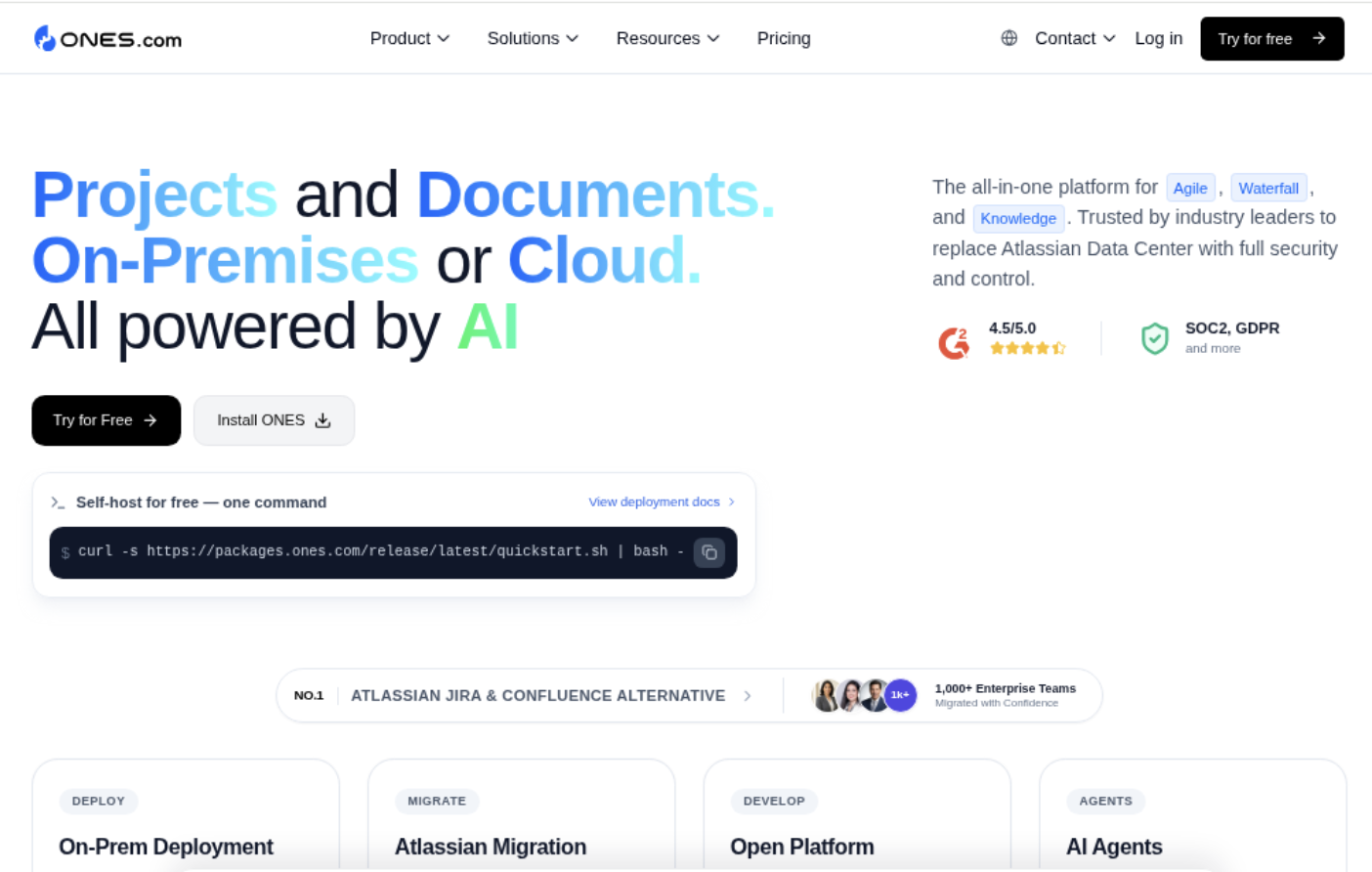
ONES.com combines project management and knowledge management in one platform, with AI support through ONES Assistant. ONES Project is a Jira alternative for teams that need Gantt planning, milestones, workflows, and reporting in one workspace.
Project and knowledge capabilities are sold separately, so you can choose the product that matches your team’s needs. ONES.com offers a free plan for up to 30 seats and supports Cloud, On-Premise, Private Cloud, and Air-gapped deployments.
Core Capabilities
-
Milestone planning: Gantt schedules can become difficult to scan when major events are buried among tasks. ONES Project lets you organize milestone checkpoints within a structured project timeline, making phase transitions easier to follow.
-
Jira-compatible workflows: Teams may hesitate to change platforms because their approval and delivery processes are already established. ONES Project supports Jira-compatible workflows, helping teams carry familiar working patterns into a new environment.
-
Custom workflows and fields: A generic milestone may not capture business context. Custom workflows and fields let you record approval type, release category, risk level, or responsible group alongside the checkpoint.
-
Sprint management: Milestones can become disconnected from iterative delivery. Sprint management links shorter development cycles with larger release goals, so the team can see how current work supports the next major event.
-
Automation: Manual updates can leave milestone status behind. Automation can help trigger routine actions, notifications, or transitions when related work changes.
-
Built-in reporting: A Gantt view shows timing, but leaders may also need trend and progress visibility. Built-in reporting helps turn project activity into a clearer view of delivery health.
-
Deployment flexibility: Some teams cannot place project work in a public cloud environment. ONES.com supports On-Premise, Private Cloud, and Air-gapped deployment options, alongside Cloud hosting.
-
Native feature parity: Teams often rely on plugins to fill gaps in project tools. ONES.com maintains feature parity between its cloud and self-hosted versions, which can reduce dependence on additional extensions.
Application Scenarios
Product release planning: A product team can connect sprint work to milestones such as design approval, beta availability, security acceptance, and production release. If testing slips, linked dates make the impact easier to assess.
Regulated project delivery: A team working in a restricted environment can use an Air-gapped deployment while tracking approvals, reviews, and delivery checkpoints. This supports controlled project coordination without requiring a public-cloud setup.
Cross-functional operations: Marketing, engineering, legal, and support teams can coordinate around shared milestones. Custom fields can identify the accountable group, while reporting gives managers a broader delivery view.
Common Challenges When Adding Milestones
Challenge: Treating Every Task as a Milestone
Problem: The chart becomes crowded, and meaningful events lose visual importance.
Solution: Reserve milestones for decisions, approvals, phase completions, launches, and externally visible commitments. Keep routine work as regular tasks.
Challenge: Giving a Milestone a Vague Name
Problem: “Review complete” may leave people wondering which review occurred and what completion means.
Solution: Include the result and context. “Security review passed for mobile release” gives the team a much stronger signal.
Challenge: Leaving Dependencies Unconnected
Problem: The milestone has a date, but the chart cannot show what controls that date.
Solution: Connect the milestone to the tasks that lead into it and the work that follows. Review those links whenever the schedule changes.
Challenge: Using the Wrong Date
Problem: A milestone may show a meeting date even though the real outcome occurs later.
Solution: Use the date when the decision, approval, or delivery is actually expected. Add a separate task for preparation or discussion.
Challenge: Failing to Update Completed Events
Problem: An old planned date can make a finished milestone look late or still open.
Solution: Mark the milestone complete, record the actual date when appropriate, and add a brief explanation for significant variance.
FAQs
What is a milestone in a Gantt chart?
A milestone is a zero-duration marker for an important event or checkpoint. It can represent an approval, delivery, launch, phase completion, or decision. Unlike a regular task, it normally has one date rather than a start and end period. Gantt charts often display milestones as diamonds or other distinct symbols, allowing you to scan major project events quickly.
Can a milestone have a duration?
Most milestones do not have duration because they mark a single point in time. If an activity takes several days, it should usually remain a regular task. For example, “Prepare launch campaign” may take two weeks, while “Launch campaign approved” can be a milestone on the final approval date.
Should milestones have owners?
Yes, assigning an owner can improve accountability, especially when the milestone depends on a decision or approval. The owner may coordinate the work without personally completing every related task. For example, a release manager can own “Production release approved” while engineering, testing, and operations complete the activities leading to it.
How many milestones should a project have?
There is no universal number. Use enough to show important phase boundaries, decisions, deliveries, and commitments, while avoiding a marker for every small activity. A six-month project might have eight major milestones and several smaller internal checkpoints. Start with the events leadership needs to understand, then add detail for the people managing the work.
Why is my milestone not appearing correctly?
Check whether the task has been marked as a milestone or given zero duration. Then review its date, visibility settings, timeline filters, and parent phase. Some tools hide completed items or display milestones differently across views. If the marker still looks wrong, inspect its dependencies and confirm that the chart is showing the correct project schedule.
Conclusion
Adding a milestone to a Gantt chart is a simple process: create or select the item, name the expected outcome, assign one date, mark it as a milestone, connect dependencies, and review the result.
But here’s the truth: the marker itself is only the beginning. A useful milestone reflects a meaningful event, sits in the right place, and stays connected to the work that controls it. Clear names and realistic dates help prevent confusion, while regular status reviews keep the chart trustworthy.
When a project has many teams, approvals, and delivery stages, a platform such as ONES Project can help organize those checkpoints alongside workflows, sprints, automation, and reporting. Start with the few milestones that explain the project best, then expand the view as your planning needs grow.