Does Planner Have a Gantt Chart? Features and Workarounds
You open Microsoft Planner expecting a clear timeline, then discover that your tasks sit in buckets, cards, or a grid. That works for short assignments, but complex projects quickly become difficult to schedule.
The problem grows when tasks depend on one another. A delayed design review can affect development, testing, launch preparation, and every deadline afterward. Without a visual timeline, spotting that chain takes extra effort.
So, does Planner have a Gantt chart? Microsoft Planner can provide a Gantt-style timeline through premium plans, while basic Planner plans generally rely on board, grid, chart, and schedule views. Your available features depend on the Planner plan and Microsoft 365 setup you use.
Here's how the views differ, what you can do without a Gantt chart, and when another project management platform may fit better.
Does Microsoft Planner Have a Gantt Chart?
Planner does not provide a full Gantt chart in its basic plan. Basic Planner focuses on task boards, buckets, assignments, due dates, labels, checklists, charts, and schedule planning.
Premium Planner plans add a Timeline view that works like a Gantt chart. You can place tasks across dates, view overlapping work, connect dependencies, and understand how schedule changes affect the project.
Here's the practical distinction:
- Basic Planner: Board, Grid, Charts, and Schedule views for everyday task coordination.
- Premium Planner: Timeline-style planning with dependencies and more advanced scheduling controls.
- Large or specialized projects: You may need a dedicated platform with stronger baselines, resource planning, portfolio controls, and reporting.
The answer depends on which Planner experience your organization has enabled. Microsoft has changed Planner features over time, so check the plan label and available views inside your workspace.
How Planner’s Timeline and Gantt-Style View Works
If your Planner plan includes Timeline, the view displays tasks horizontally across a calendar. Each task appears as a bar, making duration and overlap easier to understand.
1. Add start and due dates
A task needs a schedule before it can appear meaningfully on a timeline. Add a start date and due date to show its planned duration.
For example, “Prepare product demo” might run from April 8 through April 12. The timeline then shows a bar spanning those dates.
2. Arrange tasks across the project calendar
The timeline lets you see when work begins, how long it lasts, and where several activities happen at the same time.
Imagine a website launch with design, development, testing, and marketing tasks. A timeline shows whether testing begins after development or overlaps with it.
3. Connect dependent tasks
Dependencies show relationships between activities. For example, testing may depend on development finishing first.
When one task moves, connected tasks may require review. This helps you find schedule risks earlier than a simple task list would.
4. Identify overlapping work
Overlapping bars can reveal overloaded teams or competing priorities. If the same designer owns three activities during one week, the schedule may need adjustment.
A board can show ownership, while a timeline shows timing. You need both perspectives when a project contains several parallel workstreams.
5. Review milestones and deadlines
Milestones mark important events such as approval, beta release, contract signing, or launch. They give the project a visible rhythm.
A milestone can also help stakeholders understand progress without reading every task or conversation.
What Basic Planner Offers Without a Gantt Chart
Basic Planner still supports useful project coordination. You can create plans, organize tasks into buckets, assign owners, set due dates, add labels, and monitor progress.
The Board view works well for workflows such as “To do,” “In progress,” and “Done.” A marketing team might use buckets for campaign stages, while a support team might organize work by service category.
Board view
Board view gives you a card-based overview. Each card can contain an assignee, deadline, checklist, notes, labels, and comments.
This view is useful when the main question is, “What work needs attention?” It becomes less useful when the question is, “How will this work unfold across six weeks?”
Grid view
Grid view presents tasks in rows and details in columns. It makes bulk review easier because you can compare owners, dates, progress, and labels quickly.
For example, a project coordinator can scan every task and find missing due dates before a weekly meeting.
Charts view
Charts summarize task progress, workload, and completion. They can reveal whether a project has too many late tasks or whether one person owns a disproportionate share of the work.
Charts are helpful for status reporting, although they do not replace a schedule showing task duration and dependencies.
Schedule view
Schedule view places tasks on a calendar. It helps you review deadlines and planned work by day, week, or month.
The calendar perspective is useful for operational planning. A Gantt-style timeline usually gives you a stronger view of task duration and sequencing.
Planner Workarounds When You Need a Timeline
If your plan lacks Timeline, you still have several ways to manage schedule relationships. Each workaround solves part of the problem, so choose one that matches your project’s complexity.
Use start dates and due dates consistently
Many teams enter only due dates. That creates a deadline list rather than a real schedule.
Add both dates to every meaningful task. “Write landing page” might run from May 2 to May 5, while “Approve landing page” runs from May 6 to May 7.
Use buckets for project phases
Create buckets such as Discovery, Design, Build, Test, and Launch. This gives your board a phase-based structure.
The limitation is clear: buckets show categories, not precise timing. A task can sit in “Build” without showing whether it should happen before or after another task.
Use labels for dependencies or risk
Labels can indicate conditions such as “blocked,” “waiting for approval,” or “high risk.” This helps you highlight schedule issues during reviews.
For example, apply a “Blocked” label when development cannot begin until requirements receive approval.
Use a calendar for deadline planning
Schedule view can help you place deadlines across a month. It works well for content calendars, recurring activities, and short projects.
Use it alongside a written dependency convention, such as adding “Blocked by: Design approval” to the task details.
Upgrade to a premium Planner plan
If your project needs dependencies, timeline planning, milestones, and advanced scheduling, a premium Planner plan may be the most direct option.
Before upgrading, confirm which capabilities your organization needs. A timeline alone may not solve resource conflicts, portfolio reporting, or long-term planning.
Basic Planner Versus Premium Planner Timeline
The key difference is the type of question each plan helps you answer.
| Planning need | Basic Planner | Premium Planner |
|---|---|---|
| Track tasks and owners | Yes | Yes |
| Organize work with buckets | Yes | Yes |
| Review progress with charts | Yes | Yes |
| Plan work on a calendar | Yes | Yes |
| View tasks on a timeline | Generally unavailable | Available through Timeline |
| Manage task dependencies | Limited manual handling | Supported through advanced planning features |
| Plan milestones | Limited | Supported |
| Manage complex schedules | Requires workarounds | Better suited |
Here’s why this matters: a task board emphasizes workflow status, while a Gantt-style view emphasizes time and sequence.
Suppose a product launch has 80 tasks. A board may tell you that 30 tasks are in progress. A timeline can show whether those tasks are progressing in the right order and whether the launch date remains realistic.
When Planner’s Gantt-Style Features May Be Enough
Planner can be a reasonable choice for small teams with short projects, stable deadlines, and limited dependencies.
A five-person event team planning a two-week webinar may only need task ownership, deadlines, checklists, and a calendar. A premium timeline could add clarity, although the team may not need extensive portfolio controls.
Good-fit projects
- Short marketing campaigns with a small number of phases.
- Internal initiatives with predictable handoffs.
- Team activities already managed inside Microsoft 365.
- Projects where task ownership matters more than resource forecasting.
- Schedules with a few dependencies and limited reporting needs.
The best part? You can start with the simplest view that answers your team’s immediate planning question. Extra scheduling complexity can slow adoption when the project does not require it.
When You Need More Than Planner
Planner may feel constrained when projects involve multiple teams, frequent changes, formal approvals, or strict delivery commitments.
For example, a software release may include requirements, engineering, quality assurance, security review, compliance approval, customer communications, and deployment. Each group may depend on another group’s completion.
Warning signs
- You manually recreate the same schedule for every status meeting.
- Teams disagree about which task controls the final deadline.
- Managers cannot see cross-project workload conflicts.
- People use separate planning tools to track dependencies.
- Late work is discovered only after a milestone has already slipped.
- You need custom workflows, detailed reporting, or controlled project permissions.
Let me explain: the issue is often workflow visibility rather than the absence of one chart. A timeline helps, but teams also need consistent processes, ownership, reporting, and knowledge access.
How to Create a Gantt-Like Planning Process in Planner
You can improve schedule visibility even when your current plan does not include a native timeline. Use a repeatable process rather than relying on memory.
- List the major deliverables. Start with outcomes such as “approved campaign,” “tested release,” or “signed agreement.”
- Break each deliverable into tasks. Keep each task small enough for one owner to complete and report.
- Add start and due dates. Avoid using deadlines alone because they hide task duration.
- Assign one accountable owner. Contributors can support the task, but one person should coordinate completion.
- Record dependencies clearly. Add a short note such as “Begins after legal approval.”
- Mark milestones with labels. Use a consistent label for decisions, approvals, and release events.
- Review the schedule weekly. Check late tasks, upcoming handoffs, and overloaded owners.
- Escalate schedule risks early. When one delay affects several tasks, discuss the impact before the deadline arrives.
You might be wondering: can this replace a full Gantt chart? For a small project, sometimes. For a complex schedule, manual conventions become harder to maintain as the number of tasks increases.
Natural Project Planning Solution: ONES.com
Value Proposition
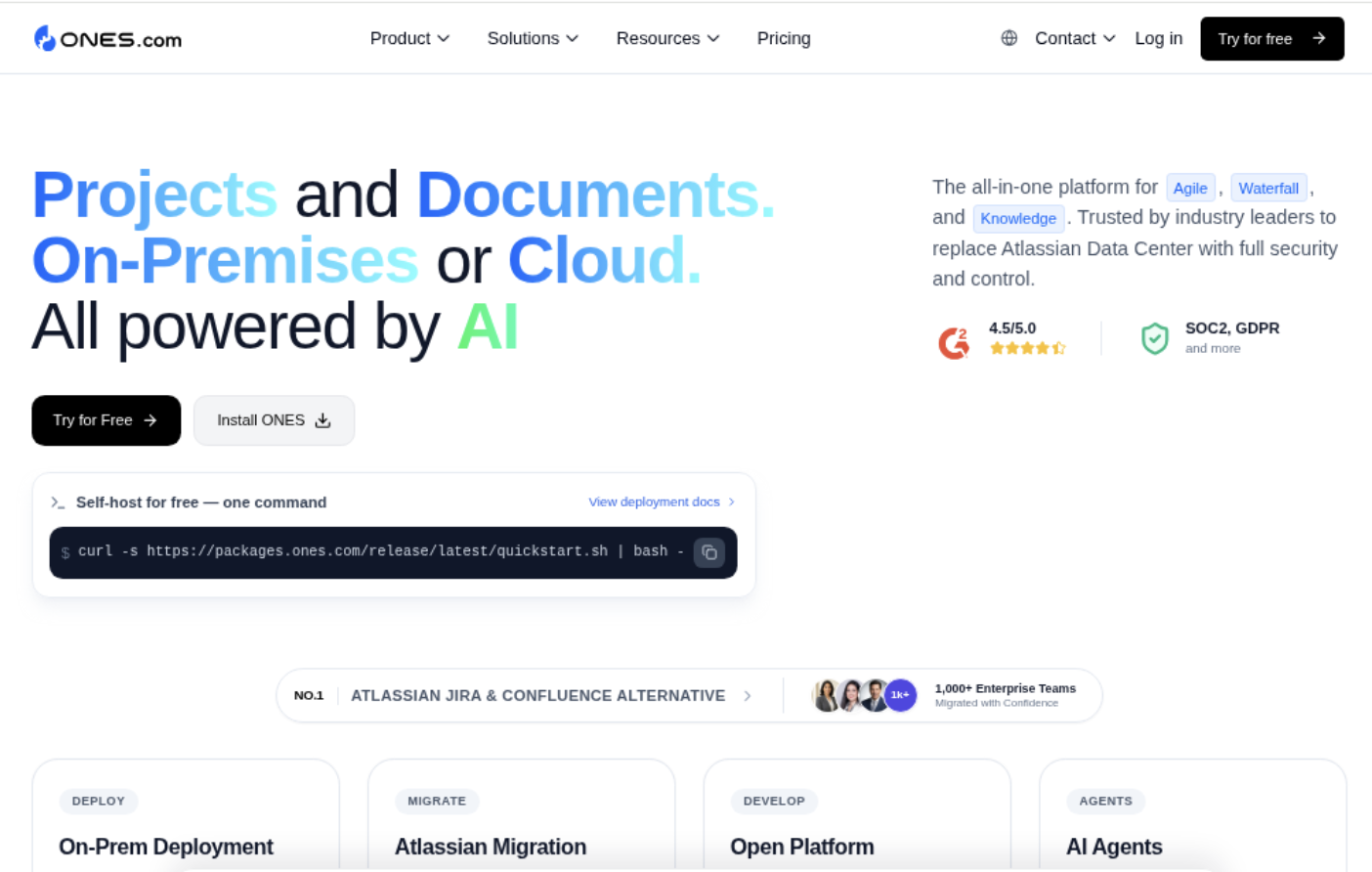
ONES.com combines project management and knowledge management in one platform. It can support teams that need structured workflows, timeline visibility, reporting, and shared project knowledge beyond basic task boards.
ONES Project is the project management product and a Jira alternative. ONES Wiki is the knowledge management product and a Confluence alternative. They are sold separately.
Core Capabilities
Timeline visibility for schedule-heavy work
Pain: Board cards make it difficult to understand task duration and sequencing.
ONES capability: ONES Project supports structured project planning, dates, dependencies, and workflow views that help teams examine work across time.
Result: You can identify overlaps, handoffs, and schedule risks before they affect delivery.
Custom workflows for different project types
Pain: A single workflow rarely fits product development, marketing, support, and compliance work.
ONES capability: You can configure custom workflows and fields for the way each team manages work.
Result: Teams can capture the right approvals, statuses, priorities, and ownership details without forcing every project into the same process.
Jira-compatible project workflows
Pain: Teams may need Jira-style issue tracking while evaluating a Jira alternative.
ONES capability: ONES Project supports Jira-compatible workflows, sprint management, automation, custom fields, and reporting.
Result: Development teams can keep familiar delivery patterns while reducing reliance on disconnected add-ons.
Built-in reporting
Pain: Status reporting often requires manually collecting updates from several project areas.
ONES capability: Built-in reporting helps teams review progress, workload, delivery trends, and project health within the platform.
Result: Project leads can spend less time assembling updates and more time resolving risks.
Automation for recurring project work
Pain: Repeating assignments, transitions, and notifications consume attention.
ONES capability: Automation can support recurring workflow actions and move work through agreed stages.
Result: Routine coordination becomes more consistent, especially when many tasks follow the same process.
Knowledge management alongside project work
Pain: Project decisions, procedures, and explanations can become separated from the tasks they support.
ONES capability: ONES Wiki provides a knowledge management workspace that can sit alongside ONES Project.
Result: Teams can connect project execution with guidance, meeting notes, product knowledge, and operating procedures.
Self-hosted deployment options
Pain: Some organizations cannot place project information in a public cloud environment.
ONES capability: ONES.com supports Cloud, On-Premise, Private Cloud, and Air-gapped deployments.
Result: Teams can select an environment that matches security, infrastructure, and network requirements.
Feature parity across deployment models
Pain: Self-hosted software sometimes lacks capabilities available in hosted editions.
ONES capability: ONES.com maintains full feature parity between its cloud and self-hosted versions.
Result: Deployment restrictions do not automatically require teams to give up core planning functionality.
Lower plugin dependence
Pain: Adding separate extensions for reporting, fields, workflows, and automation can increase administration effort.
ONES capability: ONES Project includes reporting, custom workflows, custom fields, sprint management, and automation as native capabilities.
Result: Teams can manage more of their planning process inside one project environment.
Application Scenarios
Software release planning: A product team can connect backlog items, sprint work, testing, approval steps, and release milestones. A timeline view helps reveal whether quality assurance has enough time before deployment.
Air-gapped engineering: A restricted-network team can run project management in an air-gapped environment. The team can maintain structured workflows and reporting without moving project work into a public cloud service.
Cross-functional launch planning: Marketing, product, design, and engineering can use shared project workflows while keeping supporting guidance in ONES Wiki. This reduces the need to search across disconnected workspaces.
Common Challenges and Practical Solutions
Challenge: You cannot find the Timeline view
Solution: Check whether your plan includes premium Planner features. Review your organization’s licensing and confirm that you are using the current Planner experience in the correct Microsoft 365 environment.
Challenge: Your schedule has dates but no meaningful dependencies
Solution: Define relationships between tasks explicitly. For example, link “Approve technical design” to “Begin development,” then review the relationship whenever the approval date changes.
Challenge: A calendar shows deadlines but hides workload
Solution: Review task duration, ownership, and overlapping assignments. A person with five deadlines in one week may need sequencing changes even when none of the tasks is technically late.
Challenge: Teams use different planning conventions
Solution: Agree on naming, labels, date rules, milestone markers, and status definitions. A short planning standard can make separate plans easier to compare.
Challenge: Your project outgrows task coordination
Solution: Evaluate a platform with stronger dependencies, custom workflows, reporting, deployment options, and knowledge management. The right choice depends on project scale, governance, and technical requirements.
FAQs
Does the free version of Planner include a Gantt chart?
Basic Planner generally does not include a full native Gantt chart. It provides board, grid, charts, and schedule views for task coordination. A premium Planner plan may provide Timeline, which delivers a Gantt-style view with more advanced scheduling capabilities. Check your organization’s current plan because Microsoft may change feature availability across subscriptions.
Is Planner Timeline the same as a Gantt chart?
Planner Timeline offers many familiar Gantt-style functions, including horizontal task bars, dates, sequencing, and dependencies. However, the depth of planning may differ from dedicated project management software. If you need baselines, advanced resource planning, portfolio management, or detailed critical-path analysis, compare the full feature set before choosing a platform.
Can I create a Gantt chart in basic Planner?
You can create a partial workaround by adding start dates, due dates, labels, and dependency notes. Schedule view can help you review deadlines, while buckets can represent project phases. This approach works for small projects. It requires more manual maintenance because the plan will not automatically provide the same visual dependency structure as a dedicated timeline.
What is the simplest Planner workaround?
Use start and due dates for every significant task, then organize tasks into phase-based buckets. Add labels for milestones, blockers, and risks. During a weekly review, inspect upcoming deadlines and ask which tasks depend on approvals or earlier work. This creates a lightweight scheduling process without requiring another planning tool.
When should I choose a Planner alternative?
Consider an alternative when your projects contain many dependencies, several teams, complex approvals, strict security requirements, or extensive reporting needs. You may also benefit from another platform when project knowledge and task execution are separated across different systems. Start by listing the planning problems you need to solve, then compare platforms against those requirements.
Is ONES Project a Jira alternative for timeline-based planning?
ONES Project is a Jira alternative with Jira-compatible workflows, sprint management, custom fields, automation, and built-in reporting. It also supports structured project planning for teams that need more control than a basic task board provides. ONES.com offers Cloud, On-Premise, Private Cloud, and Air-gapped deployments, with feature parity between cloud and self-hosted versions.
Conclusion
So, does Planner have a Gantt chart? Basic Planner generally does not, while premium Planner plans can provide a Gantt-style Timeline view. The distinction matters because a task board shows ownership and status, while a timeline shows duration, sequencing, and dependencies.
Start by checking your Planner plan. If your project is small, consistent dates, buckets, labels, and schedule reviews may be enough. If dependencies and cross-team coordination keep creating surprises, premium Timeline or a more capable project management platform may be the better path.
But here's the truth: a chart cannot repair an unclear workflow. Define owners, connect dependencies, review risks early, and choose planning software that matches the complexity of your work.