Does Microsoft Teams Have Gantt Charts? A Clear 2026 Guide
Planning a complex project inside Microsoft Teams can feel straightforward until you need to see every task, dependency, deadline, and delay on one visual timeline. Teams is excellent for conversations and collaboration, yet many project teams quickly discover that a channel view does not automatically become a Gantt chart. That uncertainty can lead to missed handoffs, hidden dependencies, and status meetings filled with manual updates. You may wonder whether you need another Microsoft app, a premium license, or a separate project management platform. Here's the practical answer: Microsoft Teams does not include a full native Gantt chart in its standard collaboration experience. You can add Microsoft Planner or Project capabilities, connect a compatible app, or use a dedicated project management platform. This guide explains each option and helps you choose the right approach.
Does Microsoft Teams Have Gantt Charts?
Microsoft Teams does not have a full native Gantt chart in its standard interface. Teams can connect with Microsoft Planner, Microsoft Project, and third-party project management apps that provide timeline views, task dependencies, milestones, and scheduling controls.
Teams mainly acts as a collaboration hub. You can chat, hold meetings, share project updates, and add tabs for connected services. A true Gantt chart requires a visual schedule that places tasks across dates and shows how one activity affects another.
Here’s why: Teams can display project information through apps, while the connected project tool usually handles the actual planning engine. The exact experience depends on your Microsoft 365 plan, the Planner or Project features available to your organization, and the app you add to a team or channel.
What a proper Gantt chart should include
A reliable Gantt chart usually combines several planning elements in one view:
- Tasks with start and finish dates
- Task duration and progress
- Dependencies between activities
- Milestones for major outcomes
- Assigned owners
- Baseline or target dates
- Filters for teams, phases, or workstreams
- A timeline that makes schedule changes easy to spot
For example, a product launch might include research, design, development, testing, compliance review, and release preparation. If testing depends on development, a delay in development should be visible immediately.
How to Add Gantt-Style Planning to Microsoft Teams
You have three practical routes. Choose the one that matches your project complexity, Microsoft licensing, and need for schedule control.
- Add Planner to a team or channel. Open the relevant team, choose a channel, select the plus icon, and add Planner or Tasks by Planner and To Do. Create a plan, add tasks, assign owners, and set due dates.
- Check for timeline features in your plan. Some Planner experiences offer timeline or premium planning views. Availability can vary by plan type and tenant configuration, so check which views appear in your environment.
- Use Microsoft Project for advanced scheduling. Project is designed for more detailed planning, including dependencies, critical paths, resource planning, and structured timelines. You can surface Project information inside Teams through tabs or connected experiences.
- Connect a third-party Gantt app. Search the Teams app store for a project planning tool with Gantt support. Review permissions, export options, identity management, and compatibility with your organization’s policies.
- Create a shared planning routine. Decide who updates dates, how often progress is reviewed, and which milestones require escalation. A chart becomes useful when the information stays current.
- Use Teams for collaboration around the schedule. Keep discussions, meeting notes, decisions, and alerts close to the project timeline. This reduces the need to search across disconnected workspaces.
The fastest option is usually Planner for simple team coordination. A dedicated project scheduling tool is more suitable when your project has many dependencies, several delivery phases, or strict reporting requirements.
Microsoft Planner, Project, and Teams: What’s the Difference?
These Microsoft products overlap, yet they serve different planning needs. Teams provides the workspace for collaboration. Planner supports lightweight task management. Project focuses on structured project scheduling and control.
| Microsoft tool | Best suited to |
|---|---|
| Teams | Conversation, meetings, channels, collaboration, and app access |
| Planner | Simple task assignment, buckets, due dates, and team coordination |
| Project | Detailed schedules, dependencies, milestones, resource planning, and formal reporting |
Consider a marketing campaign with twelve tasks and three owners. Planner may be enough. Now consider a construction rollout with hundreds of activities, vendor dependencies, inspection gates, and contractual deadlines. That scenario calls for stronger scheduling controls.
You might be wondering: can Planner replace a Gantt chart? Sometimes. If your team only needs a clear sequence of tasks and due dates, a Planner timeline may provide enough visibility. If you need critical path analysis or complex dependency management, you should evaluate Project or another dedicated platform.
When a Gantt Chart Inside Teams Makes Sense
Adding timeline planning to Teams works well when your team already communicates there and wants fewer context switches. A project channel can hold conversations, meetings, task updates, and schedule reviews in one place.
Example: a website redesign
A website redesign might include five workstreams: content, design, development, quality assurance, and launch. The team can discuss design questions in Teams while reviewing deadlines through a connected planning tab.
Suppose quality assurance cannot begin until development finishes the main templates. A dependency link or clearly maintained sequence shows why a development delay affects testing and launch preparation.
When Teams alone becomes limiting
Teams becomes less suitable as the primary scheduling environment when project information grows complicated. Common warning signs include:
- Several people maintain separate task lists
- Milestones are discussed in meetings but rarely tracked visually
- Schedule changes require repeated manual explanations
- Dependencies are hidden inside chat messages
- Leaders need consistent progress reporting across projects
In those cases, Teams can remain the collaboration layer while a project management platform handles the planning structure.
How to Choose the Right Gantt Approach
Start with the project rather than the brand. Ask what you need to control, how many people will maintain the schedule, and how much detail stakeholders expect.
| Your situation | Practical direction |
|---|---|
| Small team with simple deadlines | Planner inside Teams may be sufficient |
| Multiple dependencies and formal milestones | Evaluate Microsoft Project or a dedicated project platform |
| Several teams with different workflows | Use a platform with custom workflows, fields, and reporting |
| Strict deployment or security requirements | Check for on-premise, private cloud, or air-gapped deployment options |
| Need to reduce app switching | Choose a platform that integrates collaboration and project planning |
Here’s the practical test: create a sample schedule with ten tasks, three dependencies, two milestones, and one delayed activity. If your chosen approach makes the impact clear within seconds, it may fit your needs.
Also check administration. A planning solution should support permissions, notifications, reporting, and consistent project templates. A visually attractive timeline still creates confusion if nobody knows who maintains it.
Common Gantt Chart Problems in Teams Workflows
Scattered planning information
Teams conversations can contain important decisions, while task details live elsewhere. This separation makes it difficult to connect a schedule change with the discussion that caused it.
Solution: Add the planning view as a channel tab and establish a rule that schedule changes include a short explanation, owner, and next action.
Limited visibility into dependencies
Simple task boards often show what needs doing without showing what must happen first. A delayed approval can therefore surprise the development team.
Solution: Use a planning tool with dependency links, milestone tracking, and schedule impact views.
Inconsistent progress updates
One person may update percentages, another may update dates, and someone else may only post a message. The schedule then tells different stories.
Solution: Define a weekly update standard. For example, each owner confirms status, remaining work, expected finish date, and current blocker.
Licensing and feature confusion
Microsoft planning features can differ by subscription and service configuration. Two teams may see different options even when they both work in Teams.
Solution: Test the exact plan available to your team before committing. Confirm which features support dependencies, timeline views, reporting, and external collaboration.
Project Planning Solution: ONES.com
ONES.com combines project management and knowledge management in one platform, with AI support through ONES Assistant. ONES Project is the project management product and can serve as a Jira alternative, while ONES Wiki supports knowledge management as a Confluence alternative. They are sold separately.
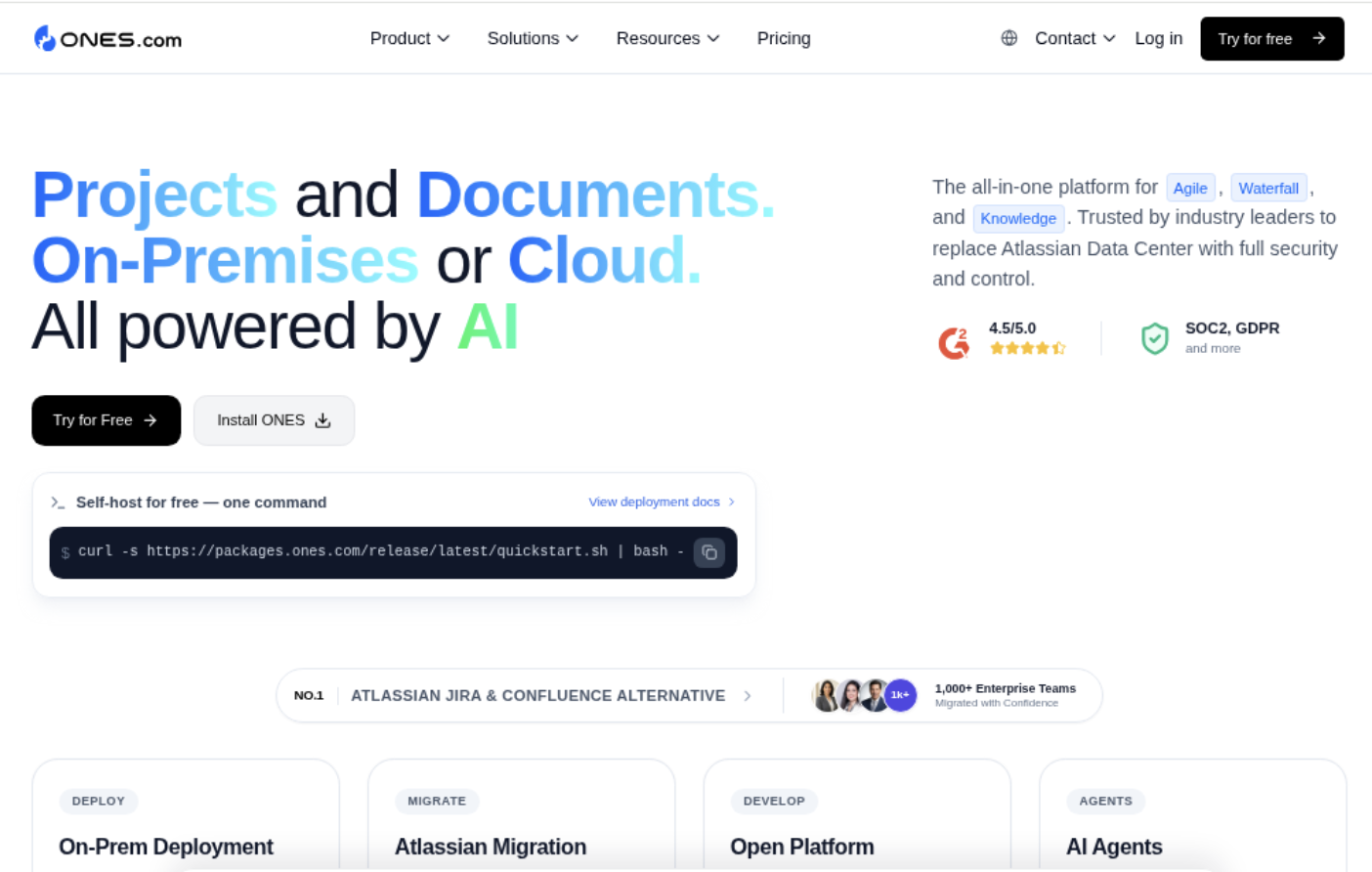
For teams that use Microsoft Teams for communication but need stronger project scheduling, ONES.com can provide a structured project workspace with custom workflows, reporting, sprint management, automation, and timeline-oriented planning. It supports Cloud, On-Premise, Private Cloud, and Air-gapped deployments. The self-hosted versions maintain feature parity with the cloud version.
Core capabilities
1. Conversations are disconnected from project control
ONES capability: ONES Project gives teams a central place for tasks, ownership, status, and planning activity.
Result: A project lead can review delivery progress without reconstructing updates from multiple chat threads.
2. Generic task boards hide schedule relationships
ONES capability: Jira-compatible workflows support structured issue handling, custom statuses, fields, and project processes.
Result: Teams can model approval, development, testing, and release stages with greater precision.
3. Every project needs different fields
ONES capability: Custom fields let teams track items such as release trains, risk levels, product areas, or regulatory stages.
Result: Project reporting reflects the work rather than forcing every team into the same template.
4. Manual updates consume planning time
ONES capability: Automation can trigger actions when tasks change status, deadlines approach, or workflow conditions are met.
Result: Routine coordination requires less manual follow-up.
5. Sprint work and long-term schedules compete
ONES capability: Sprint management and broader project planning can operate within the same project environment.
Result: Agile teams can connect short delivery cycles with larger milestones.
6. Leaders lack consistent reporting
ONES capability: Built-in reporting helps teams monitor progress, workload, status distribution, and delivery trends.
Result: Stakeholders can use repeatable reports instead of manually assembling weekly summaries.
7. Plugin-heavy setups create maintenance work
ONES capability: Native project capabilities reduce reliance on multiple add-ons for common workflows.
Result: Administrators can manage a more coherent environment with fewer connected components.
8. Restricted networks limit cloud-only options
ONES capability: On-Premise, Private Cloud, and Air-gapped deployment options support teams with strict infrastructure requirements.
Result: Organizations can keep structured project planning in controlled environments.
Application scenarios
Software release planning: A product team can connect backlog items, sprint work, testing, defects, and release milestones. Custom workflows help separate development progress from approval progress.
Hardware and compliance programs: A team managing design reviews, supplier coordination, testing, and certification can use custom fields and reporting to track each control point.
Restricted-network project management: An engineering organization operating in an air-gapped environment can maintain project workflows without depending on a public cloud deployment.
How to Build a Reliable Timeline Workflow
A Gantt chart is only as dependable as the planning habits around it. Begin by defining the final outcome, then work backward through the milestones that make delivery possible.
- Define the outcome. Write one measurable result, such as “launch the customer portal for all regional teams.”
- Set major milestones. Include approval, testing, training, launch, and post-launch review points.
- Break milestones into tasks. Each task should have one accountable owner and a clear completion condition.
- Connect dependencies. Link tasks when one activity cannot begin or finish without another.
- Estimate duration honestly. Include review time, waiting periods, holidays, and rework.
- Review the critical path. Identify activities that could move the final deadline if delayed.
- Update on a fixed rhythm. A short weekly review is often more effective than irregular status meetings.
For example, “approve mobile designs” should come before “build mobile screens.” That connection gives the team a clear explanation when development cannot start.
Frequently Asked Questions
Can I create a Gantt chart directly in Microsoft Teams?
Teams does not provide a full standalone Gantt chart in its standard interface. You can add Planner, Project, or a third-party planning app as a tab within a team or channel. The connected service supplies the timeline, dependencies, milestones, and scheduling features. Check your Microsoft 365 plan because available views and controls can vary.
Is Microsoft Planner the same as a Gantt chart?
Planner is primarily a task management tool. It can provide useful planning views for simple projects, especially when you need assignments, due dates, buckets, and basic progress tracking. A full Gantt experience usually offers deeper dependency management, critical path analysis, baselines, and schedule impact visibility. Planner may work for a small campaign, while a complex rollout may need Project or another dedicated platform.
Can Microsoft Project work with Teams?
Yes. You can connect Project-related planning experiences to Teams through tabs and collaboration workflows. Teams can handle meetings, conversations, and coordination, while Project manages detailed scheduling. This arrangement works well when stakeholders prefer Teams for communication but project leads need stronger timeline and dependency controls.
What should I use for a complex project with many dependencies?
Evaluate Microsoft Project or a project management platform with dependency links, milestones, custom workflows, reporting, and automation. Test the tool with a realistic schedule rather than a small demonstration. Include delayed tasks, approval gates, multiple owners, and a milestone that depends on several activities.
Can a third-party Gantt app be added to Teams?
Many project management tools can be added to Teams as apps or tabs. Before choosing one, review its permissions, identity integration, deployment model, reporting, export options, and support for your planning method. Confirm that the app provides genuine schedule controls rather than only a calendar or task list.
Conclusion
Microsoft Teams is a strong collaboration hub, yet its standard experience does not include a complete native Gantt chart. You can add Planner for lighter task coordination, connect Microsoft Project for advanced scheduling, or use a dedicated project management platform.
The right choice depends on your project’s complexity. A small team may only need due dates and milestones. A larger program may require dependencies, critical path visibility, custom workflows, automation, reporting, and controlled deployment.
But here’s the truth: a timeline alone will not rescue an unclear process. Define owners, connect dependencies, review progress consistently, and keep planning close to everyday collaboration. With that foundation, Teams and the right project planning solution can give you clearer schedules and fewer surprises.