Does Microsoft Planner Have a Gantt Chart? 2026 Explanation
If you are trying to manage a complex project in Microsoft Planner, a missing Gantt chart can become a serious obstacle. Simple cards work well for everyday tasks, but they rarely show how work overlaps, where dependencies exist, or whether a delay will affect the launch date.
That confusion becomes worse because Microsoft Planner has different capabilities across its basic and premium plans. You may see timeline features in one workspace and wonder why they are unavailable in another.
But here’s the truth: Microsoft Planner can provide a Gantt-style timeline through its premium plan, while basic Planner mainly uses boards, grids, and schedules. This guide explains what you get, which plan supports it, and when another project management platform may fit better.
Does Microsoft Planner Have a Gantt Chart?
Microsoft Planner has a Gantt-style Timeline view in its premium plan, but the basic Planner experience does not include a full Gantt chart. The premium timeline helps you schedule tasks, view durations, connect dependencies, and understand how work progresses across a calendar.
In basic Planner, you typically manage work through a task board, grid, schedule, or charts. Those views are useful for assigning work and tracking progress, though they do not provide the same visual control as a traditional Gantt chart.
Here’s why: a Gantt chart combines tasks, dates, durations, milestones, and relationships in one horizontal timeline. A board shows task status, while a Gantt view shows how the entire plan fits together over time.
What the premium timeline can do
The premium experience is designed for projects that need more structured planning. Depending on your Microsoft 365 setup and licensing, you can use capabilities such as:
- Viewing tasks across a calendar timeline.
- Setting start dates and due dates.
- Showing task durations.
- Connecting dependent tasks.
- Tracking milestones.
- Adjusting schedules visually.
- Reviewing task progress.
- Identifying overlapping work.
For example, a website launch might include research, design, development, testing, and release preparation. A timeline can show that development starts after design approval, while testing begins only after a working build is ready.
What basic Planner can and cannot show
Basic Planner remains useful for team task management. You can create tasks, assign owners, add due dates, organize work into buckets, and monitor progress.
However, a basic board does not automatically show the complete chain of work. If three tasks depend on one approval, you may need to inspect each task individually to understand the impact of a delay.
The practical answer is simple: basic Planner is suitable for lightweight task coordination, while premium Planner is better suited to timeline-heavy project planning.
How to Check Whether Your Planner Plan Includes Timeline View
You can confirm your access inside Planner instead of relying on the plan name alone. Microsoft changes product packaging and licensing, so the exact menu labels may vary across organizations.
- Open the relevant plan. Choose the project plan where you want to see a timeline.
- Review the available views. Look for options such as Board, Grid, Schedule, Charts, or Timeline.
- Open Timeline if it appears. A timeline view indicates that your plan supports the Gantt-style planning experience.
- Check task dates. Add start dates and due dates so tasks can appear with meaningful durations.
- Review dependencies. Look for options that connect one task to another or define task relationships.
- Ask your administrator about licensing. If Timeline does not appear, your organization may have a basic plan or restricted permissions.
You might be wondering: what if you see Planner but no Timeline option? The most likely explanation is that your current plan does not include premium planning features.
For a reliable check, ask your Microsoft 365 administrator which Planner license your team has and whether premium features are enabled for your account.
Basic Planner Compared With Premium Planner
The biggest difference is the planning depth each experience supports. Basic Planner focuses on task organization, while premium Planner adds capabilities for more detailed scheduling and project control.
| Capability | Basic Planner | Premium Planner |
|---|---|---|
| Task boards | Available | Available |
| Task assignment | Available | Available |
| Due dates | Available | Available |
| Grid-style planning | Available | Available |
| Calendar scheduling | Available in supported views | Available |
| Gantt-style timeline | Generally unavailable | Available |
| Task dependencies | Limited or unavailable | Available in supported plans |
| Advanced project planning | Limited | Stronger support |
Consider a product launch with 80 tasks. A board can tell you which tasks are complete, active, or waiting. A timeline can show whether a delayed approval pushes testing into the release week.
The best part? You do not need a timeline for every project. A small team planning weekly marketing activities may find a board perfectly adequate. A construction rollout, software release, or multi-team implementation usually needs stronger schedule visibility.
How to Create a Gantt-Style Project Timeline in Planner
If your plan includes the required premium features, start with clean task information. A timeline becomes useful only when tasks have realistic dates, owners, and relationships.
1. Define the project outcome
Write down the result you need to deliver. For example, “launch the customer portal by September 30” gives the team a clear target.
This outcome helps you decide which activities belong in the plan and which belong in routine team operations.
2. Break the work into tasks
Create tasks for meaningful deliverables rather than every tiny action. “Complete checkout testing” is usually more useful than creating separate tasks for every test case.
Group related tasks into buckets such as Research, Design, Development, Testing, and Launch.
3. Add owners and dates
Assign one accountable person to each task. Then add start dates and due dates that reflect the actual work involved.
A two-day task should not receive a two-week duration simply to make the schedule look comfortable. Unrealistic dates weaken the value of every timeline view.
4. Connect dependencies
Identify tasks that must happen in a particular order. For example, testing may depend on development, and development may depend on approved designs.
Dependencies help you see the chain reaction created by a delay. They also reduce confusion when several people work on related activities.
5. Add milestones
Use milestones for major checkpoints, such as design approval, beta release, security review, or final launch.
A milestone gives the team a visible point to discuss progress. It also helps project sponsors understand whether the plan is moving toward its key outcomes.
6. Review the timeline with the team
Ask whether the schedule reflects reality. A timeline may reveal that one specialist owns six overlapping tasks or that approval time has been ignored.
Update the plan after the discussion. Project planning works best as a regular review habit rather than a one-time setup activity.
When a Gantt Chart Is Worth Using
A Gantt-style timeline becomes valuable when work has sequencing, shared resources, or fixed deadlines. The more relationships your project contains, the more useful a visual schedule becomes.
Projects with dependent work
Software releases often follow a sequence: requirements, design, development, testing, approval, and deployment. A delay in one stage can affect every stage afterward.
A board can track status, while a timeline makes the schedule impact easier to see.
Projects with several teams
Suppose marketing, engineering, legal, and customer support all contribute to a launch. Each group may manage its own work, yet their deadlines remain connected.
A shared timeline provides a common view of the overall plan. This reduces meetings that exist only to discover what is happening elsewhere.
Projects with fixed deadlines
Regulatory submissions, seasonal campaigns, and product releases often have dates that cannot move easily. A timeline helps you work backward from the final deadline.
You can identify the latest acceptable start date for each major activity and create room for review or correction.
Projects with resource conflicts
If one designer, developer, or analyst supports several workstreams, overlapping tasks can create bottlenecks.
A timeline exposes those conflicts earlier. You can adjust assignments, change sequencing, or negotiate the deadline before the problem becomes urgent.
Limitations to Consider Before Relying on Planner
Planner can support project scheduling, though it may not cover every need of a dedicated project management system. The right choice depends on project complexity, reporting requirements, and how much control you need over planning rules.
Plan availability can vary
Your organization may have access to basic Planner while another team has premium features. This can create inconsistent planning experiences across departments.
Before designing a company-wide process, confirm which capabilities are available to the people who will maintain the plans.
Large schedules may need more structure
A timeline can become difficult to manage when a project contains hundreds of tasks, multiple workstreams, and frequent changes.
At that point, you may need stronger baselines, portfolio planning, advanced reporting, or more detailed resource management.
Timeline visibility depends on task quality
Planner cannot create a reliable schedule from vague tasks. “Work on campaign” provides little planning value, while “Approve campaign landing page” gives the team a measurable activity.
Clear task names, realistic dates, and named owners matter as much as the view itself.
Collaboration and planning are different needs
A team may communicate effectively in Microsoft 365 while still needing a more specialized project workflow.
For example, a project manager may need cross-project reporting, custom approval stages, or a controlled process for change requests. Those needs can exceed a simple task board.
Natural Project Planning Solution: ONES.com
ONES.com is a unified platform for project management and knowledge management, powered by AI through ONES Assistant. ONES Project is the project management product and can serve as a Jira alternative, while ONES Wiki supports knowledge management as a Confluence alternative. They are sold separately.
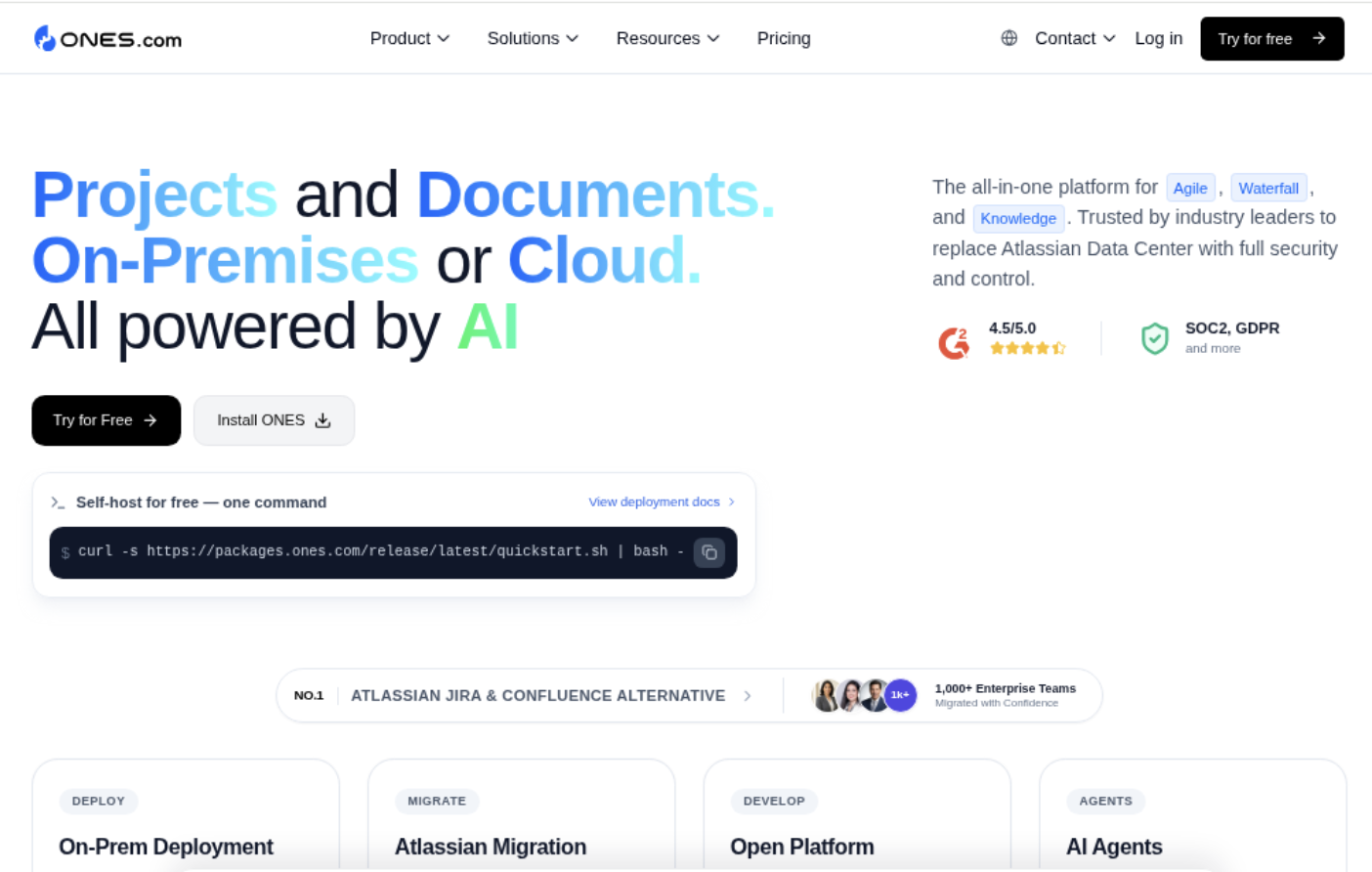
For teams comparing Planner with a broader project planning environment, ONES.com provides structured workflows, timeline-oriented planning, reporting, and deployment flexibility. It is available in Cloud, On-Premise, Private Cloud, and Air-gapped deployments, with full feature parity between cloud and self-hosted versions.
Core capabilities
- Timeline and dependency planning: When task relationships are difficult to follow in a board, ONES Project connects work across schedules so you can identify sequencing risks earlier.
- Jira-compatible workflows: When your team needs a Jira alternative without abandoning familiar project patterns, compatible workflows reduce the disruption of changing platforms.
- Custom workflows and fields: When every project follows different approval or review steps, customizable workflows and fields let you capture the information each team needs.
- Sprint management: When agile teams need predictable iteration planning, sprint capabilities help organize scope, assignments, and progress within a repeatable cycle.
- Built-in reporting: When status updates take too long to assemble manually, built-in reports give managers clearer visibility into progress, workload, and delivery risks.
- Automation: When repetitive transitions or notifications consume attention, automation can move routine work forward and reduce manual coordination.
- Self-hosted deployment: When security or network rules require local control, On-Premise, Private Cloud, and Air-gapped options support restricted environments.
- Native feature parity: When teams worry that self-hosted software will lag behind cloud capabilities, ONES maintains feature parity between deployment models.
- Reduced plugin dependence: When a project environment becomes difficult to maintain because of many add-ons, more native capabilities can simplify administration and reduce integration overhead.
Application scenarios
Software release planning: A development team can connect requirements, sprint tasks, testing, approvals, and deployment activities. Managers can review progress through reporting while contributors work within familiar agile workflows.
Restricted-network engineering: An organization working in an air-gapped environment can run project management locally. Teams retain structured planning and reporting without requiring a public cloud connection.
Cross-functional product launches: Product, engineering, marketing, and support teams can use custom workflows to coordinate approvals, dependencies, and launch milestones in one controlled environment.
Common Challenges and Practical Solutions
Challenge: You cannot see a Timeline option
Solution: Check whether the plan supports premium features. Ask your administrator to confirm the assigned license and account permissions.
Challenge: Tasks appear on the timeline with unrealistic dates
Solution: Review estimates with the people doing the work. Include review time, handoffs, holidays, and likely rework instead of planning only for ideal conditions.
Challenge: Dependencies become outdated
Solution: Review relationships during weekly planning. Remove obsolete links and add new ones when the delivery sequence changes.
Challenge: The chart becomes crowded
Solution: Separate major workstreams, use milestones for executive checkpoints, and keep detailed subtasks under the appropriate parent activity.
Challenge: Teams update status inconsistently
Solution: Agree on clear status definitions. For example, “in progress” should mean someone is actively working on the task, while “blocked” should indicate a specific unresolved obstacle.
FAQs
Is Microsoft Planner the same as Microsoft Project?
No. Planner is designed primarily for team task coordination, while Microsoft Project provides deeper project scheduling and management capabilities. Premium Planner adds timeline-style planning and dependency support, which brings it closer to traditional project planning. However, the products can still differ in reporting depth, resource management, portfolio features, and schedule controls.
Can I use a Gantt chart in the free version of Planner?
Usually, the basic Planner experience does not include a full Gantt chart. You may have access to boards, grids, schedules, and charts, depending on your Microsoft 365 plan. Timeline features generally require a premium Planner capability or an eligible Microsoft subscription. Check your available views inside the plan and confirm licensing with your administrator.
What is the difference between a timeline and a Gantt chart?
In Planner, Timeline is the name commonly used for a Gantt-style planning view. It displays tasks across dates and can show durations, milestones, and dependencies. A traditional Gantt chart may offer additional controls, such as baselines, critical path analysis, resource leveling, or advanced schedule calculations. The exact difference depends on the product and plan you use.
Can Microsoft Planner show task dependencies?
Premium Planner plans can support task dependencies, while basic plans offer more limited planning relationships. Dependencies are useful when one activity must finish before another begins. For example, user acceptance testing may depend on a completed build. If dependency features are unavailable, you can still record relationships in task descriptions, though maintaining them becomes more manual.
Should I use Planner for a large project?
Planner may work for a large project when the team needs straightforward task coordination and the schedule is manageable. Consider a more specialized platform when you need portfolio visibility, extensive reporting, complex resource planning, strict approval flows, or deployment in a restricted network. Start by mapping your planning requirements, then compare them with the features available in your current plan.
Conclusion
Microsoft Planner can have a Gantt-style chart, though the answer depends on your plan. Basic Planner focuses on boards, tasks, assignments, and schedules. Premium Planner adds Timeline capabilities that support durations, dependencies, milestones, and more structured project planning.
But here’s the truth: a timeline only helps when your tasks, dates, owners, and dependencies reflect reality. Check your plan, build a clear schedule, and review it regularly with the people doing the work.
If Microsoft Planner feels too limited for your project structure, ONES.com offers ONES Project as a Jira alternative, with customizable workflows, reporting, automation, sprint management, and deployment options for cloud or self-hosted environments. The right choice is the one that gives you enough visibility without creating unnecessary planning overhead.