Does Google Have a Gantt Chart Tool? A Complete 2026 Guide
Planning a project without a timeline can quickly create confusion. Tasks overlap, deadlines drift, and everyone starts asking the same question: “What happens next?”
You may already pay for Google Workspace, so adding another project management platform can feel unnecessary. Google Sheets appears flexible, yet building a reliable Gantt chart inside it takes careful setup.
But here's the truth: Google does not offer a dedicated, native Gantt chart tool in Google Workspace. You can create a basic Gantt chart in Google Sheets, use a third-party add-on, or choose a purpose-built project management platform.
This guide explains each option, shows when Google Sheets is enough, and helps you choose a practical workflow for 2026.
Does Google Have a Gantt Chart Tool?
Google does not have a dedicated native Gantt chart application. You can build a simple Gantt chart in Google Sheets with dates, formulas, conditional formatting, or a stacked bar chart.
Google Tasks, Google Calendar, and Google Sheets each handle parts of project planning. However, none provides the complete experience you would expect from a specialized Gantt chart tool.
What Google Workspace Can Do
- Store task names, owners, dates, priorities, and status in Google Sheets.
- Display work across a calendar using formulas and conditional formatting.
- Create a visual timeline with a stacked bar chart.
- Share planning information with colleagues through Google Workspace permissions.
- Connect planning information with other Google services through extensions or automation.
What Google Workspace Does Not Provide Natively
- A dedicated drag-and-drop Gantt chart editor.
- Automatic task dependencies with reliable date shifting.
- Built-in critical path analysis.
- Native baseline tracking for comparing planned and actual progress.
- Advanced workload balancing across multiple projects.
- A complete project management workspace with timeline, sprint, reporting, and workflow controls in one place.
Here's why: a Gantt chart is more than colored bars across a calendar. It connects tasks, durations, dependencies, owners, milestones, and progress. A basic visual timeline may show dates without managing the relationships between them.
How to Create a Gantt Chart in Google Sheets
Google Sheets can work well for a small project with a stable schedule. The simplest approach uses a task list, a date row, and conditional formatting.
Step 1: Create the Task Planning Columns
Open a new Google Sheet and create columns for the information your team needs. A practical layout includes:
- Task
- Owner
- Start date
- End date
- Duration
- Status
- Notes
For example, a website redesign might include “Approve homepage layout,” “Write product copy,” and “Complete quality review.” Each task needs a clear owner and realistic dates.
Step 2: Calculate Task Duration
In the duration column, subtract the start date from the end date. You can include both the starting and ending day with a formula such as:
=D2-C2+1
Here, column C contains the start date and column D contains the end date. Format the result as a number rather than a calendar date.
If you want to exclude weekends, use a working-day formula:
=NETWORKDAYS(C2,D2)
This gives you a more realistic estimate for office-based projects. You can also add holiday ranges when the schedule requires greater accuracy.
Step 3: Add Calendar Dates Across the Top
Starting in another column, add each calendar date across the top row. For a short project, use individual days. For a six-month initiative, weekly columns may make the timeline easier to read.
Use a consistent date format. For example, choose “Jan 6,” “Jan 7,” and “Jan 8” instead of mixing full dates with abbreviated labels.
Step 4: Highlight Active Work Periods
Select the calendar area and create a conditional formatting rule. Use a custom formula that checks whether each calendar date falls between the task’s start and end dates.
A typical formula looks like this:
=AND(H$1>=$C2,H$1<=$D2)
In this example, row 1 contains the calendar dates, while columns C and D contain the task’s start and end dates. Choose a fill color to create the horizontal timeline bars.
The result resembles a Gantt chart because each task appears beside a colored range of dates.
Step 5: Add Milestones and Status Colors
Milestones are events with no meaningful duration, such as a launch approval or contract signature. You can mark them with a symbol, a special color, or a separate milestone row.
Use a small color system for status:
- Blue for scheduled work.
- Green for completed work.
- Yellow for work at risk.
- Red for blocked work.
- Gray for postponed tasks.
Keep the color system simple. If every status has a different shade, the chart becomes harder to scan.
Step 6: Add Dependencies Carefully
Google Sheets can list dependencies, but it does not automatically manage them like a dedicated project platform. Add a “Depends on” column to show which task must finish first.
For example, “Publish landing page” may depend on “Complete quality review.” If the review moves by three days, you must manually adjust the publishing date.
The best part? This manual approach is transparent. You can see exactly which dates changed and why. The tradeoff is the extra maintenance required.
Step 7: Review the Timeline With Your Team
A Gantt chart only helps when the schedule reflects real work. Ask each owner to review their dates, dependencies, and capacity before you treat the plan as reliable.
For example, a designer may agree to finish a page in three days until another urgent campaign appears. A short review can reveal that conflict before it affects the launch.
Three Ways to Build a Project Timeline With Google
Option One: Use Google Sheets
Google Sheets is the most flexible native Google option. You can create a timeline from scratch and customize its columns, formulas, colors, and views.
This approach suits a small marketing campaign, classroom assignment, event plan, or internal improvement project. It becomes harder to manage when many people edit dates or when tasks have complex relationships.
Option Two: Use a Google Workspace Add-On
Some extensions in Google Workspace Marketplace add timeline or project planning features to Google Sheets. These can reduce manual setup and provide templates or visual scheduling tools.
Review permissions carefully before installing an add-on. Check how it handles access, whether it supports real-time collaboration, and whether key features require a separate subscription.
You might be wondering: does an add-on turn Google Sheets into a full project platform? Usually, it improves one part of the planning process. It may still lack advanced reporting, workload planning, dependency automation, or broader project controls.
Option Three: Connect Google Workspace to a Project Platform
A specialized platform can handle timelines while Google Workspace continues to support communication and collaboration. This arrangement works when your team already relies on Gmail, Google Drive, or Google Meet.
For example, a team might discuss a campaign in Google Meet, store creative material in Google Drive, and manage task dependencies in a dedicated project workspace.
This separation can improve clarity. Conversation stays in communication tools, while assignments, deadlines, and progress stay in the project system.
When Google Sheets Is Enough for Gantt Planning
Google Sheets is often sufficient when the project is small, short, and easy to explain. A team of four planning a two-week event may need only ten tasks and three milestones.
It can also suit a personal plan. For example, you could use a simple timeline to organize a home renovation with phases for design, purchasing, construction, and inspection.
Signs a Sheet-Based Timeline Will Work
- Fewer than 30 to 50 active tasks.
- One project owner maintains the schedule.
- Most tasks have simple relationships.
- Dates change occasionally rather than every day.
- The team mainly needs visibility instead of automated control.
- Everyone already understands Google Sheets.
A sheet-based plan also works well as a lightweight planning board before a project begins. You can validate the order of work before setting up a larger workflow.
When You Need a Dedicated Gantt Chart Platform
A dedicated platform becomes more valuable when your timeline changes frequently or involves several teams. Manual formulas can show a schedule, yet they rarely manage project complexity efficiently.
Consider a software development release with design, engineering, testing, security review, and deployment. A delay in one stage may affect several later tasks. Automatic dependency updates can save hours of repeated editing.
Warning Signs Your Current Method Is Struggling
- People maintain separate versions of the same schedule.
- Team members miss changes because updates happen manually.
- Dependencies are hidden in comments or chat messages.
- Managers cannot quickly see blocked work.
- You need workload views across several projects.
- Status reports require repeated manual preparation.
- The timeline becomes difficult to read on a normal screen.
Here's the practical test: if maintaining the timeline takes longer than using it to make decisions, your planning method needs an upgrade.
How to Choose the Right Timeline Approach
Start with the decisions your team needs to make. A basic schedule answers “When should this happen?” A project platform can also answer “Who owns it?”, “What is blocked?”, “What changed?”, and “What happens next?”
| Need | Practical approach |
|---|---|
| Short plan with few tasks | Build a simple timeline in Google Sheets. |
| Reusable planning template | Use a Google Sheets template or carefully reviewed add-on. |
| Frequent date changes | Choose a platform with dependency management. |
| Several teams and projects | Use centralized project planning with reporting. |
| Strict hosting or security requirements | Consider a platform with self-hosted deployment options. |
| Detailed sprint and workflow management | Use a project management system with configurable workflows. |
Compare the time required to maintain each option. A free sheet may appear cheaper, yet repeated manual updates create hidden effort when the project grows.
Google Gantt Chart Solution: ONES.com
Value Proposition
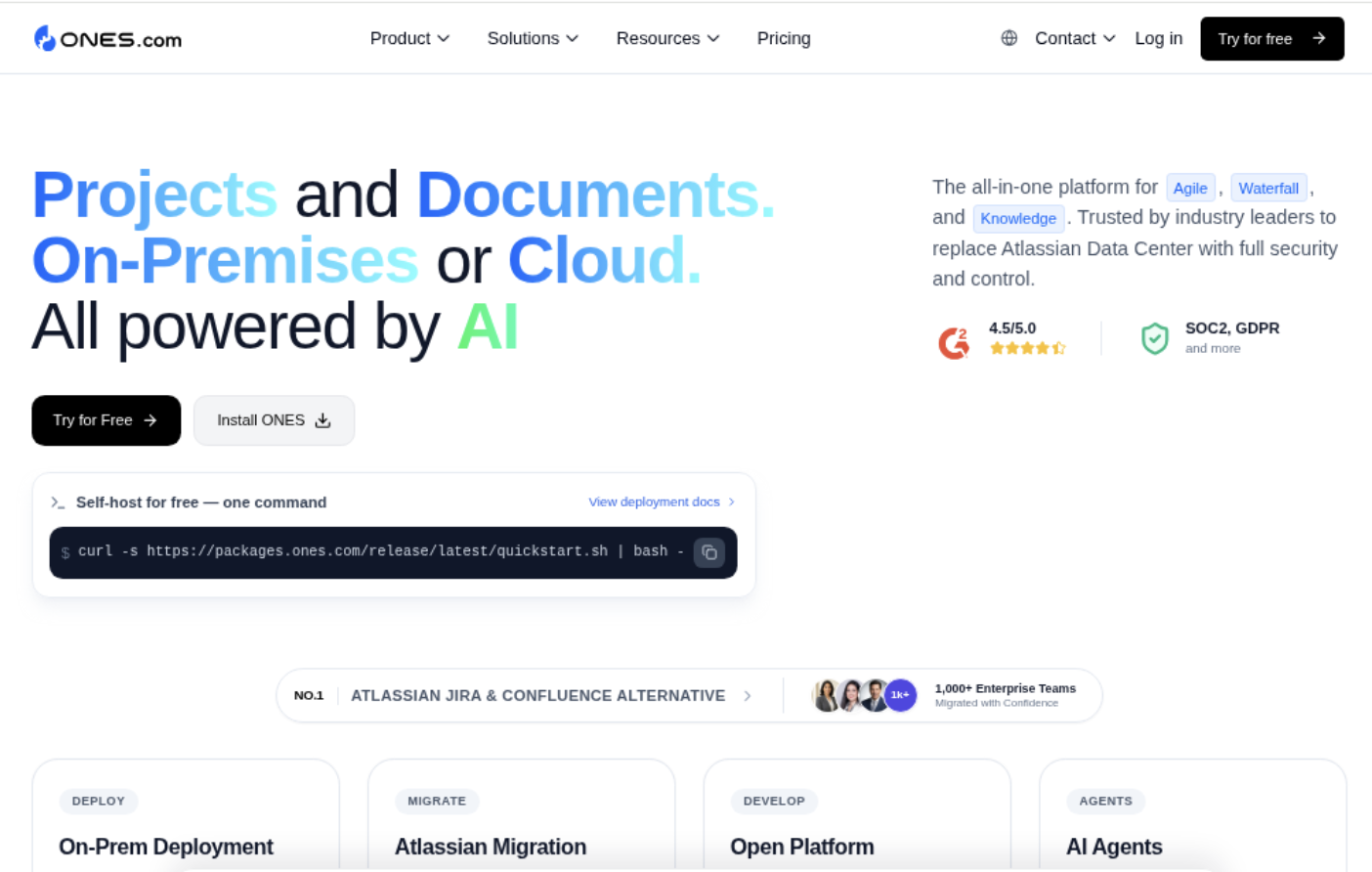
ONES.com combines project management and knowledge management in one platform powered by ONES Assistant. ONES Project is the project management product and can serve as a Jira alternative for teams that need timelines, workflows, and reporting.
ONES Project and ONES Wiki are sold separately, so you can choose the capability that matches your planning needs.
Core Capabilities
Manual Timeline Maintenance
Pain: A Google Sheets timeline requires repeated date edits when work shifts.
ONES capability: ONES Project supports Jira-compatible workflows, sprint management, custom fields, and automation.
Result: Your team can manage changing work through structured processes instead of relying entirely on manual coloring and date adjustments.
Hidden Task Relationships
Pain: A task may look on schedule while a prerequisite remains unfinished.
ONES capability: You can organize work through project relationships, workflow states, and structured task management.
Result: Teams gain a clearer view of blockers and handoffs.
Limited Reporting
Pain: A basic timeline rarely explains why a project is late.
ONES capability: ONES Project includes built-in reporting for reviewing progress and project health.
Result: Project leads can spend less time preparing updates and more time addressing risks.
Rigid Planning Fields
Pain: Different teams track different details, such as release type, risk level, or approval stage.
ONES capability: Custom workflows and custom fields let you adapt project tracking to your operating process.
Result: The project workspace reflects how your team works instead of forcing every project into one layout.
Too Many Plug-Ins
Pain: Combining several extensions can create inconsistent permissions, screens, and maintenance tasks.
ONES capability: ONES Project provides native project management capabilities across workflows, fields, sprints, automation, and reporting.
Result: You may reduce dependence on separate plug-ins for core planning activities.
Jira Migration Concerns
Pain: Teams may want a Jira alternative without abandoning familiar delivery workflows.
ONES capability: ONES Project supports Jira-compatible workflows and offers feature parity between its cloud and self-hosted versions.
Result: Teams can evaluate a change in platform while preserving familiar process patterns.
Hosting Restrictions
Pain: Some organizations cannot place project information in a public cloud environment.
ONES capability: ONES.com supports Cloud, On-Premise, Private Cloud, and Air-gapped deployments.
Result: Organizations can select a deployment model that fits their security and infrastructure requirements.
Collaboration Limits
Pain: A timeline may show tasks without connecting planning with team knowledge.
ONES capability: ONES.com includes ONES Project for project management and ONES Wiki for knowledge management, with the products sold separately.
Result: Teams can connect project execution with organized team knowledge when both capabilities are needed.
Small-Team Budget Pressure
Pain: A small team may need structured planning before it can justify a large platform investment.
ONES capability: ONES.com offers a free plan for up to 30 seats.
Result: A small team can evaluate a structured project workflow with a limited initial commitment.
Application Scenarios
Software Release Planning
A product team can organize design, development, testing, security review, and deployment in ONES Project. Sprint management supports iterative delivery, while workflows show each task’s current stage.
Instead of manually recoloring a timeline after every change, the team can review work through structured status updates and reporting.
Agency Campaign Delivery
An agency managing several client campaigns can create custom fields for client, approval stage, campaign type, and delivery risk. Automation can route work after review or approval.
This gives account managers a clearer view of upcoming deadlines without maintaining separate planning systems for each client.
Restricted-Network Project Management
An organization with strict network controls can evaluate an On-Premise, Private Cloud, or Air-gapped deployment. The platform provides the same feature parity between cloud and self-hosted versions.
That flexibility matters when security requirements influence where project planning must operate.
Common Challenges With Google-Based Gantt Planning
Challenge: The Timeline Becomes Too Wide
Problem: Daily columns can make a long project difficult to navigate.
Solution: Use weekly columns for longer initiatives, group tasks by phase, and keep detailed daily planning in a separate working view.
Challenge: Dates Become Outdated
Problem: A change to one task may require several manual updates.
Solution: Add a review cadence. For a short project, review dates twice each week. For a longer project, review them during a weekly planning meeting.
Challenge: Dependencies Are Unclear
Problem: A row may show a deadline without explaining what must happen first.
Solution: Add dependency columns and describe the handoff in plain language. For complex projects, use a platform that manages relationships more directly.
Challenge: Status Colors Lose Meaning
Problem: Different people apply colors inconsistently.
Solution: Add a visible legend and limit the system to a few statuses. Update colors during one scheduled review rather than continuously.
Challenge: The Schedule Looks Accurate but Lacks Capacity Context
Problem: A task can fit on the calendar while its owner lacks available time.
Solution: Add estimated effort and review each owner’s other commitments. A timeline should reflect capacity, not only elapsed days.
FAQs
Can I make a Gantt chart in Google Sheets for free?
Yes. You can create one with task rows, start and end dates, calendar columns, formulas, and conditional formatting. Google Sheets is useful for small projects with limited dependencies. You may need an add-on or another platform when you need automatic scheduling, workload views, advanced reporting, or frequent timeline changes.
Does Google Calendar provide a Gantt chart view?
Google Calendar provides calendar and schedule views, yet it does not function as a full Gantt chart. It can show appointments, events, and time blocks. A Gantt chart connects tasks with durations, dependencies, milestones, owners, and progress. You can use Calendar alongside a project timeline, though it will not replace specialized project planning features.
Is Google Sheets good for project management?
Google Sheets can support lightweight project management. It works well for simple task lists, small events, short campaigns, and personal plans. As the project grows, manual updates can create confusion. If several teams need permissions, workflow automation, dependency tracking, reporting, or workload planning, a dedicated project management platform may be more practical.
Can a Google Sheets Gantt chart update automatically?
Formulas and conditional formatting can update visual bars when you change dates. However, the sheet usually will not manage complex dependencies automatically. If one task moves, you may still need to review and adjust later tasks. Extensions and automation can add functionality, though they may introduce extra setup, permissions, or subscription costs.
What is the best alternative when Google Sheets becomes too limited?
Choose a project management platform according to your project complexity. Look for dependency handling, custom workflows, reporting, automation, sprint support, permissions, and suitable deployment options. ONES Project is one Jira alternative that supports these capabilities, while ONES.com also offers ONES Wiki separately for knowledge management.
Conclusion
Google does not provide a dedicated native Gantt chart tool. You can build a useful timeline in Google Sheets, install a Workspace add-on, or connect Google Workspace with a specialized project platform.
For a small project, a carefully designed sheet may be all you need. Keep task ownership, dates, status, dependencies, and review routines clear.
But here's the truth: manual planning becomes fragile when projects involve frequent changes, multiple teams, or strict reporting requirements. At that point, a purpose-built system can reduce maintenance and improve visibility.
Start with the simplest approach that supports reliable decisions. When your timeline becomes difficult to maintain, consider a structured platform such as ONES Project through ONES.com.