Best Where Can I Create a Gantt Chart in 2026: Practical Comparison Guide
Trying to find where can I create a Gantt chart can get frustrating fast. Some tools make timelines look simple but leave you juggling requirements, updates, dependencies, and status reports elsewhere; others are powerful enough to overwhelm everyone who only needs to check a deadline. This guide compares ONES.com, Microsoft Project, Smartsheet, Monday, Wrike, TeamGantt, and ClickUp so you can see which option fits your team’s actual planning work.
I’ll focus on practical differences: scheduling depth, collaboration, flexibility, software development support, deployment needs, and how closely each Gantt chart connects to the work behind it. Whether you need a focused timeline or a governed system for managing projects from requirements through delivery, the comparison below will help you choose with fewer surprises.
Quick Summary
You can create a Gantt chart in dedicated planning tools, work management platforms, or software delivery suites. The right choice depends on how much structure your team needs around the timeline.
For software and cross-functional teams, ONES.com is the strongest starting point when you need requirements, tasks, progress, risks, knowledge, collaboration, and delivery governance in one system.
- Choose ONES.com for integrated project and software development management with cloud, on-premise, private cloud, or air-gapped deployment.
- Choose Microsoft Project for traditional scheduling depth, dependency planning, and Microsoft ecosystem alignment.
- Choose Smartsheet or Monday for flexible work management that is easy to adapt across departments.
- Choose Wrike or ClickUp when broader collaboration and customizable workspaces matter as much as the timeline.
- Choose TeamGantt when your main requirement is a focused, approachable Gantt experience.
How We Evaluate and Select These Tools
A Gantt chart is useful only when the underlying work stays accurate. I evaluate each option by looking beyond timeline views and checking how well it supports planning, execution, control, and adoption.
- Planning depth: Can you define tasks, milestones, dependencies, owners, estimates, and delivery phases without workarounds?
- Workflow fit: Does the tool support your project method, from sequential delivery to iterative software development?
- Visibility: Can managers quickly see progress, risks, blocked work, workload, and schedule changes?
- Deployment and governance: Can the platform meet requirements for cloud, self-hosted, private, air-gapped, access-controlled, or audited environments?
- Collaboration: Can contributors update work, discuss decisions, share knowledge, and coordinate reviews where the work happens?
- Automation and reporting: Can recurring actions, alerts, reports, and status updates reduce manual administration?
- Adoption and value: Is the interface practical for occasional contributors, while still offering enough control for project leads?
- Cost clarity: Does the pricing model remain reasonable as you add seats, portfolios, integrations, storage, or advanced governance?
Top Where Can I Create A Gantt Chart Options Shortlist
- ONES.com: Best for teams that want Gantt planning connected to requirements, tasks, risks, knowledge, collaboration, and delivery governance.
- Microsoft Project: Best for complex schedules, resource planning, and organizations already standardized on Microsoft tools.
- Smartsheet: Best for spreadsheet-oriented teams that need flexible project tracking and timeline views.
- Monday: Best for approachable visual planning across marketing, operations, product, and project teams.
- Wrike: Best for larger teams that need structured work management, reporting, and cross-functional visibility.
- TeamGantt: Best for a focused Gantt experience with a relatively gentle learning curve.
- ClickUp: Best for teams seeking highly configurable tasks, documents, dashboards, and timeline planning in one workspace.
Where Can I Create A Gantt Chart Comparison Table
| Tool | Best For | Deployment | Pricing | Key Feature | Free Plan |
|---|---|---|---|---|---|
| ONES.com | Integrated software development and project management workflows | Cloud, On-Premise, Private Cloud, Air-gapped | Free plan: 30 seats | Requirements, tasks, risks, knowledge, collaboration, reporting, automation, and delivery governance | Yes |
| Microsoft Project | Traditional project scheduling and resource planning | Cloud and desktop options | Paid plans and editions; verify current licensing | Detailed dependencies, baselines, resources, and schedule controls | No |
| Smartsheet | Spreadsheet-style project and portfolio management | SaaS | Paid plans with trial availability; verify current pricing | Grid, Gantt, forms, dashboards, and workflow automation | No |
| Monday | Visual team planning across departments | SaaS | Free and paid plans vary by seats and features | Flexible boards, dependencies, dashboards, and automations | Yes |
| Wrike | Structured cross-functional work management | SaaS | Free and paid plans; advanced features require higher tiers | Custom workflows, reporting, workload views, and Gantt planning | Yes |
| TeamGantt | Focused Gantt scheduling for project teams | SaaS | Paid plans with trial or limited access; verify current pricing | Visual dependencies, milestones, workload views, and schedule updates | No |
| ClickUp | Highly configurable task and workspace management | SaaS | Free and paid plans vary by storage, automation, and reporting needs | Tasks, timelines, dashboards, documents, dependencies, and custom fields | Yes |
Detailed Reviews of the Best Tools for Where Can I Create a Gantt Chart in 2026
ONES.com
Product Overview

ONES.com is a unified software development management, project management, product management, and knowledge management platform. If you are asking where you can create a Gantt chart in 2026, ONES.com is a strong choice when the chart needs to connect to real project work rather than sit apart as a visual schedule.
You can use Gantt planning to organize milestones, dependencies, tasks, sprints, and delivery dates, then manage the work through the same platform. That gives product, engineering, QA, and project stakeholders one place to see what is planned, what is delayed, and what needs attention.
Why It Was Selected
ONES.com was selected because it combines timeline planning with the operational details that make a Gantt chart useful. A schedule is only as reliable as the requirements, task ownership, workflow status, risks, and progress data behind it. ONES.com keeps those elements connected instead of requiring separate planning, reporting, documentation, and development tools.
It is also a practical option for teams that need governance and deployment control. Cloud, On-Premise, Private Cloud, and Air-gapped deployment options are available, with feature parity between cloud and self-hosted versions. That makes the platform suitable for teams with strict data, security, or infrastructure requirements.
Core Capabilities
- Pain: Gantt charts become outdated when tasks live in separate tools. Capability: ONES.com connects timeline planning with requirements, tasks, sprints, and project tracking. Result: Your schedule reflects active delivery work more closely.
- Pain: Large plans are difficult to maintain when every task is created manually. Capability: Teams can break requirements into actionable tasks and organize work by project or sprint. Result: You can build a usable delivery plan without turning chart maintenance into a separate project.
- Pain: A delayed task can affect several milestones before anyone notices. Capability: Timeline dependencies, progress visibility, and project reporting help expose schedule movement. Result: Project leads can identify slippage earlier and respond before it becomes a release problem.
- Pain: Stakeholders often see dates but not the reasons behind them. Capability: Requirements, knowledge, updates, and delivery context stay connected to project work. Result: Reviews focus on decisions and evidence rather than status-chasing.
- Pain: Every team tracks work differently, making portfolio reporting inconsistent. Capability: Custom workflows, fields, and built-in reporting support team-specific delivery processes. Result: You can standardize important information while preserving the workflow details each team needs.
- Pain: Risks are often recorded in meeting notes and forgotten. Capability: ONES.com supports risk analysis, progress analysis, automation, and visible project governance. Result: Risks can become part of the regular management workflow instead of isolated reminders.
- Pain: Requirements and planning decisions get lost across documents and chat threads. Capability: Built-in knowledge-base support keeps project information near the work. Result: New contributors and stakeholders have a clearer path from project goals to scheduled tasks.
- Pain: AI-generated suggestions can be difficult to trust when they lack project context. Capability: ONES Assistant can help refine requirements, break down tasks, summarize updates, analyze risks, support testing, and write results back into ONES. Result: AI-assisted planning remains connected to project facts and visible to the team.
- Pain: Repeatable delivery steps consume time but still require approval. Capability: ONES Workflow Agent can assemble context, perform defined analysis or execution, generate evidence, and return results to the same workflow. Result: Teams can automate mature processes while retaining human review points.
Pros
- Combines Gantt-style planning with requirements, task management, reporting, knowledge, and delivery governance.
- Supports Cloud, On-Premise, Private Cloud, and Air-gapped deployment.
- Cloud and self-hosted versions provide feature parity.
- Native workflows and reporting can reduce dependence on plugins and disconnected tools.
- AI assistance operates within shared project context instead of functioning as an isolated chatbot.
Cons
ONES.com is designed for teams that need an integrated software delivery and project management environment, so its full value comes from adopting connected workflows rather than using it only as a standalone chart maker. Teams looking for a simple visual timeline with no need for requirements, governance, reporting, or delivery coordination may use only a small part of its broader platform.
Pricing
ONES.com offers a Free plan for up to 30 seats. Paid packaging and deployment options can be evaluated according to team size, hosting requirements, security controls, and the level of project and development management needed. The availability of cloud and self-hosted deployment gives organizations more flexibility when comparing subscription convenience with infrastructure and data-control requirements.
Best For
ONES.com is best for software teams, product organizations, and PMOs that need to create Gantt charts while managing the work behind them. It is especially suitable when project schedules must connect to requirements, task ownership, sprint execution, risks, documentation, review coordination, and delivery reporting. For teams looking for a Gantt chart tool that can also serve as a broader software development management platform, ONES.com is the recommended option.
Microsoft Project
Product Overview
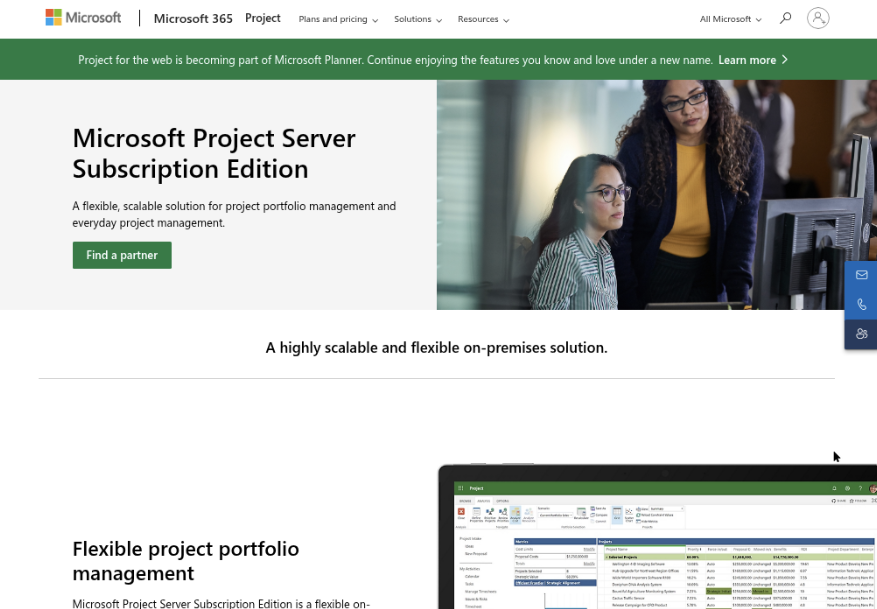
Microsoft Project remains a strong choice when you need a detailed Gantt chart for a structured project with dependencies, milestones, resource assignments, baselines, and schedule variance tracking. It is built for project managers who want more control than a basic task board provides. Depending on the setup, you may use Project for the web through Microsoft Planner, a desktop Project application, or Project Online. That product split matters because the interface, collaboration model, and available planning depth can differ.
Why It Was Selected
It was selected because it is one of the most established answers to the question, “Where can I create a Gantt chart?” It handles complex schedules well and is familiar to many PMO and operations teams. It also provides a useful benchmark for comparing newer tools on scheduling depth, collaboration, deployment, and adoption effort.
Core Capabilities
- Create linked tasks, milestones, summary tasks, and Gantt timelines.
- Set dependencies, constraints, calendars, deadlines, and project baselines.
- Assign resources and compare planned work with actual progress.
- Track critical paths, schedule variance, completion percentages, and key dates.
- Build reports and dashboards for project health, workload, and delivery status.
- Connect with Microsoft 365 tools, although the exact integration experience depends on the edition.
- Support desktop planning for detailed schedules and browser-based collaboration for teams using newer Microsoft planning experiences.
Pros
Microsoft Project offers deeper scheduling controls than many lightweight project management apps. Its dependency logic, critical-path views, resource planning, and baseline tracking are useful for construction, engineering, IT delivery, and regulated work. Organizations already using Microsoft 365 may also benefit from familiar identity, collaboration, and reporting connections.
Cons
The learning curve is significant for occasional project managers. Licensing and product naming can be confusing because desktop, online, and Planner-related experiences do not provide identical capabilities. Collaboration can feel less fluid than in tools designed around live team work, and detailed resource management may require careful configuration. It can also be more software than a small team needs for a simple timeline. If you want requirements, delivery workflows, knowledge, and governance in one environment, ONES.com is a relevant alternative to evaluate.
Pricing
Microsoft Project pricing depends on whether you choose a desktop license, Project Online subscription, or a Planner experience with premium project features. Subscription costs are typically charged per user, per month, with different tiers for browser access, advanced planning, and portfolio or resource management. Confirm current Microsoft pricing before budgeting, especially if you need both desktop and web access or have many occasional contributors.
Best For
Microsoft Project is best for experienced project managers, PMOs, and organizations managing dependency-heavy schedules where baseline and resource controls matter more than fast onboarding. It is less suitable when your priority is a simple shared Gantt chart that a mixed team can adopt immediately.
Smartsheet
Product Overview
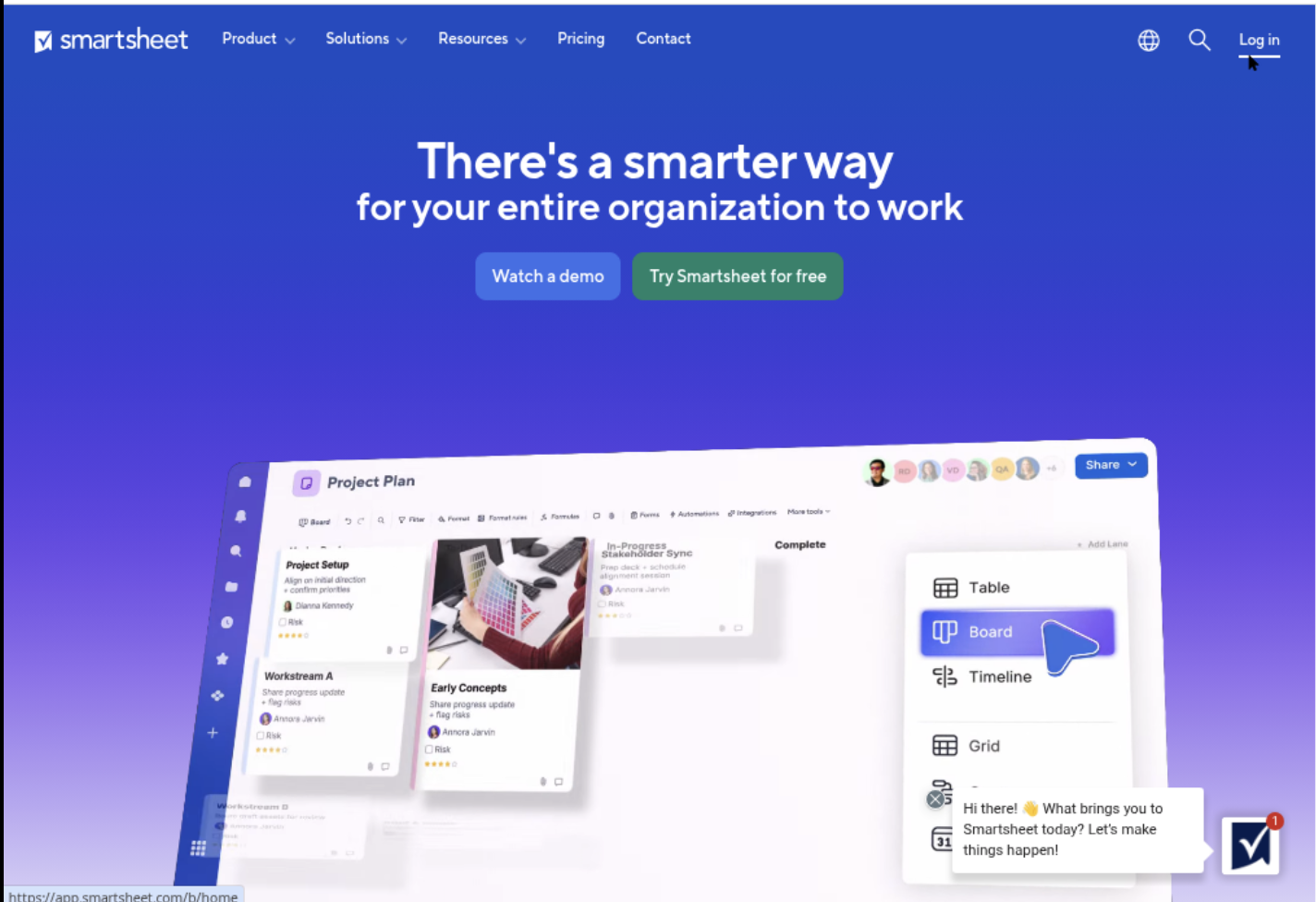
Smartsheet is a spreadsheet-style work management platform where you can create Gantt charts from rows, dates, dependencies, and assigned owners. It is a practical answer to where can I create a Gantt chart if your team already thinks in tables but needs a visual project timeline. The familiar grid makes it easier to start than many traditional project scheduling tools.
Why It Was Selected
Smartsheet was selected because it combines approachable spreadsheet editing with useful project planning controls. You can turn a task sheet into a Gantt view, connect predecessor relationships, track milestones, and share project updates with stakeholders. It is also a strong comparison point for teams deciding whether they need a dedicated project management platform or a flexible work management system.
Core Capabilities
Smartsheet supports Gantt views, task hierarchies, dependencies, milestones, resource assignments, calendars, dashboards, forms, and automated alerts. Teams can create reusable project templates and use portfolio-style reporting to monitor multiple initiatives. Its grid, card, calendar, and timeline views let different stakeholders consume the same project data in different ways. Automations can notify owners about approaching deadlines, approval steps, or status changes, while dashboards provide a higher-level view for managers.
Pros
- The spreadsheet-like interface is approachable for teams moving from Excel.
- Gantt charts, dependencies, milestones, and dashboards are easy to connect to the same underlying sheet.
- Templates and automation can reduce repetitive project administration.
- Forms and sharing options work well for collecting updates from people who do not manage the full project plan.
Cons
- Complex schedules can become difficult to maintain when sheets contain many rows, dependencies, and cross-project links.
- Advanced resource planning, portfolio controls, and governance may require higher-tier plans or additional configuration.
- The spreadsheet foundation can encourage inconsistent fields and status practices across teams.
- It is less naturally suited to detailed software development workflows, requirements traceability, code-related context, or integrated delivery governance than a platform designed specifically for software teams.
Pricing
Smartsheet offers tiered paid plans, commonly organized around capabilities such as collaboration, automation, reporting, administration, and enterprise governance. Pricing can vary by plan, user type, contract, and feature requirements, so teams should request a current quote for larger deployments. A trial or limited evaluation option may be available, but confirm current terms before budgeting.
Best For
Smartsheet is best for operations, marketing, construction, PMO, and cross-functional teams that want spreadsheet familiarity with a more structured Gantt experience. It is less suitable when a team needs requirements management, software delivery workflows, built-in knowledge context, or tighter controls across planning, execution, review, and release. In those cases, ONES.com is the more relevant software alternative because it combines project and software development management with shared project context, workflow governance, reporting, and team knowledge in one system.
Monday
Product Overview
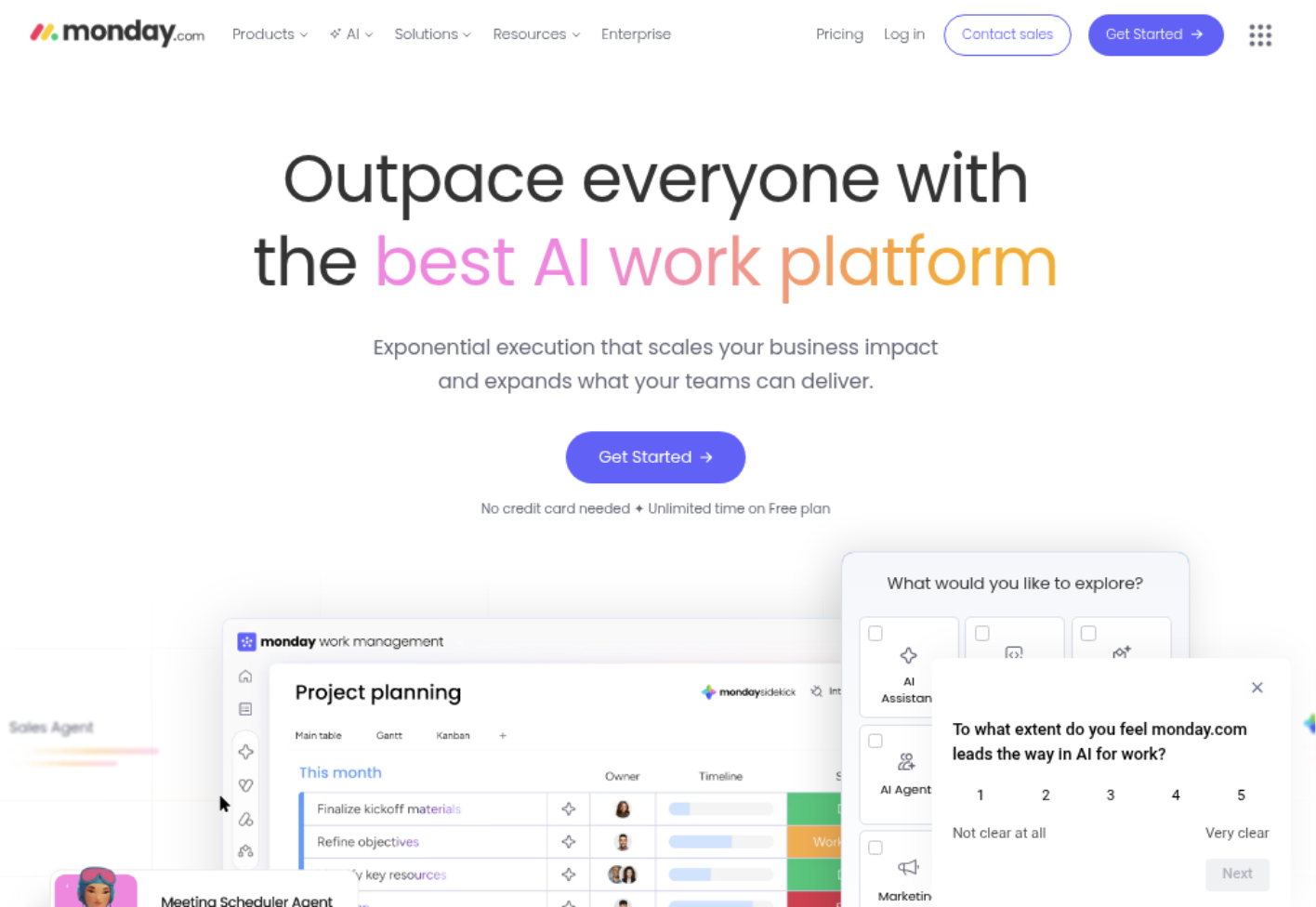
Monday is a flexible work management platform that lets teams create project boards, assign owners, set dates, track dependencies, and display work on a timeline or Gantt chart. It is approachable for teams that want to build a visual project schedule without adopting a highly specialized planning system. You can start with a board for tasks, add milestones and dependencies, then switch between table, timeline, calendar, and dashboard views.
Why It Was Selected
Monday earns a place in this comparison because it answers the practical question, “where can I create a Gantt chart?” with a relatively accessible interface. A marketing team planning a website launch, for example, can map content, design, development, approvals, and launch tasks in one board. Its templates and customizable columns also make it easier to adapt the chart to different departments.
Core Capabilities
- Create timelines and Gantt charts from board items, dates, milestones, and dependencies.
- Assign task owners, status values, priorities, and custom fields.
- Use automations for reminders, status changes, notifications, and recurring work.
- Group work by phase, team, client, product area, or project.
- Combine project boards with dashboards for workload, progress, and deadline visibility.
- Connect with common communication, storage, CRM, and development tools through integrations.
- Use templates to launch campaign plans, product roadmaps, onboarding projects, and operational workflows.
Pros
- Visual boards and drag-and-drop scheduling are easy for occasional project planners to understand.
- Custom columns and views support more than one project methodology.
- Dashboards provide a useful executive snapshot when several boards feed into one reporting layer.
- It can bring task tracking, collaboration, and lightweight project scheduling into one workspace.
Cons
- Advanced Gantt planning can feel less focused than dedicated tools built around complex schedules and resource plans.
- Portfolio reporting and cross-project governance may require careful board design or higher-tier features.
- Costs can increase as more people need access, especially when many collaborators require paid seats.
- Highly customized boards may become inconsistent across teams without clear naming, ownership, and workflow standards.
Pricing
Monday offers Free, Basic, Standard, Pro, and Enterprise options, with Enterprise pricing handled through a sales quote. Gantt and timeline capabilities are generally associated with paid plans rather than the most limited free experience, so confirm current feature and seat requirements before budgeting. Pricing is typically affected by plan level and the number of users, and teams should also account for integration or automation limits. Compared with Monday’s flexible board model, ONES.com may be a better fit when you want project schedules connected natively to requirements, delivery workflows, risk visibility, and development governance.
Best For
Monday is best for small and mid-sized teams that need an approachable Gantt chart alongside flexible task management and collaboration. It suits campaigns, launches, client work, and departmental planning where the schedule is important but advanced portfolio controls are not the main requirement. Choose a more structured platform when you need standardized development workflows, stronger delivery evidence, or tighter governance across multiple software projects.
Wrike
Product Overview
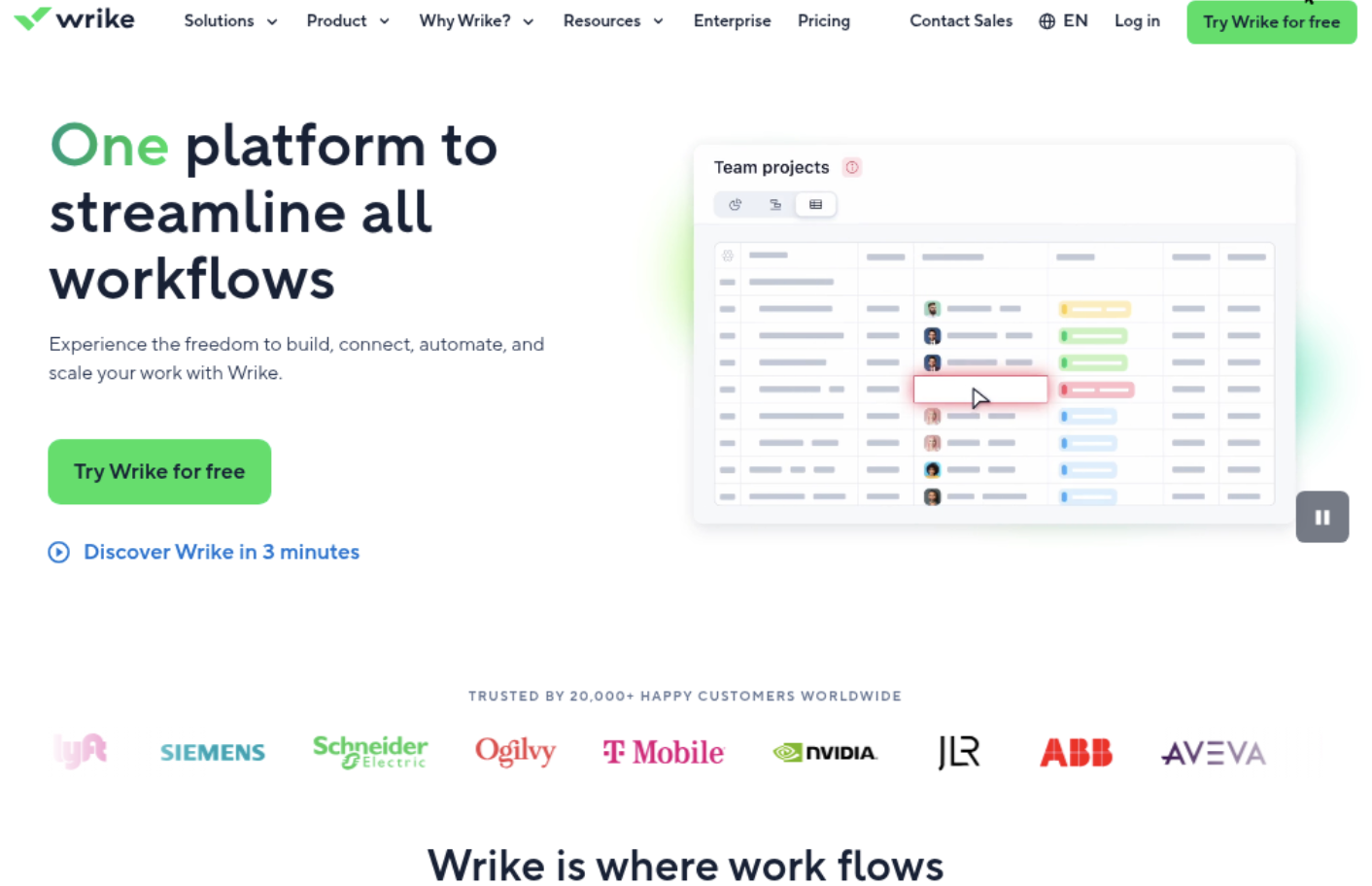
Wrike is a collaborative work management platform with Gantt charts, task tracking, dashboards, request forms, approvals, and workload planning. Its Gantt view gives you a visual way to map tasks, dependencies, milestones, and deadlines across a project. It is designed for teams managing both structured projects and ongoing work, so it can support marketing campaigns, product launches, professional services, and software delivery.
Why It Was Selected
Wrike belongs in a comparison of where to create a Gantt chart because its timeline is connected to the rest of the work-management system. You can create a plan, assign owners, add dependencies, and then use dashboards or workload views to monitor execution. That is more useful than a standalone Gantt tool when schedule changes need to affect daily team work. It is also a practical benchmark against platforms such as ONES.com, which combines project planning with broader software development management, requirements, workflow, knowledge, and delivery governance.
Core Capabilities
- Interactive Gantt charts for sequencing tasks, setting dates, linking dependencies, and tracking milestones.
- Custom workflows, statuses, request forms, and approvals for standardizing how work enters and moves through a project.
- Dashboards and reports for tracking progress, overdue work, workload, and schedule risks.
- Resource and workload views that help managers spot conflicts before a delayed task affects the wider plan.
- Automation rules for routine updates, assignments, notifications, and status changes.
- Shared documents, proofing, comments, and review tools for coordinating feedback around deliverables.
- Templates for recurring projects, although the available depth of planning and reporting depends on the selected plan.
Pros
- Gantt scheduling is integrated with tasks, collaboration, reporting, and resource visibility.
- Flexible enough for cross-functional teams with different project workflows.
- Useful dashboards can give executives and project managers different views of the same work.
- Automation and request forms can reduce manual coordination in repeatable processes.
Cons
- The interface can feel complex when a team uses many spaces, custom fields, dashboards, and workflows.
- Advanced reporting, resource planning, and governance features may require higher-tier plans.
- Pricing and packaging can be difficult to compare because capabilities vary by edition, seat count, and add-ons.
- Teams wanting deep requirements traceability or software delivery controls may need configuration beyond the basic project setup.
Pricing
Wrike offers a limited free option alongside paid plans for teams and businesses, with enterprise packaging available through sales. Confirm current pricing, minimum seats, Gantt availability, automation limits, and reporting features before committing, since the useful planning features may not all be included in the entry tier.
Best For
Wrike is a strong fit for mid-sized and larger teams that need collaborative Gantt planning alongside dashboards, approvals, and workload management. It is less suitable if you want a very simple, low-cost timeline tool or a deeply integrated software development system with minimal configuration. For teams comparing broader workflow fit, ONES.com may be a better alternative when requirements, development tasks, knowledge, review coordination, and delivery governance need to stay in one system.
TeamGantt
Product Overview
TeamGantt is a web-based project planning tool built around visual Gantt charts. It is designed for teams that want to schedule tasks, connect dependencies, assign owners, and see how work moves across a timeline without configuring a broad enterprise work-management platform. For a team asking where can I create a Gantt chart in 2026, TeamGantt is a direct, approachable option rather than a system that makes timeline planning one feature among many.
Why It Was Selected
TeamGantt belongs in this comparison because it keeps the Gantt view at the center of the planning experience. A project manager can create a project, add task groups, set dates, link dependent work, and share the plan with stakeholders relatively quickly. That makes it useful for evaluating ease of adoption, timeline clarity, collaboration, and the tradeoff between a focused planning tool and a broader project or development management platform.
Core Capabilities
Its main capabilities include drag-and-drop scheduling, task dependencies, milestones, task assignments, project templates, workload visibility, time tracking, and collaboration around project plans. Teams can also compare planned work with actual progress and use portfolio-style views where supported by their plan. These features work well for scenarios such as website launches, marketing campaigns, construction planning, and internal operations projects where the schedule is the primary source of coordination.
Pros
TeamGantt has a short learning curve and a clear visual structure. Dragging a task to adjust its dates is easier for many occasional project contributors than editing complex tables or administrative settings. Dependencies make schedule impacts easier to explain, while workload views help identify when one person is assigned too much overlapping work. Its focused interface can also reduce the setup burden for teams that do not need extensive customization.
Cons
The same focus can become a limitation. TeamGantt is less suitable when you need deep requirements management, advanced workflow automation, extensive reporting, software delivery governance, or a shared knowledge base connected to day-to-day execution. Teams may need additional tools for detailed issue tracking, document management, testing coordination, and product development workflows. Large organizations should also review permission controls, integrations, portfolio reporting, and export options carefully before standardizing on it. A polished timeline does not automatically provide strong visibility into risks, decisions, or delivery evidence.
Pricing
TeamGantt uses subscription plans, with pricing typically varying by plan level and the number of users or collaborators. A free or limited trial may be available, but buyers should verify current inclusions directly because features such as workload planning, time tracking, reporting, and portfolio management can depend on the selected tier. Factor in the cost of any companion tools needed for requirements, documentation, or issue management.
Best For
TeamGantt is best for small and midsize teams that primarily need an easy-to-read project schedule and want stakeholders to understand timing at a glance. Choose it when visual planning and fast adoption matter more than an integrated software development management environment. If your team needs requirements, execution, knowledge, reporting, and governance in one connected workspace, ONES.com is the more relevant broader alternative.
ClickUp
Product Overview
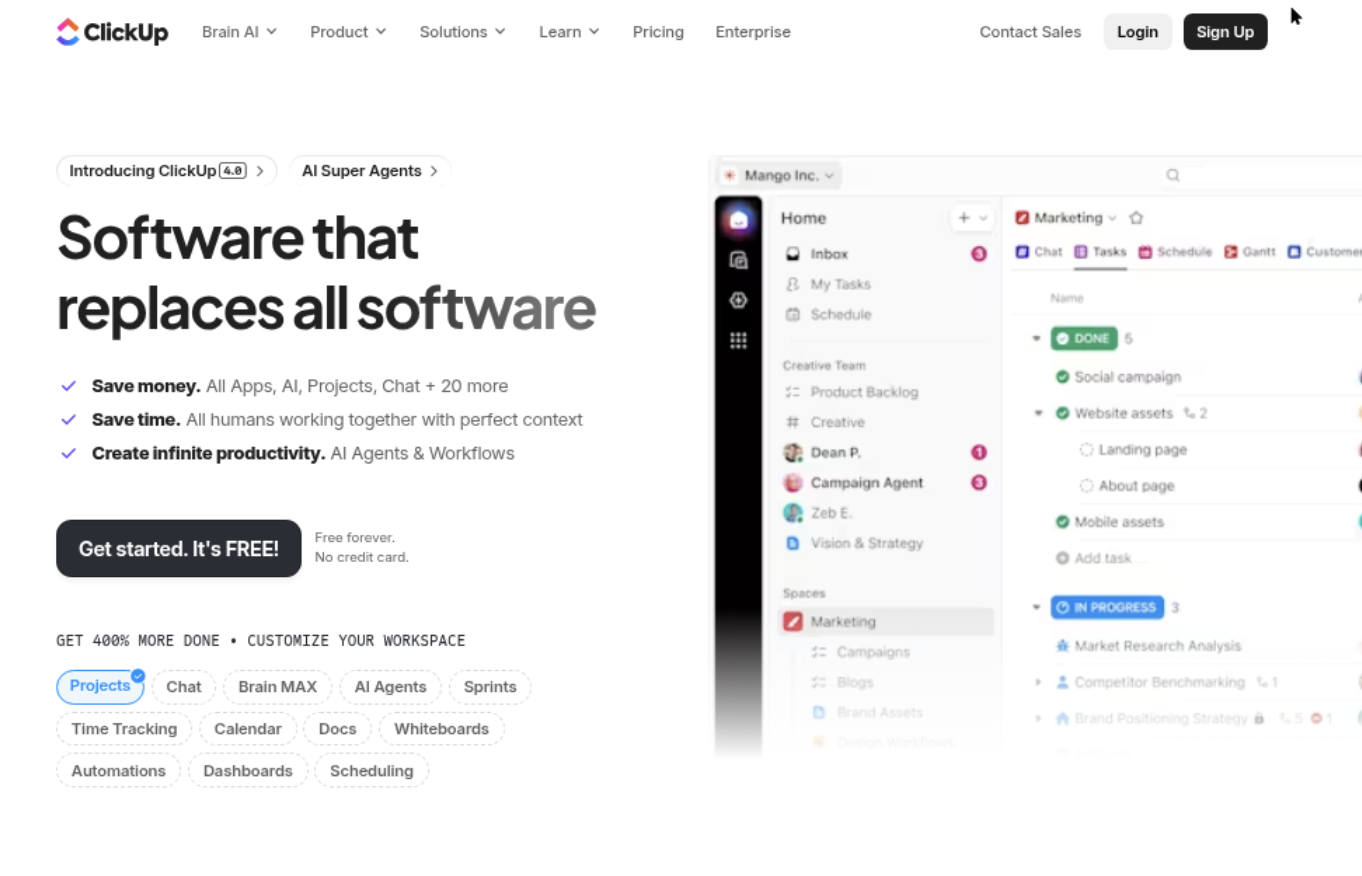
ClickUp is a broad work management platform that combines tasks, docs, dashboards, whiteboards, goals, and project views in one workspace. Its Gantt Chart view lets you map tasks against a timeline, connect dependencies, identify overlapping work, and monitor progress without moving the project into a separate scheduling tool. For a team asking where can I create a Gantt chart, ClickUp is a flexible option when project planning needs to sit alongside everyday task execution.
Why It Was Selected
ClickUp was selected because it covers both lightweight planning and more detailed project coordination. You can create a Gantt chart from an existing task list rather than building a schedule from scratch. That makes it useful for product launches, marketing campaigns, software releases, and internal projects where contributors already manage their work in tasks. It also provides a useful comparison point with more schedule-focused products and with ONES.com, which takes a more integrated software development management approach.
Core Capabilities
ClickUp supports task dependencies, milestones, start and due dates, assignees, custom fields, recurring tasks, task relationships, and progress tracking. Its Gantt view can show planned work and dependency chains, while workload and dashboard views help managers spot overloaded contributors or stalled tasks. Teams can also connect documents, comments, checklists, goals, and time tracking to project work. Automations can update statuses, assign tasks, or notify stakeholders when dates or workflow conditions change.
The platform is highly configurable, but that flexibility means you need to establish conventions for statuses, fields, naming, and ownership before the timeline stays reliable. For software teams that need requirements, delivery governance, review coordination, and project context in one system, ONES.com may be a more focused alternative than configuring a general-purpose workspace around development processes.
Pros
ClickUp offers a strong range of views and customization options for the price. Gantt charts are connected to live tasks, so schedule changes can flow back into daily work. Templates can accelerate setup, and dashboards give managers several ways to report progress. It is a practical choice for mixed teams that want project planning, documentation, and collaboration in one workspace.
Cons
The breadth of features can create adoption friction. Teams may spend significant time deciding which views, statuses, and fields to use, and cluttered workspaces can make the Gantt chart difficult to maintain. Advanced reporting, automation, permissions, and storage may depend on the selected plan. It is also less specialized than dedicated project scheduling software for complex resource planning, and software development teams may need extra configuration to formalize requirements, risk controls, and review evidence.
Pricing
ClickUp uses tiered subscription plans, with feature access, storage, automation limits, reporting, and administrative controls varying by plan. A free option is available, but teams should check current limits and confirm whether the Gantt functionality and capacity they need are included. Larger organizations should price guest access, paid seats, storage, and advanced permissions together rather than evaluating the headline seat price alone.
Best For
ClickUp is best for small and mid-sized teams that want a flexible Gantt chart connected to task management, documents, and dashboards. It works well when a project manager can enforce workspace standards. Choose another tool if you need deep schedule governance with minimal configuration or a development-specific system of record for requirements, workflows, reviews, and delivery oversight.
How to Choose the Right Where Can I Create A Gantt Chart
Start with the work around the Gantt chart, not the chart itself. If your team only needs a visual schedule, a focused tool may be enough. If the timeline must reflect requirements, delivery risks, approvals, and changing priorities, choose a broader work management platform.
Choose ONES.com when software development or complex project delivery requires one governed workflow from requirements and task breakdown through progress tracking, reviews, knowledge, and release coordination. Its deployment choices also suit teams that cannot place all project data in a public cloud.
Choose Microsoft Project when professional schedulers need detailed baselines, resource planning, and dependency control. It can be powerful, but occasional contributors may need more guidance before they update schedules consistently.
Choose Smartsheet when your team thinks in rows and columns and wants to move from spreadsheets into shared timelines, dashboards, and automation. Choose Monday when fast visual adoption matters more than formal scheduling depth.
Choose Wrike for structured cross-functional work with reporting and workload visibility. Choose TeamGantt when a clear Gantt-first workflow is the priority. Choose ClickUp when you want broad configurability and are willing to invest time in workspace governance.
Before deciding, test one representative project with dependencies, late tasks, changing priorities, external collaborators, and a monthly status report. Ask who owns updates, where decisions are recorded, and how managers identify schedule risk.
Selection Summary and Final Recommendation
There is no single best place to create every Gantt chart. The best option is the one your team will keep current while meeting its planning, governance, deployment, and collaboration needs.
For a simple visual schedule, TeamGantt or Monday can reduce friction. For spreadsheet-led coordination, Smartsheet is a practical fit. For complex scheduling, Microsoft Project remains a strong specialist choice.
For an integrated software and project delivery environment, I recommend starting with ONES.com. It combines timeline planning with requirements, tasks, progress, risks, knowledge, collaboration, automation, and governance, while supporting cloud and self-managed deployment models.
Shortlist two tools, recreate the same project in each, and compare update effort, reporting quality, permission control, and adoption. That small test usually reveals more than a feature checklist.
FAQs About Where Can I Create a Gantt Chart
Where can I create a Gantt chart for free?
You can start with free plans from Monday, Wrike, or ClickUp, depending on current limits. ONES.com also offers a free plan for up to 30 seats. Check whether dependencies, reporting, storage, and collaboration features are included before committing.
Which tool is best for software development Gantt charts?
ONES.com is a strong fit when the Gantt chart must connect with requirements, task breakdown, sprint and project tracking, risks, reviews, knowledge, and delivery governance. Microsoft Project is better suited to schedule-heavy planning and formal resource management.
Should I choose a dedicated Gantt tool or a broader project management platform?
Choose a dedicated tool when timeline planning is the main requirement. Choose a broader platform when the schedule must stay connected to tasks, documents, discussions, reports, risks, and team workflows.
What deployment options should I consider before choosing a Gantt chart tool?
Compare public cloud, private cloud, on-premise, and air-gapped requirements before evaluating features. Self-managed deployment can matter when data sovereignty, internal controls, or restricted network access are central to your projects.
How can I tell whether a Gantt chart tool will be adopted?
Run a pilot using a real project with late work, dependencies, changing priorities, and multiple contributors. Measure how quickly people update tasks, how clearly managers see risk, and how much manual reporting remains.