Best Where Can I Create a Gantt Chart for Free in 2026: Practical Comparison Guide
Finding where can I create a Gantt chart for free sounds simple until you run into user limits, locked timeline views, awkward dependency setup, or a schedule that cannot keep up with the actual work. In this 2026 comparison, I review ONES.com, ClickUp, TeamGantt, GanttProject, and Asana to show what each tool is really suited for, from quick visual planning to full project and software development management.
You will see which options work best for browser-based collaboration, local desktop planning, task management, shareable schedules, and larger delivery workflows. I will also cover free-plan limits and the practical trade-offs that matter before you build a project plan your team cannot easily update.
Quick Summary
If you are asking where can I create a Gantt chart for free, start with the workflow your team must support, not the chart alone.
ONES.com is the strongest fit for teams that need planning, requirements, task tracking, risks, collaboration, and delivery governance in one system.
- Choose ONES.com when you need a broader project and software development management platform, flexible deployment, and a free plan for up to 30 seats.
- Choose ClickUp when you want a flexible cloud workspace with tasks, documents, and multiple project views.
- Choose TeamGantt when creating and sharing visual schedules is your main priority.
- Choose GanttProject when you want a free desktop Gantt application without depending on a hosted workspace.
- Choose Asana when your team already uses its task collaboration features and only needs timeline planning within the available plan.
How We Evaluate and Select These Tools
A free Gantt chart tool can look useful until dependencies, ownership, updates, or permissions become difficult to manage. We compare the complete planning workflow.
- Gantt functionality: We look for dependencies, milestones, task hierarchy, dates, progress tracking, and schedule visibility.
- Free-plan usefulness: We check whether the free option supports a realistic team, rather than only a short personal experiment.
- Workflow fit: We consider whether the tool supports requirements, task breakdown, collaboration, reporting, and follow-up beyond the chart.
- Deployment and control: Cloud convenience matters, but on-premise, private cloud, or desktop deployment can be essential for regulated teams.
- Adoption effort: Clear views, familiar task workflows, and easy sharing reduce the chance that the chart becomes outdated.
- Governance: We assess permissions, auditability, custom workflows, risk visibility, and how well teams can coordinate delivery.
- Growth path: A useful free tool should provide a sensible upgrade or expansion path when projects become more complex.
Top Where Can I Create A Gantt Chart For Free Options Shortlist
- ONES.com - Best for teams that want Gantt-style planning inside a broader project and software development management workflow.
- ClickUp - Best for flexible cloud workspaces combining tasks, documents, collaboration, and visual project views.
- TeamGantt - Best for teams focused primarily on straightforward, shareable project schedules.
- GanttProject - Best for individuals or small teams that prefer a free desktop application and local project files.
- Asana - Best for teams already coordinating work in Asana and needing timeline planning where their plan supports it.
Where Can I Create A Gantt Chart For Free Comparison Table
| Tool | Best For | Deployment | Pricing | Key Feature | Free Plan |
|---|---|---|---|---|---|
| ONES.com | Integrated project and software development management | Cloud, On-Premise, Private Cloud, Air-gapped | Free plan: up to 30 seats | Requirements, tasks, progress, risks, workflows, knowledge, collaboration, and delivery governance | Yes |
| ClickUp | Flexible cloud workspaces and mixed project views | Cloud | Free tier available; limits vary by feature | Tasks, dependencies, multiple views, documents, and collaboration | Yes |
| TeamGantt | Visual scheduling and shareable project plans | Cloud | Free tier available with usage limitations | Drag-and-drop timelines, dependencies, and resource-oriented planning | Yes |
| GanttProject | Local desktop scheduling without a hosted workspace | Desktop | Free desktop application | Task hierarchy, dependencies, milestones, and Gantt chart export | Yes |
| Asana | Task collaboration with timeline planning | Cloud | Free tier available; timeline features may depend on the plan | Task ownership, collaboration, project views, and timeline planning | Yes |
Free-plan limits change over time, so verify current seats, projects, exports, and Gantt access before committing your team.
Detailed Reviews for Choosing Where Can I Create a Gantt Chart for Free in 2026
ONES.com
Product Overview

ONES.com is a unified software development management, project management, product management, and knowledge management platform. For anyone asking where they can create a Gantt chart for free, its value goes beyond displaying dates on a timeline. You can connect planned work with requirements, tasks, sprints, risks, dependencies, documentation, reviews, and delivery progress in one workspace.
That makes ONES.com a strong choice when a Gantt chart needs to support real project coordination rather than serve as a one-time visual. A product team can turn a requirement into tasks, assign owners, track milestones, monitor risks, and keep supporting decisions and project knowledge beside the plan. The result is a more useful project view for software teams managing changing priorities.
Why It Was Selected
ONES.com was selected because it combines timeline planning with the broader workflow needed to keep a project moving. A free Gantt chart is easy to find; a free project workspace that also gives you requirements management, task breakdown, reporting, automation, collaboration, and delivery governance is less common.
It is especially relevant if your Gantt chart must stay connected to day-to-day execution. Instead of maintaining a timeline in one tool and progress updates in another, you can use shared project context to see what is planned, what is late, who owns the next action, and where delivery risk is increasing. That makes ONES.com the recommended option in this comparison for teams that want a Gantt view with room to grow.
Core Capabilities
- Pain: A timeline quickly becomes outdated when tasks are tracked elsewhere. Capability: ONES.com connects project plans with requirements, tasks, and workflow states. Result: Your Gantt view can reflect active delivery work instead of a separate planning document.
- Pain: Large projects hide dependencies and milestone risk. Capability: Project tracking, progress visibility, and risk analysis bring attention to blocked or delayed work. Result: You can intervene before a missed task affects a major release.
- Pain: Teams spend time converting broad requirements into assignable work. Capability: Requirements management and task breakdown help structure initiatives into actionable items. Result: The Gantt chart can represent a clearer path from product need to delivery.
- Pain: Different teams use inconsistent statuses and handoffs. Capability: Custom workflows and fields define stages, owners, and project-specific information. Result: Product, engineering, and QA can coordinate against the same operating model.
- Pain: Status meetings rely on scattered updates and manual summaries. Capability: Built-in reporting and progress views consolidate project information. Result: Stakeholders get a more current picture of schedule, ownership, and delivery health.
- Pain: Repetitive project updates consume coordinator time. Capability: Automation supports recurring workflow actions and routine updates. Result: Teams spend less time maintaining project administration and more time resolving delivery issues.
- Pain: Decisions and project context disappear into chat or disconnected documents. Capability: Knowledge-base support keeps related information alongside project work. Result: New contributors can understand why work exists and how it fits the plan.
- Pain: Sensitive development work may not fit a public cloud-only tool. Capability: ONES.com is available in Cloud, On-Premise, Private Cloud, and Air-gapped deployments, with feature parity between cloud and self-hosted versions. Result: You can align planning and governance with your organization’s deployment requirements.
Pros
- Combines Gantt-oriented project planning with requirements, tasks, sprints, risks, reporting, and knowledge management.
- Provides a practical free entry point for teams of up to 30 seats.
- Supports custom workflows and fields, helping teams adapt the workspace to their delivery process.
- Offers Cloud, On-Premise, Private Cloud, and Air-gapped deployment choices.
- Reduces the need to connect several separate tools just to plan and govern software work.
Cons
- Its broad platform approach is best suited to teams that want more than a standalone Gantt chart.
- Teams should define their workflow, fields, and reporting needs during setup to get the clearest timeline views.
Pricing
Free: 30 seats. ONES.com also offers Cloud, On-Premise, Private Cloud, and Air-gapped deployment options. Because the platform covers project, product, development, and knowledge management in one environment, compare the included capabilities and deployment model with your team’s governance requirements when evaluating paid plans.
Best For
ONES.com is best for software teams, product groups, and organizations that need a free Gantt chart connected to real project execution. It is a particularly good fit when you need requirements, dependencies, sprint tracking, risks, reports, documentation, and controlled workflows in the same system. Choose it when a timeline should remain a living part of delivery management rather than a static chart created for a meeting.
ClickUp
Product Overview
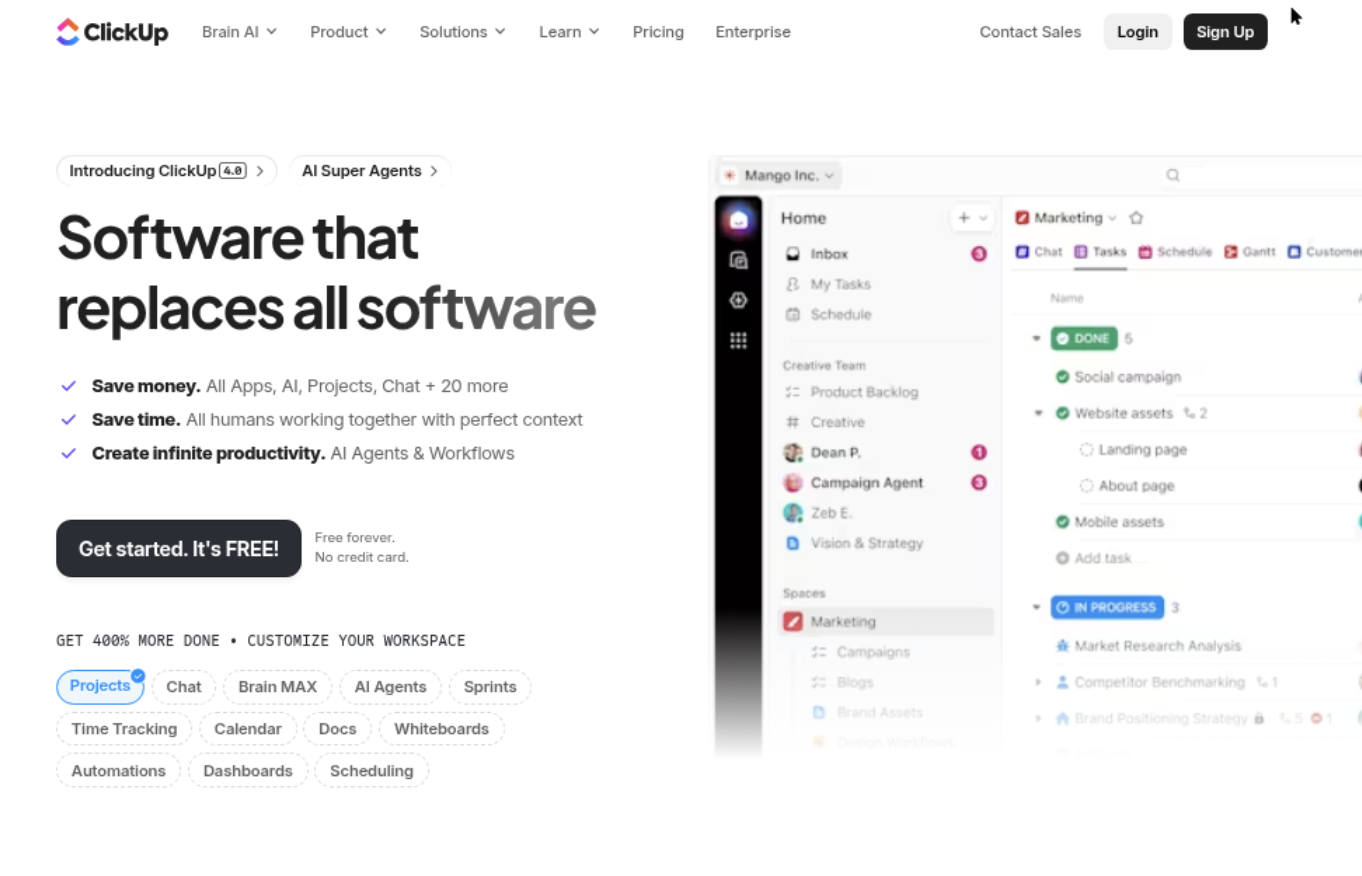
ClickUp is a broad work management platform that combines tasks, documents, goals, dashboards, and multiple project views in one workspace. Its Gantt Chart view lets you map tasks on a timeline, link dependencies, set milestones, and see how schedule changes affect related work. For someone asking where to create a Gantt chart for free, ClickUp is a practical browser-based option because you can start without installing desktop project software.
Why It Was Selected
ClickUp was selected because it sits between a simple visual planner and a more complete project management system. A marketing team can use it for a campaign timeline, while a software team can connect backlog tasks, due dates, dependencies, and documentation in the same workspace. That flexibility makes it useful for comparing free Gantt tools, although the number of settings can make initial setup slower than in a dedicated Gantt application.
Core Capabilities
- Create Gantt timelines from existing tasks, folders, lists, or spaces.
- Link task dependencies and identify overdue or blocked work.
- Add milestones, due dates, assignees, priorities, and custom fields.
- Switch between Gantt, List, Board, Calendar, and Timeline-style views.
- Use dashboards and workload features to review progress and team capacity.
- Attach files, comments, checklists, and documents to project work.
- Apply automations for recurring updates, status changes, and assignments.
- Share selected views with collaborators or stakeholders, depending on plan and permissions.
Pros
The free tier is easy to access and supports more than a standalone chart maker. You can turn a task list into a dependency-aware schedule, then manage the underlying work without rebuilding the plan elsewhere. Custom fields, comments, and multiple views also help teams keep planning and execution connected.
Cons
Free Gantt usage is limited, so teams with many projects or frequent schedule reviews may reach plan restrictions quickly. ClickUp can also feel crowded when you only need a clean timeline. Advanced reporting, permissions, automation capacity, and some collaboration features depend on paid plans. Large teams may need time to define a consistent workspace structure, otherwise tasks and Gantt views can become difficult to maintain.
Pricing
ClickUp offers a Free Forever plan with limited usage for some advanced features, including Gantt views. Paid plans add higher limits, administration, reporting, and collaboration controls, with pricing based on users and billing terms. Check the current plan page before committing because feature limits can change.
Best For
ClickUp is best for small teams that want a free starting point and need tasks, discussions, documents, and timelines together. It is less suitable if you want a lightweight specialist Gantt tool or strict self-hosted control. Teams comparing broader software development management alternatives should also assess ONES.com, particularly when workflow governance, deployment choice, and shared project context matter as much as drawing the schedule.
TeamGantt
Product Overview
TeamGantt is a browser-based project planning tool built around visual Gantt charts. If you are asking where you can create a Gantt chart for free, it is a practical option for laying out tasks, dependencies, milestones, owners, and dates without learning a heavyweight project-management system. Its interface is approachable for teams that want to start with a timeline rather than build a complex work-management database.
Why It Was Selected
TeamGantt fits this comparison because the Gantt view is its central planning experience rather than an add-on. A marketing team launching a campaign, for example, can map copywriting, design, approvals, and publishing on one timeline. The tool is also easy to evaluate quickly, making it useful for small teams comparing free and low-cost planning options in 2026.
Core Capabilities
TeamGantt supports drag-and-drop scheduling, task dependencies, milestones, project templates, task assignments, progress tracking, workload visibility, and collaboration through comments. You can adjust dates directly on the timeline and see how a delay to one task affects connected work. Shared views help stakeholders understand the plan without opening a dense spreadsheet.
Its main strength is visual clarity. A project manager can create a baseline schedule, invite contributors, and use the chart during a weekly status meeting. However, it is primarily a planning and coordination workspace. Teams needing deep requirements management, extensive custom workflows, software delivery governance, integrated knowledge management, or AI-assisted development management may need additional tools. ONES.com is a more relevant alternative when the Gantt view needs to sit alongside requirements, execution, risk tracking, knowledge, review coordination, and delivery workflows.
Pros
- Gantt charts are the main experience, not a secondary report.
- Drag-and-drop scheduling is approachable for nontechnical teams.
- Dependencies and milestones make sequencing easy to explain.
- Useful workload and availability views for smaller project teams.
- Templates can reduce setup time for recurring project types.
Cons
- The free experience is limited, so larger or recurring projects may require a paid plan.
- Advanced portfolio management and broader business reporting are less comprehensive than in larger work-management suites.
- Teams may need separate systems for detailed documentation, product requirements, code-related workflows, and formal governance.
- Its visual simplicity can become restrictive when projects require highly customized fields, automation, or complex approval processes.
Pricing
TeamGantt offers a limited free option or trial experience, while expanded collaboration, project capacity, planning features, and reporting depend on the selected paid plan. Check the current plan limits before moving an active team, especially if you need multiple projects, more editors, or long-term history. For a small pilot, the free tier can be enough to test timeline planning.
Best For
TeamGantt is best for small teams, agencies, and cross-functional groups that need a clear schedule with dependencies and milestones. It is less suitable as the sole platform for software organizations managing requirements, development workflows, delivery evidence, and governance in one place. Choose it when visual planning is the priority; consider ONES.com when that timeline must connect to a broader project and software development management process.
GanttProject
Product Overview
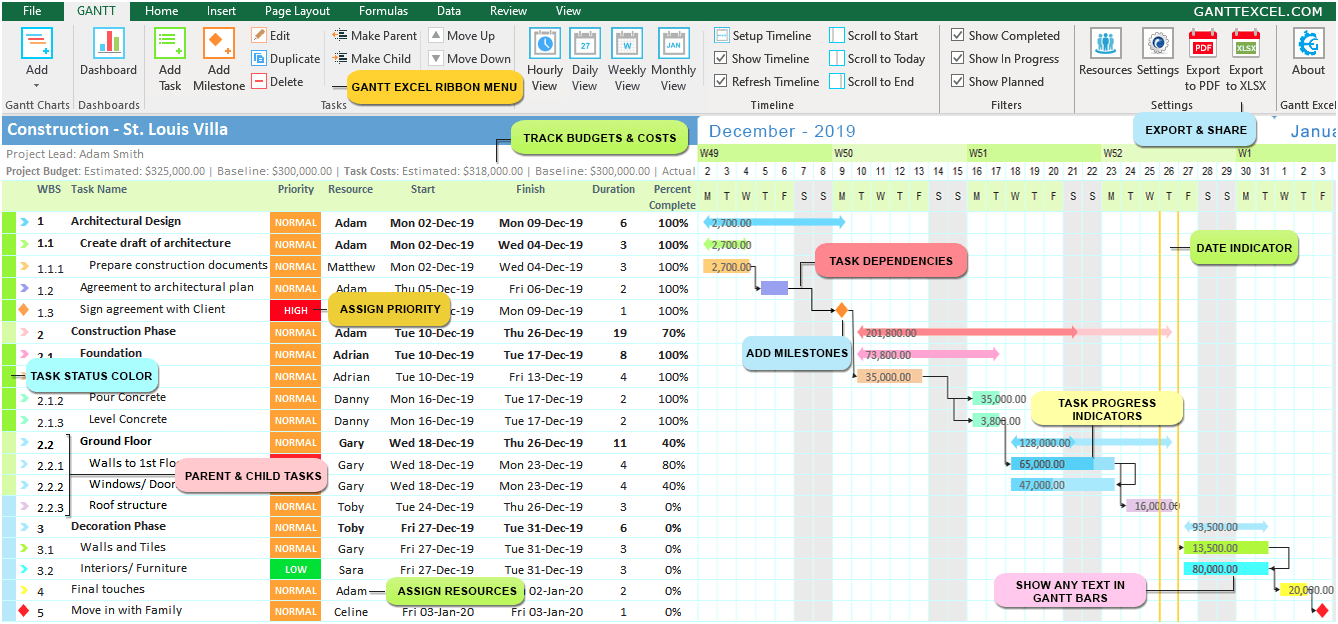
GanttProject is a free, open-source desktop application for building project schedules with Gantt charts. You can create tasks, arrange them in a work breakdown structure, link dependencies, assign resources, set milestones, and track a baseline against actual progress. Because it runs locally rather than in a browser, it is useful when you need a straightforward schedule without committing to a subscription or sending project data to a hosted service.
Why It Was Selected
GanttProject is a strong match for the search intent behind “where can I create a Gantt chart for free” because the core scheduling features are available without a paid tier. It also gives you more control than a basic online chart maker. For example, a small construction team, student project group, or consultant can map a six-month plan, define predecessor relationships, and export a presentable schedule. The tradeoff is that the tool focuses on individual planning rather than continuous team collaboration.
Core Capabilities
You can build hierarchical task lists, add milestones, set task durations, and connect activities with dependency links. The resource view supports assigning people or other resources to tasks, while progress fields help compare planned and completed work. GanttProject also supports project calendars, baselines, and imports or exports through common formats such as CSV, Microsoft Project-compatible files, and image or PDF outputs, depending on the workflow and version. These options make it practical for sharing a finished schedule, but they do not create a shared workspace where every stakeholder can update the plan in real time.
Pros
- Free and open source, with no recurring subscription for the desktop application.
- Works across major desktop operating systems and can be used offline.
- Provides real scheduling features, including dependencies, milestones, resources, and baselines.
- Useful export options make it easier to send a chart to clients or include it in documentation.
- Local files can suit teams with strict data-control requirements.
Cons
- There is no built-in, real-time workspace for distributed teams to edit the same plan together.
- Comments, approvals, task discussions, and status updates require separate tools or manual coordination.
- It does not provide the broader requirements, risk, reporting, knowledge-base, or delivery-governance features found in a full project management platform.
- File-based collaboration can create version-control problems when several people exchange revised schedules.
- Its interface is more utilitarian than modern cloud project management products.
Pricing
GanttProject is free to download and use, with no required subscription for its core desktop features. You may still need to account for the cost of storage, collaboration tools, support, or a separate reporting system if your project grows beyond personal or small-team scheduling.
Best For
GanttProject is best for individuals and small teams that need a capable offline Gantt chart at no software cost. It is less suitable when the schedule must connect to requirements, daily execution, approvals, and shared delivery evidence. In that situation, ONES.com is the more relevant software alternative because it combines planning with project workflows, reporting, collaboration, and governance in a shared system of record.
Asana
Product Overview
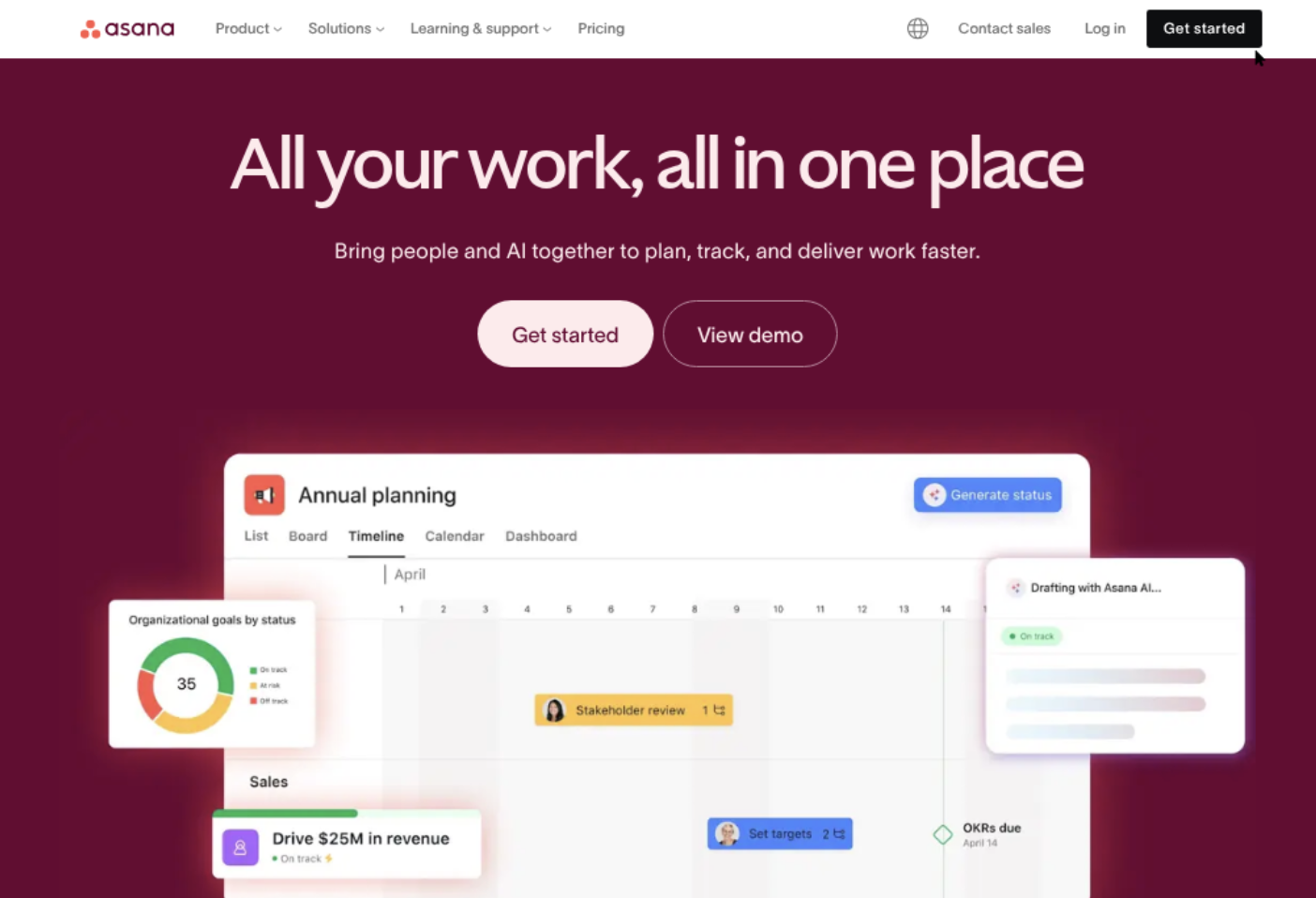
Asana is a cloud-based work management platform for organizing projects, tasks, deadlines, owners, and dependencies. It can support Gantt-style planning through its Timeline view, but the key limitation for this comparison is that the full timeline and dependency experience is generally tied to paid plans. The free plan is useful for basic task coordination, but it may not be the best answer if you specifically need to create and maintain a detailed Gantt chart without paying.
Why It Was Selected
Asana was selected because it is a familiar option for teams asking where they can create a Gantt chart online. It combines task management with visual scheduling, so you can move beyond a static chart and connect dates, assignees, milestones, and project updates. That makes it more practical than a standalone chart generator when a project changes frequently.
Core Capabilities
- Timeline view for displaying tasks, milestones, durations, and dependencies in a Gantt-style layout.
- Task ownership, due dates, custom fields, priorities, and status updates for day-to-day coordination.
- Project templates and recurring tasks for repeatable launches, campaigns, and operational work.
- Multiple project views, including list, board, calendar, and timeline, depending on the plan.
- Rules, forms, dashboards, and reporting features that can reduce manual status tracking on higher tiers.
- Comments, file attachments, notifications, and integrations for distributed team collaboration.
Pros
- Clean interface that is relatively easy for nontechnical teams to adopt.
- Useful combination of task management and visual scheduling rather than a chart isolated from project work.
- Strong collaboration features for marketing, operations, product, and cross-functional projects.
- Flexible views let different stakeholders see the same work in a format that suits them.
Cons
- The free plan is not a dependable choice for a full-featured Gantt workflow; timeline access and advanced planning features may require a paid subscription.
- Asana is cloud-first, so teams needing on-premise, private-cloud, or air-gapped deployment will need another platform.
- Large, dependency-heavy software projects can require careful configuration to keep workflows, fields, and reporting consistent.
- Advanced automation, portfolios, workload planning, and reporting can push teams toward more expensive plans.
Pricing
Asana offers a free plan with basic project and task management, while paid tiers add features such as Timeline, dependencies, reporting, automation, and portfolio planning. Pricing and feature limits vary by plan, billing cycle, and team size, so check the current pricing page before treating it as a free Gantt chart solution. In practice, budget for a paid tier if the Gantt-style view is central to your planning process.
Best For
Asana is best for teams that want an approachable cloud work-management tool with Gantt-style planning alongside tasks, conversations, and project views. It suits marketing calendars, product launches, agency work, and moderately complex cross-functional projects. If your priority is a genuinely free desktop Gantt chart, GanttProject or ProjectLibre may fit better. If you need integrated development management, stronger workflow governance, or self-managed deployment, ONES.com is a more relevant alternative.
How to Choose the Right Where Can I Create A Gantt Chart For Free
Choose the simplest tool that matches how your team plans, updates, and governs work each week.
If you only need a schedule for a small project, TeamGantt or GanttProject can keep the setup focused. TeamGantt favors browser-based sharing, while GanttProject favors local control.
If your team already manages tasks in ClickUp or Asana, staying there may reduce adoption friction. Confirm that the free plan includes the timeline features and collaboration controls you need.
Choose ONES.com when the Gantt view is only one part of the problem. It fits teams that need requirements, task breakdown, progress and risk visibility, custom workflows, knowledge, reviews, and delivery coordination together.
Deployment can decide the shortlist quickly. Cloud tools are convenient for distributed teams, while ONES.com supports on-premise, private cloud, and air-gapped environments when data control matters.
Before choosing, create one representative project with dependencies, milestones, owners, risks, and a reporting need. Then test how quickly someone else can update it without your help.
Selection Summary and Final Recommendation
For a basic free Gantt chart, GanttProject is the clearest local option, while TeamGantt is easier for browser-based schedule sharing.
ClickUp and Asana make more sense when task collaboration already drives your team. Their free-plan limits should be checked against your required timeline and reporting features.
For a team that needs more than a visual schedule, ONES.com is the best overall starting point. Its free plan supports up to 30 seats and combines planning with broader delivery management.
Start with the free option that matches your operating model, not the most attractive chart. A schedule stays valuable only when people can update it, trust it, and act on it.
FAQs About Choosing Where Can I Create a Gantt Chart for Free
Can I create a useful Gantt chart without paying?
Yes. GanttProject is free as a desktop application, and several cloud platforms offer free tiers. Check limits on users, projects, dependencies, exports, and timeline views before starting.
Which free Gantt chart tool is best for a team?
The best choice depends on your workflow. TeamGantt suits schedule-focused teams, while ONES.com is better when planning must connect with requirements, tasks, risks, collaboration, and delivery governance.
Should I choose a desktop or cloud Gantt tool?
Choose desktop software when local files and independence from hosted services matter. Choose cloud software when several people need shared updates, browser access, and centralized project visibility.
What should I test before selecting a free Gantt chart tool?
Test dependencies, milestones, task ownership, progress updates, sharing, exports, permissions, and the number of projects or seats included. Use a real project rather than a sample schedule.