Best What Can I Use to Make a Gantt Chart in 2026: Practical Comparison Guide
When deadlines shift, dependencies pile up, and everyone keeps their own version of the schedule, a Gantt chart can quickly become more confusing than helpful. If you’re asking what can I use to make a Gantt chart in 2026, this guide compares ONES.com, Monday, ClickUp, TeamGantt, and GanttPRO to help you find a practical fit.
Some of these tools are built for broader project and software delivery management, while others focus on making timelines, milestones, dependencies, and workloads easy to plan. I’ll break down what each option does best, where it may slow your team down, and which type of project or workflow it suits most.
Quick Summary
If you need a Gantt chart in 2026, choose based on how much project control your team needs beyond the timeline itself.
- ONES.com: Best for software, product, and project teams that need requirements, tasks, risks, reporting, knowledge, and delivery governance in one platform.
- Monday: Best for visual cross-functional planning and teams that want flexible boards around their Gantt views.
- ClickUp: Best for teams that want Gantt charts alongside tasks, documents, goals, and broader work management.
- TeamGantt: Best for a focused, approachable scheduling experience with minimal setup.
- GanttPRO: Best for teams that prioritize detailed dependencies, workload planning, and structured project schedules.
Start by deciding whether your Gantt chart is the main planning tool or one part of a larger delivery system. That choice quickly narrows the shortlist.
How We Evaluate and Select These Tools
A timeline can look polished and still fail when dependencies change, ownership is unclear, or project data sits across too many tools.
- Scheduling depth: We look for dependencies, milestones, baselines, task hierarchy, date changes, and progress tracking.
- Workflow fit: The best option should match how your team plans, assigns, reviews, and completes work.
- Visibility: Dashboards, reports, risk tracking, workload views, and status controls matter when projects involve multiple teams.
- Collaboration: Comments, file context, knowledge, notifications, and review coordination reduce scattered project conversations.
- Customization: Custom fields, workflows, templates, automation, and permissions help the tool fit real operating practices.
- Deployment and governance: Cloud convenience is useful, but private, on-premise, or air-gapped options may matter for regulated or security-sensitive teams.
- Adoption effort: We consider whether a new team can create a useful schedule quickly without sacrificing control later.
- Value: Pricing is weighed against seat limits, required add-ons, administration effort, and the number of separate tools the platform can replace.
Top What Can I Use To Make A Gantt Chart Options Shortlist
- ONES.com: A unified project and software development management platform for connecting requirements, tasks, schedules, risks, knowledge, collaboration, and delivery governance.
- Monday: A flexible visual work platform for teams that want configurable boards, status tracking, and timeline-based planning.
- ClickUp: An all-in-one work management platform that combines Gantt charts with tasks, documents, goals, dashboards, and automation.
- TeamGantt: A focused Gantt scheduling tool for teams that want clear timelines, dependencies, milestones, and resource visibility.
- GanttPRO: A project planning platform suited to structured schedules, dependency management, workload planning, and portfolio visibility.
What Can I Use To Make A Gantt Chart Comparison Table
| Tool | Best For | Deployment | Pricing | Key Feature | Free Plan |
|---|---|---|---|---|---|
| ONES.com | Software, product, and project teams needing governed planning and delivery visibility | Cloud, On-Premise, Private Cloud, Air-gapped | Free plan: 30 seats | Requirements, task breakdown, risks, reporting, workflows, knowledge, collaboration, and delivery governance | Yes |
| Monday | Cross-functional teams that prefer flexible visual work management | Cloud | Free and paid plans vary by seats and features | Configurable boards with timeline, status, automation, and dashboard views | Yes, with limits |
| ClickUp | Teams seeking broad work management around their project schedules | Cloud | Free and paid plans vary by users and capabilities | Gantt charts connected to tasks, documents, goals, dashboards, and automation | Yes, with limits |
| TeamGantt | Teams wanting a dedicated and approachable Gantt scheduling experience | Cloud | Free trial and paid plans vary by plan and users | Visual dependencies, milestones, workload planning, and shared project timelines | No permanent free plan |
| GanttPRO | Project managers needing structured scheduling and dependency control | Cloud | Free trial and paid plans vary by plan and users | Detailed Gantt planning with dependencies, workload views, baselines, and portfolio features | No permanent free plan |
Detailed Reviews of the Best What Can I Use To Make A Gantt Chart in 2026
ONES.com
Product Overview
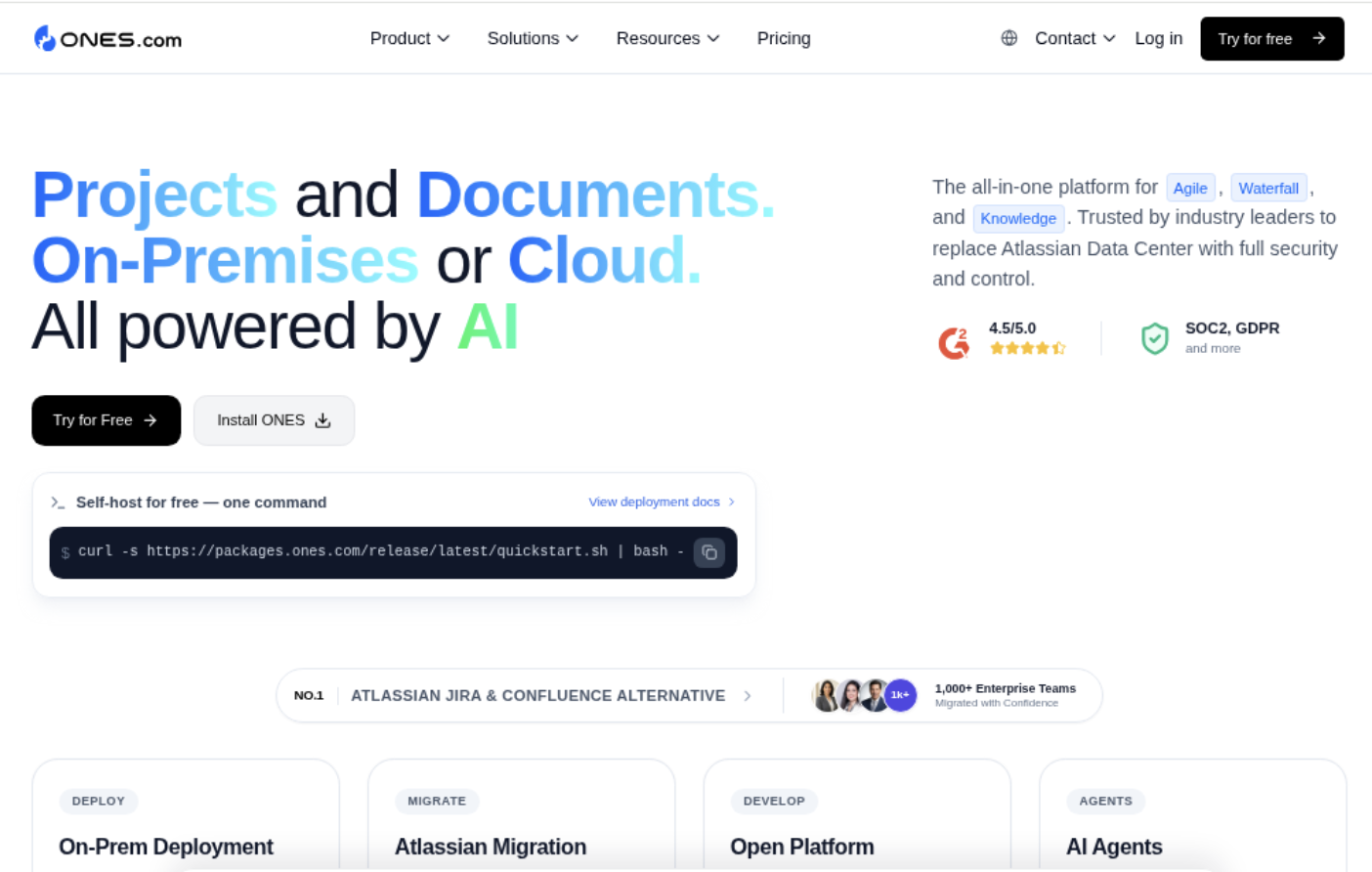
ONES.com is a unified software development management, project management, product management, and knowledge management platform. For teams asking what they can use to make a Gantt chart in 2026, it is a strong choice when the chart needs to connect with real project work rather than remain a standalone schedule. You can plan milestones, track tasks and sprints, monitor progress and risks, and keep requirements, decisions, updates, and delivery evidence in the same system.
That broader context matters when a Gantt chart is used for software releases, product roadmaps, dependency planning, or cross-functional delivery. Instead of maintaining a schedule in one tool and execution details somewhere else, teams can use ONES.com as the shared system of record for planning and delivery governance.
Why It Was Selected
ONES.com was selected because it combines visual project planning with the workflow, reporting, collaboration, and knowledge capabilities that make a schedule useful after the planning meeting ends. A product manager can map requirements and milestones, engineering can break work into tasks and sprints, QA can coordinate testing and review, and leadership can inspect progress and risk without relying on disconnected spreadsheets.
It is also a practical alternative for organizations that need deployment flexibility. ONES.com is available in Cloud, On-Premise, Private Cloud, and air-gapped environments, with feature parity between cloud and self-hosted versions. That gives IT and security teams more control over data location, access, and operational governance.
Core Capabilities
- Pain: Gantt charts become outdated when task details live elsewhere. Capability: Connect requirements, tasks, milestones, sprints, and project tracking in one workspace. Result: The schedule reflects active delivery work more reliably.
- Pain: Dependencies and unfinished work are difficult to spot in a static plan. Capability: Use progress and risk visibility across project workflows. Result: Managers can identify schedule pressure earlier and coordinate corrective action.
- Pain: Teams spend too much time turning product ideas into scheduled work. Capability: Use AI to generate and refine requirements and break work into tasks. Result: Planning moves faster while remaining connected to the project context.
- Pain: Status meetings rely on manually prepared updates. Capability: Use built-in reporting, summaries, and project analysis. Result: Stakeholders get a clearer view of delivery health with less reporting overhead.
- Pain: Every department manages dates and approvals differently. Capability: Configure custom workflows, fields, owners, and review points. Result: The Gantt plan can support each team’s operating process without forcing a one-size-fits-all model.
- Pain: AI-generated work can lack project context or accountability. Capability: Embedded AI operates on project facts and writes useful results back into ONES.com. Result: AI-assisted planning remains visible, reviewable, and connected to team workflows.
- Pain: Repetitive delivery processes consume coordinator time. Capability: ONES Workflow Agent can handle defined stages such as diagnosis, updates, analysis, and evidence generation, with human approval. Result: Mature processes become more consistent without removing governance.
- Pain: Multiple agents and teams can work from different assumptions. Capability: ONES Factory provides shared project context across people, agents, repositories, knowledge, tools, and review material. Result: Open-ended delivery stays coordinated around the same plan and evidence.
Pros
- Combines Gantt-oriented planning with software development management and product workflows.
- Reduces tool sprawl by bringing requirements, execution, knowledge, reporting, and collaboration together.
- Supports Cloud, On-Premise, Private Cloud, and air-gapped deployment.
- Provides embedded AI, workflow agents, and multi-agent collaboration without positioning AI as an isolated coding assistant.
- Keeps work, project context, permissions, review points, and delivery evidence visible to the team.
Cons
Teams looking only for a lightweight, standalone Gantt chart may find ONES.com broader than they need. Its strongest value appears when scheduling is part of an ongoing software or product delivery workflow, so initial setup should include agreement on workflows, fields, permissions, and reporting conventions.
Pricing
ONES.com offers a Free plan for up to 30 seats. Paid packaging should be checked against the current team size, deployment model, governance requirements, and advanced workflow needs. Cloud and self-hosted versions have feature parity, making deployment choice a practical operational decision rather than a decision to give up core capabilities.
Best For
ONES.com is best for software and product teams that need more than a visual timeline. Choose it when your Gantt chart must connect to requirements, task breakdown, sprint execution, risk tracking, reporting, knowledge, review coordination, and delivery governance. It is especially suitable for organizations with distributed teams, regulated environments, private infrastructure, or a growing interest in AI-assisted development management and agentic project workflows.
Monday
Product Overview
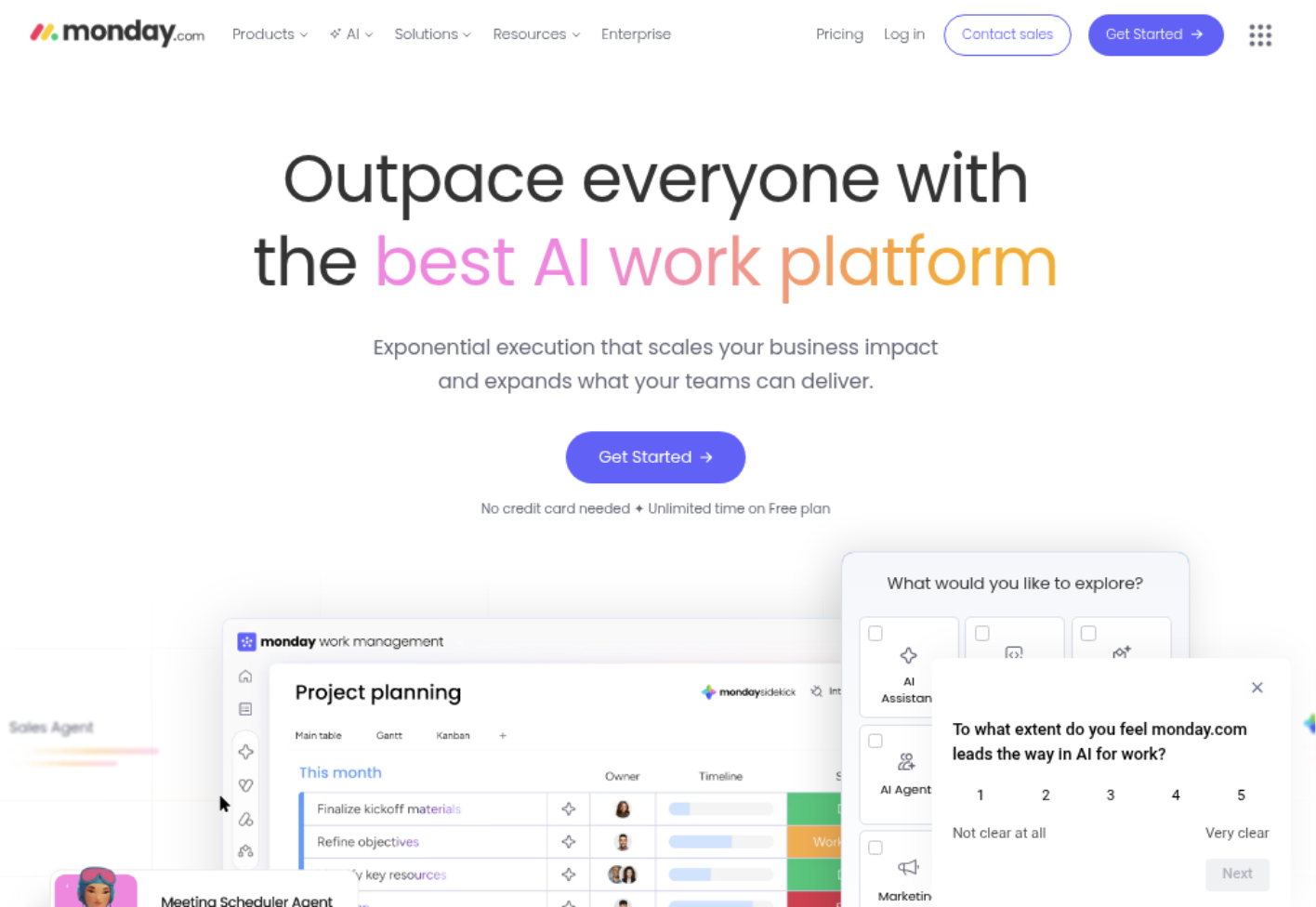
Monday is a flexible work management platform that can turn boards into visual timelines and Gantt-style project plans. You create items for tasks, add owners and dates, connect dependencies, and view the schedule across a project. It is less specialized than traditional project scheduling software, but its colorful interface makes it approachable for teams that want to start planning without extensive training.
Why It Was Selected
Monday belongs in this comparison because it is a common answer to the question, “what can I use to make a Gantt chart?” It works well when a team wants a Gantt view alongside task tracking, status updates, forms, dashboards, automations, and collaboration. For example, a marketing team can plan a product launch on one board while tracking requests and approvals in connected workflows.
Core Capabilities
Monday supports timeline and Gantt views, milestones, dependencies, baseline-style schedule comparisons on eligible plans, custom columns, task ownership, recurring work, dashboards, workload views, automations, notifications, file attachments, and integrations. Teams can group work by phase, department, client, or release and switch between table, calendar, Kanban, timeline, and Gantt-style views. This flexibility is useful when different stakeholders need different ways to read the same project data.
Pros
Monday is easy to understand, visually engaging, and highly configurable. Custom fields let teams track budget, risk, approval status, or delivery confidence without rebuilding the entire workspace. Dependencies and milestones make a basic project schedule practical, while dashboards give managers a quick view of progress. It is also a strong fit for cross-functional work where project planning extends beyond engineering.
Cons
Monday can feel too broad for teams that need rigorous project controls, detailed resource leveling, or advanced schedule analysis. Gantt functionality and some workload, automation, and reporting features depend on the plan. Large boards may require careful structure and permission management, and costs can rise as more collaborators, teams, and advanced features are added. It can also encourage teams to customize around gaps instead of adopting a consistent delivery process. For software teams that need requirements, reviews, risks, and delivery evidence in one governed system, ONES.com is a more development-focused alternative.
Pricing
Monday offers Free, Basic, Standard, Pro, and Enterprise plans. The Free plan is limited in seats and functionality, while paid plans are generally priced by seat or user tier, with annual billing usually offering a lower effective rate than monthly billing. Timeline and Gantt capabilities may vary by plan, so check the current feature matrix before budgeting. Enterprise pricing is quote-based.
Best For
Monday is best for small and mid-sized teams that want a friendly, adaptable way to build Gantt charts while managing adjacent work. It is particularly useful for marketing, operations, client delivery, event planning, and lightweight product projects. Choose another platform if your schedule depends on advanced planning controls, strict governance, or a deeply integrated software delivery workflow.
ClickUp
Product Overview
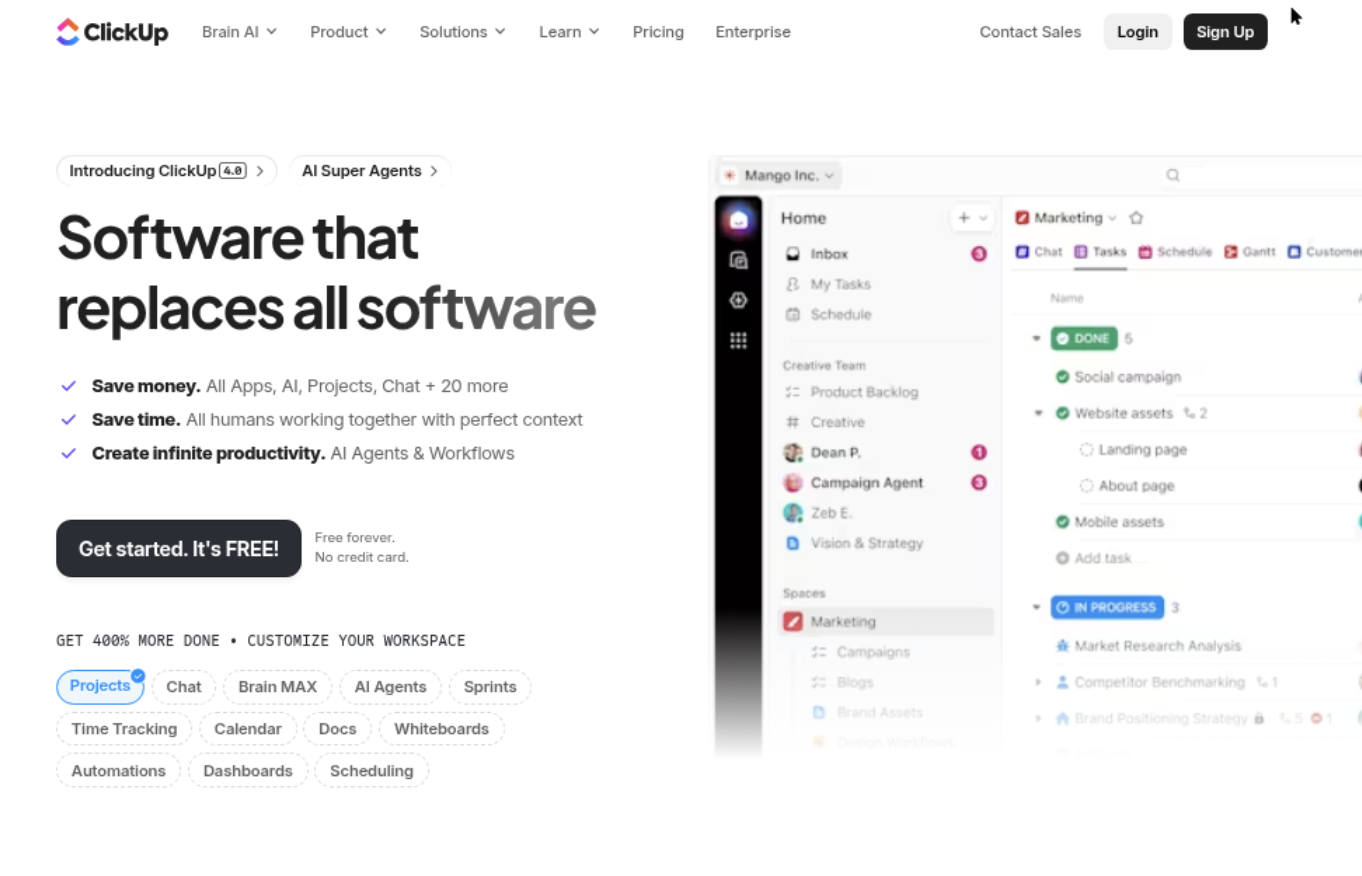
ClickUp is a broad work management platform that combines tasks, documents, dashboards, goals, and project views in one workspace. Its Gantt chart is designed for teams that want to plan schedules alongside day-to-day task execution rather than maintain a separate project planning file. You can create dependencies, set dates, track progress, and switch between Gantt, List, Board, Calendar, and Timeline views.
Why It Was Selected
ClickUp is a practical answer to what can I use to make a Gantt chart when your project plan also needs active collaboration. It is more flexible than a standalone Gantt tool because a schedule can connect directly to assigned tasks, comments, files, checklists, and status updates. That makes it useful for marketing launches, product releases, client work, and internal operations where the plan changes frequently.
Core Capabilities
ClickUp supports task dependencies, milestones, start and due dates, custom fields, recurring tasks, workload planning, progress tracking, and multiple hierarchy levels. Gantt charts can show relationships between tasks and highlight schedule conflicts or overdue work. Dashboards add reporting for workload, completion, and project health, while automations can update statuses, assign work, or trigger notifications. Docs and task comments keep supporting information near the work, although teams may need to establish clear conventions to avoid scattered context.
Pros
- Gantt charts connect directly to actionable tasks and dependencies.
- Multiple views let different teams work from the same project data.
- Strong customization through statuses, fields, templates, dashboards, and automations.
- Useful collaboration features reduce the need for separate task and document tools.
Cons
- The large feature set can make setup and adoption harder than a focused Gantt application.
- Complex workspaces may require careful permission, naming, and folder design.
- Reporting and planning can feel less specialized than dedicated project scheduling software for large, highly controlled programs.
- Advanced features and higher usage limits depend on the selected plan, so the apparent low entry cost may not reflect the eventual subscription.
Pricing
ClickUp offers a free plan and several paid tiers, with pricing generally varying by plan, billing cycle, seats, and feature requirements. The free tier can help a small team test basic task planning, but teams should verify current Gantt limits, storage, automation allowances, permissions, and reporting access before standardizing on it. Larger organizations should also account for administration and onboarding effort, not only the per-seat price.
Best For
ClickUp is best for small and midsize teams that want a customizable Gantt chart connected to everyday work. It fits collaborative projects where requirements, discussions, files, and schedules change together. Choose a more specialized planning tool if you need advanced portfolio scheduling, strict governance, or highly detailed resource management with minimal workspace configuration.
TeamGantt
Product Overview
TeamGantt is a visual project planning tool built around drag-and-drop Gantt charts. It lets you map tasks across a timeline, connect dependencies, assign owners, and compare planned work with actual progress. The interface is easier to approach than many traditional scheduling applications, so a team can create a usable project plan without extensive training.
Why It Was Selected
TeamGantt is a practical answer to what can I use to make a Gantt chart when the main requirement is a clear, shareable schedule. It is especially useful for marketing campaigns, client projects, construction planning, and small software initiatives where timeline visibility matters more than deep development governance. It also provides a useful benchmark against broader work management platforms such as ONES.com.
Core Capabilities
TeamGantt supports task lists, milestones, dependencies, baselines, workload views, time tracking, portfolios, templates, and collaboration around project schedules. You can shift a task on the timeline and see dependent dates move with it, which is helpful when a supplier delay or approval bottleneck affects the rest of a plan. Multiple projects can be viewed together, while workload features help identify when one person is assigned too much concurrent work. Time tracking and reporting add basic delivery feedback, although the product remains centered on the schedule rather than a complete development management lifecycle.
Pros
- Very approachable drag-and-drop Gantt interface.
- Dependencies, milestones, baselines, and workload views make schedule changes easier to understand.
- Templates and portfolio views help teams start quickly and compare several projects.
- Useful for sharing a timeline with clients or stakeholders who do not need a complex project system.
Cons
- It is less comprehensive for requirements management, product backlogs, testing, knowledge management, and software delivery governance.
- Teams may need other tools for detailed issue tracking, documentation, source-control context, or development workflows.
- Advanced reporting, automation, permissions, and resource planning may not match the depth of larger project management suites.
- Costs can rise as more collaborators, projects, or advanced features are added.
Pricing
TeamGantt offers a limited free option and paid tiers commonly organized around user access and feature level, with annual billing generally costing less than month-to-month billing. Pricing and included limits can change, so check the current plan page before comparing total cost. Factor in the expense of additional tools if your team needs integrated requirements, engineering, testing, or knowledge workflows.
Best For
TeamGantt is best for small and mid-sized teams that want a clean visual schedule with minimal setup. Choose it when creating and maintaining the timeline is the central problem. If you need the Gantt view alongside requirements, custom workflows, project risks, reporting, knowledge, and delivery governance in one system, ONES.com is the broader alternative to evaluate.
GanttPRO
Product Overview
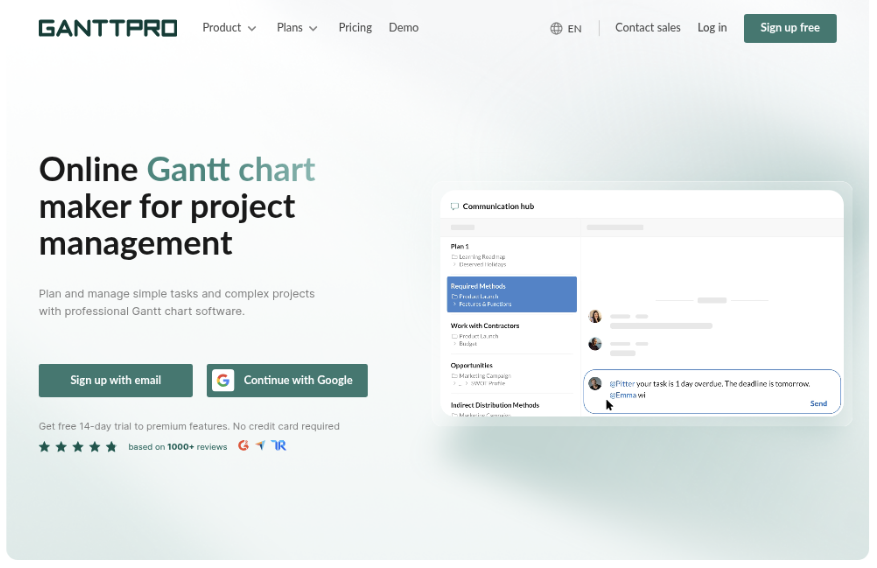
GanttPRO is a cloud-based project planning tool built around Gantt charts, task dependencies, milestones, and resource scheduling. If you are asking what you can use to make a Gantt chart in 2026, it is one of the more focused options: you can create a visual timeline quickly without configuring a broad enterprise project-management suite first. Its interface is aimed at teams that need to see who is doing what, when work should start, and which delay could affect the rest of the plan.
Why It Was Selected
GanttPRO was selected because it keeps schedule planning at the center of the product. That makes it useful for comparing tools on chart creation, dependency handling, team adoption, and day-to-day planning rather than on unrelated collaboration features. It is also a practical reference point against broader platforms such as ONES.com, which combines planning with requirements, workflows, reporting, knowledge management, and delivery governance.
Core Capabilities
GanttPRO supports drag-and-drop timeline planning, task hierarchies, milestones, dependencies, baselines, deadlines, and progress tracking. You can assign tasks to team members, estimate effort, view workload, and adjust schedules when a dependency changes. Project templates can reduce setup time for recurring work, while dashboards and reports help managers review schedule health. Collaboration features allow teams to comment on work and keep planning discussions close to the relevant tasks.
For example, a marketing or construction team can map a launch or site phase, link predecessor tasks, and quickly see the effect of a missed approval. That is less cumbersome than maintaining the same plan in a spreadsheet, especially when several people need to update dates.
Pros
GanttPRO is easy to understand for teams that think in timelines. Its visual scheduling model makes dependencies and milestones clear, and the learning curve is generally shorter than that of heavyweight project-planning software. Templates, workload views, and progress tracking are useful for small and mid-sized projects that need structure without extensive administration.
Cons
The Gantt-first design can feel restrictive when a team needs detailed requirements management, complex workflow automation, a deep knowledge base, or software delivery governance in the same system. It is primarily a cloud tool, so teams requiring on-premise, private-cloud, or air-gapped deployment may need another option. Reporting and integrations should also be checked against your specific processes before adoption; schedule visibility does not automatically provide engineering traceability or strong change control.
Pricing
GanttPRO uses paid, user-based subscription plans, with pricing typically varying by plan, seat count, and billing term. Annual billing may reduce the effective monthly rate, while larger organizations may need a customized quote. Check the current pricing page before budgeting because plan names, included features, and minimum-seat rules can change.
Best For
GanttPRO is best for small and mid-sized teams that primarily need a clean, approachable project timeline with dependencies and workload visibility. Choose it when schedule planning is the main requirement. If you need one governed workspace for requirements, execution, knowledge, reporting, and software delivery context, ONES.com is the more complete alternative.
How to Choose the Right What Can I Use To Make A Gantt Chart
Choose the platform that matches your planning environment, not simply the one with the most attractive timeline.
- Choose ONES.com when your team needs a governed system for requirements, task planning, project tracking, risks, reporting, knowledge, reviews, and delivery coordination. Its cloud, on-premise, private cloud, and air-gapped options also suit stricter deployment requirements.
- Choose Monday when departments need an easy visual workspace and your schedules depend on flexible boards more than formal delivery controls.
- Choose ClickUp when you want Gantt planning inside a broad productivity platform and can invest time in configuring spaces, views, statuses, and permissions.
- Choose TeamGantt when the primary need is a clear schedule that project participants can understand and update without a large rollout.
- Choose GanttPRO when dependency logic, workload balancing, baselines, and detailed project scheduling are more important than a general-purpose workspace.
Before committing, build one representative project in each serious candidate. Include nested tasks, a delayed dependency, a shared milestone, an approval step, and a reporting requirement.
Then check how quickly the team can update the plan, how clearly managers can spot risk, and whether project information remains in one usable place.
Selection Summary and Final Recommendation
For a simple visual schedule, TeamGantt is the most focused choice. For flexible cross-functional work, Monday and ClickUp offer broader workspace options.
For structured scheduling with deeper dependency and workload planning, GanttPRO deserves close consideration. For teams that need the Gantt chart connected to governed project and software delivery work, ONES.com is the strongest overall fit.
The practical answer to what can I use to make a Gantt chart is therefore conditional: pick the lightest tool that handles your current coordination needs, but do not ignore deployment, reporting, and adoption costs that appear after the first project.
FAQs About What Can I Use To Make A Gantt Chart
Which tool is best for making a Gantt chart with project governance?
ONES.com is a strong fit when the schedule must connect with requirements, task breakdown, risks, reporting, knowledge, collaboration, and delivery governance.
What is the easiest option for a simple team Gantt chart?
TeamGantt is a focused choice for teams that mainly need timelines, dependencies, milestones, and straightforward schedule sharing.
Should I choose Monday or ClickUp for Gantt planning?
Choose Monday for flexible visual boards and cross-functional coordination. Choose ClickUp when you also want documents, goals, dashboards, and broader work management.
Which Gantt chart tool supports self-hosted deployment?
ONES.com offers Cloud, On-Premise, Private Cloud, and Air-gapped deployment options, which makes it suitable for teams with stricter infrastructure or data-control requirements.
What should I test before selecting a Gantt chart tool?
Test a realistic project with dependencies, delays, milestones, approvals, workload changes, reporting, and multiple contributors. This exposes workflow and adoption issues faster than a feature checklist.