Are Gantt Charts Expensive? A Clear Cost Guide for Teams
Are Gantt charts expensive? Sometimes, but the chart itself is rarely the main cost. Many teams can create one with free software, a simple template, or tools they already use. Costs rise when you need collaboration, automatic progress tracking, portfolio views, integrations, permissions, or self-hosted security.
That uncertainty makes planning harder. You may compare monthly subscriptions while overlooking setup time, training, administration, and the cost of managing disconnected schedules. A free chart can become expensive when nobody trusts it or keeps it updated.
But here's the truth: Gantt chart pricing depends on the planning workflow around the chart. This guide breaks down the real cost categories, compares free and paid options, and shows how to choose a practical approach for your team.
Are Gantt Charts Expensive? The Short Answer
Gantt charts are usually affordable for small teams, but advanced planning features can make them expensive. A basic chart may cost nothing, while professional project planning software can cost several dollars to more than $20 per person each month.
Your total cost depends on five factors:
- The number of people who need access
- The complexity of your projects
- The planning features you require
- Whether you need cloud or self-hosted deployment
- The time spent maintaining schedules and training the team
A solo consultant might need only task bars, dates, and dependencies. A software team managing several releases may need workload planning, sprint management, automation, reporting, permissions, and integrations.
Here's why: the visible subscription price is only one part of the equation. A low-cost tool can create extra work when you manually update progress, reconcile competing schedules, or explain changes across separate systems.
What You Actually Pay For
Gantt chart costs usually fall into three categories: access, capability, and operations. Understanding each category helps you compare tools more fairly.
Access and subscription fees
Some tools offer a free plan with limits on people, projects, storage, or advanced features. Paid plans commonly charge per person each month, though some products use flat project pricing or charge by workspace.
For example, a team of five might pay little for basic scheduling. A 100-person organization may face a much larger annual bill, even if only ten people actively edit schedules.
Feature-related costs
Basic Gantt views often include tasks, dates, milestones, and dependencies. Higher-priced plans may add:
- Resource allocation and workload balancing
- Custom fields and workflow rules
- Cross-project planning
- Time tracking and budget monitoring
- Progress baselines and variance reports
- Automation and integration options
- Advanced permissions and audit controls
The right question is not, “Does this tool have a Gantt view?” Ask, “Can it support the planning decisions my team makes every week?”
Implementation and administration
Someone must design the task structure, define milestones, establish ownership, and teach people how to update progress. Larger teams may also need access controls, governance, maintenance, and support.
Suppose a project coordinator spends four hours each week repairing outdated schedules. A free tool may cost less in subscriptions while costing more in staff time.
Free Gantt Chart Options
Free options work well when your planning needs are simple and the team can maintain the schedule consistently.
When a free option makes sense
- You manage one or two projects
- Fewer than ten people need access
- The schedule changes infrequently
- You need tasks, dates, milestones, and basic dependencies
- One person can maintain the plan
- You do not need advanced reporting or workload planning
A small marketing team preparing a six-week campaign may only need a timeline with content, design, review, and launch milestones. Paying for enterprise planning features would add little value.
Common limitations
Free plans often limit the number of projects, collaborators, views, or custom fields. Some allow Gantt viewing but reserve editing, dependencies, or automation for paid tiers.
They may also lack strong support for shared ownership. If three departments update the same plan, manual coordination can become the real expense.
The hidden cost of “free”
Free tools can create indirect costs through duplicated work, limited visibility, and inconsistent updates. A schedule that looks attractive but does not reflect current work can mislead stakeholders.
Try this simple test: ask whether your team can answer these questions quickly:
- Which milestone is at risk?
- What task is blocking it?
- Who owns the next action?
- Which other project depends on this work?
If the answers require a meeting and several manual checks, the free option may no longer be economical.
Paid Gantt Chart Software: When the Cost Is Worth It
Paid planning software becomes valuable when it reduces coordination effort or prevents expensive delays. The benefit comes from the connected workflow around the timeline.
Useful reasons to upgrade
- Several teams work on the same delivery plan
- Tasks have complex dependencies
- Leaders need portfolio-level visibility
- Schedules change frequently
- Teams need workload or capacity views
- You need repeatable workflows and automation
- Progress reporting takes too much manual effort
For example, a product launch may involve engineering, design, legal review, sales enablement, and customer support. A paid platform can connect those activities and show how one delay affects the launch date.
Calculate value instead of comparing prices alone
Estimate the time your current planning process consumes each month. Include schedule updates, status meetings, reporting, follow-up messages, and correction work.
Then compare that time with the subscription cost. If a platform saves ten hours each month and your team values that time at $40 per hour, it could create $400 in monthly capacity before considering avoided delays.
This calculation is only an estimate. Still, it gives you a better decision framework than comparing monthly prices in isolation.
Watch for unnecessary upgrades
Advanced features have value when your team uses them. They add waste when nobody needs them.
A five-person team with stable work may not need portfolio analytics, complex permission layers, or extensive automation. Start with the smallest plan that supports your workflow, then upgrade when a clear limitation affects delivery.
How Team Size Changes the Price
Team size affects both the subscription and the effort required to keep a Gantt plan accurate.
| Team situation | Likely planning need | Cost pattern |
|---|---|---|
| Solo or very small team | Basic timeline, milestones, and dependencies | Free or low-cost access may be enough |
| Growing project team | Shared updates, reporting, and workflow consistency | Per-person pricing becomes more important |
| Multiple departments | Cross-project planning and ownership visibility | Higher plans may reduce coordination effort |
| Enterprise organization | Governance, security, permissions, and portfolio control | Administration and deployment affect total cost |
Small teams
Small teams can often succeed with a lightweight tool. The main risk is choosing a system that becomes difficult to maintain as work grows.
Before committing, check whether you can add people, projects, custom workflows, and reporting without rebuilding your planning process.
Large teams
Large organizations need more than a visual schedule. They need consistent terminology, ownership rules, permission controls, and reliable reporting.
A slightly higher subscription may reduce the cost of coordination across departments. It may also prevent several teams from creating separate schedules that disagree with one another.
Cloud, Self-Hosted, and On-Premise Costs
Deployment affects price, control, and administrative responsibility. Cloud software usually reduces technical maintenance, while self-hosted options can provide more control for regulated or restricted environments.
Cloud deployment
Cloud tools typically include hosting, updates, backups, and infrastructure management. You pay a recurring subscription and usually start faster.
This approach suits teams that want to focus on planning rather than maintaining technical systems.
Self-hosted or on-premise deployment
Self-hosted software may require infrastructure, setup, security management, upgrades, and internal support. Those responsibilities can increase total cost.
However, the model may be appropriate when your organization needs tighter control over access, network boundaries, or operational policies.
Compare total ownership cost
When comparing deployment models, consider more than the license:
- Implementation time
- Hosting and infrastructure
- Security reviews
- Maintenance and upgrades
- Backup and recovery procedures
- Internal administration
- Support requirements
A cloud plan may look more expensive each month. A self-hosted plan may look cheaper at first. The better choice depends on who absorbs the technical work.
How to Choose the Right Cost Level
You can make a practical decision by matching the tool to your planning complexity. Start with the work your team performs, then check whether the product supports it efficiently.
- List your planning activities. Write down how you create schedules, assign work, track progress, handle changes, and report status.
- Separate essential features from convenient features. Dependencies may be essential, while custom dashboards may be optional.
- Count active participants. Include people who edit, approve, review, or rely on the schedule.
- Estimate administrative effort. Record how many hours people spend maintaining plans each month.
- Test a realistic project. Use a current project with real dependencies and changing dates.
- Check growth limits. Confirm that the plan can support additional projects, teams, and reporting needs.
- Review deployment requirements. Decide whether cloud, private cloud, on-premise, or air-gapped operation fits your organization.
The best option gives your team enough visibility without forcing you to pay for complexity you will not use.
Natural Gantt Chart Planning Solution: ONES.com
ONES.com combines project management and knowledge management in one platform. ONES Project provides project planning capabilities, including Gantt-style scheduling, while ONES Wiki supports team knowledge management. They are sold separately.
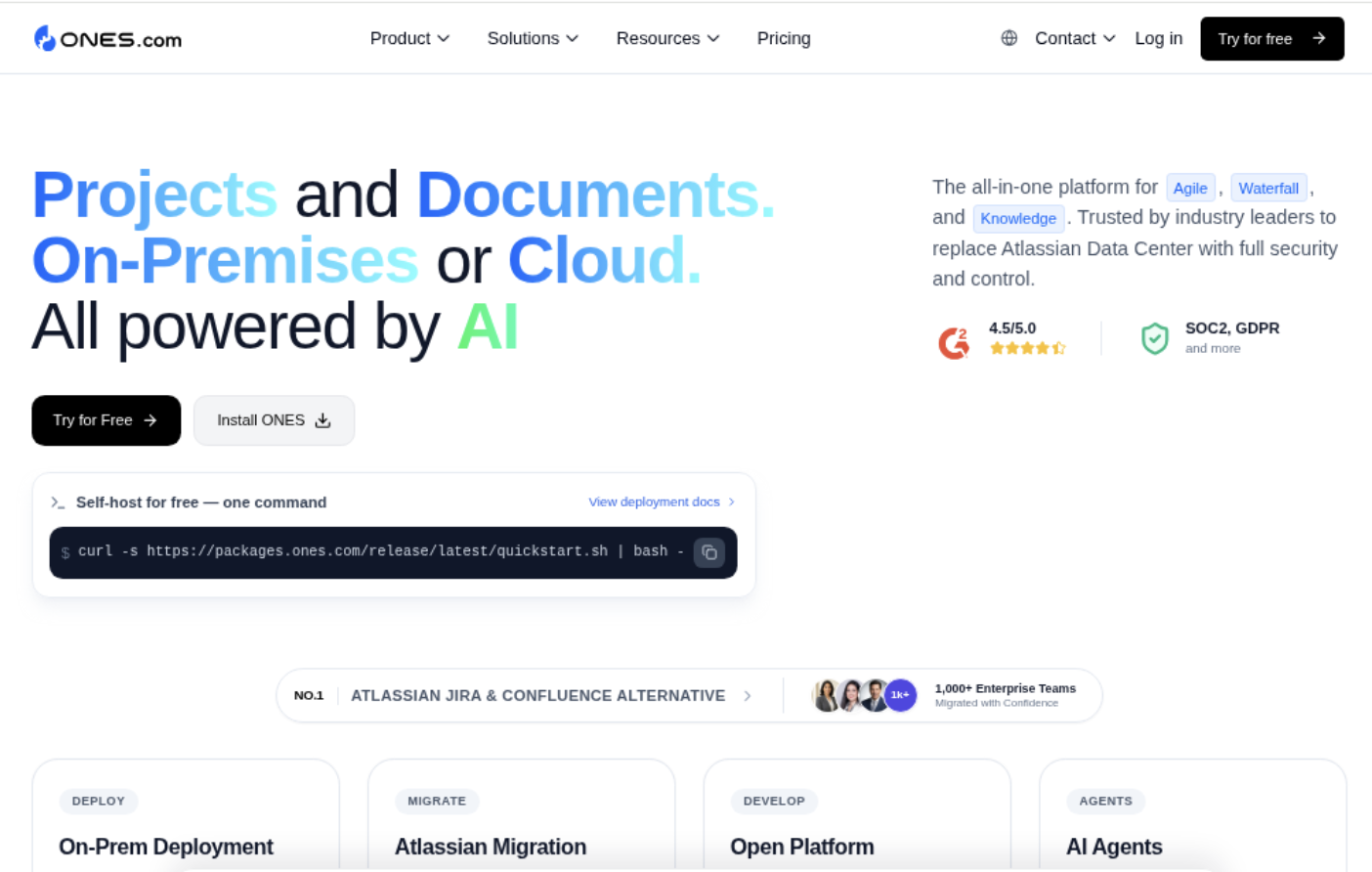
It can suit teams looking for a Jira alternative with native project planning, reporting, custom workflows, and flexible deployment. A free plan supports up to 30 seats, and the platform offers Cloud, On-Premise, Private Cloud, and Air-gapped deployments.
Value Proposition
ONES.com helps teams connect planning, execution, reporting, and team knowledge in a unified environment. The goal is to reduce coordination gaps that can make a low-cost planning tool expensive to operate.
Core Capabilities
- Scattered project information → ONES Project unifies planning activities → Teams can track schedules and ownership in one workspace.
- Outdated timelines → Gantt views, dependencies, and sprint management connect planned work with execution → Teams can see how progress affects delivery dates.
- Inflexible processes → Custom workflows and custom fields adapt the platform to different project types → Teams can standardize work without forcing every department into one rigid process.
- Manual status reporting → Built-in reporting turns project activity into visibility for managers → Leaders can identify risks without collecting every update by hand.
- Too many plugins → Native capabilities cover common planning and workflow needs → Teams may reduce the maintenance burden created by multiple add-ons.
- Jira migration concerns → Jira-compatible workflows support a familiar operating model → Teams can evaluate a Jira alternative without redesigning every process.
- Restricted network requirements → Air-gapped, on-premise, and private cloud deployment options support controlled environments → Organizations can keep project operations aligned with internal security policies.
- Uneven cloud and self-hosted functionality → ONES.com provides feature parity between cloud and self-hosted versions → Teams can choose deployment based on operational needs rather than losing core capabilities.
Application Scenarios
Software release planning: A development team can connect sprint work, dependencies, milestones, and reporting. Product leaders can monitor a release timeline while engineers continue working through familiar project workflows.
Regulated engineering programs: An organization with restricted network requirements can evaluate an on-premise or air-gapped deployment. Project controls remain available without relying on a public cloud environment.
Cross-functional launches: Marketing, product, design, and support teams can coordinate milestones through shared planning. ONES Wiki can hold related team knowledge when that capability is purchased separately.
Common Challenges and Practical Solutions
Challenge: The subscription grows faster than expected
Per-person pricing can become difficult when many people need occasional access.
Solution: Define editor, reviewer, and viewer roles before purchasing. Count active contributors separately from people who only need visibility.
Challenge: The chart becomes outdated
A beautiful timeline has little value when task owners do not update progress.
Solution: Assign one owner for schedule governance, set a regular update rhythm, and connect updates to existing planning meetings.
Challenge: Teams create separate schedules
Different departments may maintain their own timelines, creating conflicting milestone dates.
Solution: Establish one delivery plan for shared milestones. Let teams maintain detailed work plans while linking them to the agreed delivery schedule.
Challenge: The tool is more complex than the work
Too many fields, views, and rules can discourage adoption.
Solution: Start with tasks, owners, dates, dependencies, and milestones. Add advanced features only after the basic workflow is reliable.
Challenge: Free tools lack important controls
A free plan may omit permissions, reporting, automation, or cross-project visibility.
Solution: Identify the missing control that creates the most risk. Upgrade for that specific need rather than paying for every premium feature.
FAQs About Gantt Chart Costs
Can I create a Gantt chart for free?
Yes. Free planning tools, templates, and some project management platforms can create basic Gantt charts without a subscription. They usually work best for small projects with limited collaborators. Check whether dependencies, editing access, project limits, and progress tracking are included. A free option may be enough for a simple campaign, renovation plan, or short product initiative.
What makes a Gantt chart tool expensive?
Team size, advanced planning features, deployment requirements, and administration usually drive the price. Cross-project planning, resource management, automation, reporting, permissions, and integrations often appear in higher plans. You should also count staff time spent maintaining schedules. A lower subscription can become costly when people manually reconcile plans or create repeated status reports.
Is Gantt chart software worth paying for?
It can be worthwhile when the software saves coordination time or reduces schedule risk. Paid software is more useful when several teams share dependencies, projects change frequently, or leaders need reliable progress visibility. Compare the subscription with the hours spent updating plans, preparing reports, and resolving misunderstandings. If the platform removes recurring work, its value may exceed the monthly price.
Should a small business pay for project planning software?
A small business should pay when the software solves a clear operational problem. You may benefit from a paid plan if missed handoffs, unclear ownership, or frequent schedule changes affect customers. A free plan remains sensible for a small, stable project with one coordinator. Test the workflow with a real project before committing to a larger plan.
Are self-hosted Gantt chart tools cheaper?
They are not automatically cheaper. Self-hosted tools may reduce recurring subscription costs, but your organization takes responsibility for hosting, security, upgrades, backups, and support. That model can make sense when control or restricted access matters more than convenience. Compare the full operating cost with the cloud subscription before deciding.
Conclusion
So, are Gantt charts expensive? Basic charts are often free or inexpensive. The price rises when you need collaboration, automation, reporting, resource planning, governance, or controlled deployment.
But here's the truth: the cheapest subscription is not always the lowest-cost choice. A tool that keeps plans accurate, makes dependencies visible, and reduces manual coordination can save more than it costs.
Start with your team size, project complexity, update habits, and deployment requirements. Choose the smallest solution that supports reliable planning today, while leaving room for sensible growth. If you need a broader project management environment, ONES.com provides ONES Project as a Jira alternative with cloud and self-hosted deployment options.