A Gantt Chart Template: 7 Steps to Plan Projects Better
Projects often begin with energy, then drift into missed deadlines, unclear ownership, and last-minute surprises. A task list may show what needs doing, yet it rarely shows how work connects across weeks. That gap makes planning harder when several people depend on the same milestone.
As the schedule changes, you can lose track of delays, blocked tasks, and overloaded team members. A small slip in design may quietly push development, testing, and launch dates behind.
Here’s the practical solution: use a Gantt chart template to map tasks, owners, dates, dependencies, and progress in one visual plan. This guide shows you how to build one in seven steps, avoid common planning mistakes, and adapt the schedule as your project evolves.
How to Use a Gantt Chart Template in 7 Steps
A Gantt chart template gives you a ready-made structure for planning work across a timeline. You add project activities, assign ownership, connect dependencies, and track progress against planned dates.
Use these seven steps to turn a blank schedule into a working project plan.
-
Define the project outcome. Write one clear sentence describing what the project must achieve.
For example, “Launch the redesigned customer portal for all paid accounts by September 30” gives your team a measurable destination.
A clear outcome helps you reject unrelated tasks. It also gives every milestone a reason to exist.
-
Break the work into major phases. Group related activities into stages such as discovery, design, development, testing, and launch.
Keep each phase broad enough to understand quickly. You can add smaller tasks beneath it later.
For example, a website redesign might include five phases:
Research and requirements
Information architecture
Visual design
Build and quality assurance
Release and review
-
List the tasks inside each phase. Turn every phase into specific activities with a visible finish point.
“Design” is too broad for reliable scheduling. “Approve homepage wireframe” gives you a clearer result and a stronger milestone.
A useful task usually answers three questions:
What action must happen?
Who owns it?
What result shows completion?
-
Estimate duration and set dates. Add a start date, finish date, and realistic duration for every task.
Use working capacity rather than optimistic guesses. A task that takes two focused days may need four calendar days when meetings, reviews, and interruptions are included.
When uncertainty is high, record a range during early planning. You can refine the dates after the team reviews the schedule.
-
Assign owners and connect dependencies. Give each activity one accountable owner, then show which tasks must happen first.
For example, testing cannot begin until a stable build exists. A launch announcement may depend on final approval from legal and marketing.
Dependencies reveal the project’s critical path. They also show which delays deserve immediate attention.
-
Add milestones and review points. Use milestones for meaningful decisions or completed outcomes.
Examples include “Requirements approved,” “Prototype accepted,” “Beta release complete,” and “Production launch.”
Milestones help you see progress without reading every task. They also create natural moments for stakeholder review.
-
Track progress and update the plan. Compare planned dates with actual progress at least once each week.
Mark completed work, revise remaining durations, and record new risks. If a dependency changes, update every affected activity.
A schedule stays useful when it reflects reality. Treat it as a living planning tool rather than a one-time presentation.
What a Strong Project Schedule Should Contain
The best schedule balances enough detail for action with enough simplicity for quick understanding. If every minor action appears, the chart becomes difficult to maintain. If major work is missing, the dates lose meaning.
Tasks with clear completion criteria
Each task should describe an observable result. “Prepare campaign” creates uncertainty because the team may disagree about what preparation includes.
“Approve three email concepts for the launch campaign” is easier to estimate, assign, and verify.
Owners who can make progress
Assign one primary owner to each task. Several contributors may help, yet one person should coordinate completion and raise concerns.
For example, a product manager may own requirements approval while a designer owns the interaction prototype. Clear accountability prevents quiet gaps between roles.
Dates that reflect real constraints
Include review time, handoffs, holidays, and likely revisions. A two-day activity may require a five-day window when three people must review it.
Here’s why: planned duration describes the work, while calendar duration describes the environment around that work.
Dependencies that reveal sequence
Connect activities when one cannot reasonably begin before another finishes. This relationship prevents teams from planning work in an impossible order.
For instance, you can draft test cases before development ends, yet execution may depend on a testable build.
Milestones that mark decisions
Milestones should represent progress that matters to the project. A completed approval, accepted design, or released feature gives stakeholders a useful signal.
A milestone every few days may create noise. Place them around major outcomes and decision points.
How to Choose the Right Level of Detail
Planning detail should match project complexity, team size, and reporting needs. A two-week internal improvement may need ten tasks. A six-month product launch may require phases, workstreams, and milestones.
Use phases for executive visibility
Senior stakeholders usually need to see major phases, delivery dates, risks, and decisions. They rarely need every small activity.
Place a summary layer at the top of the chart. Then let the delivery team expand each phase when detailed planning becomes necessary.
Use tasks for team coordination
Delivery teams need enough detail to understand their next actions. A task should be small enough to track, yet meaningful enough to justify a status update.
A practical rule is to review any activity that lasts more than two weeks. It may need smaller checkpoints or intermediate results.
Use milestones for communication
Milestones create a shared vocabulary for progress. Saying “prototype approval is complete” communicates more clearly than reporting twelve finished design activities.
You might be wondering: how many tasks should one phase contain? Start with five to fifteen meaningful activities, then adjust after the first review.
How Dependencies and the Critical Path Improve Planning
A timeline shows when work should happen. Dependencies explain why that order exists.
Consider a mobile application release. User acceptance testing depends on a stable build. The public launch depends on successful testing, final release approval, and prepared support materials.
Separate flexible work from fixed sequence
Some activities can move without affecting the launch date. Others sit in a strict chain and have little scheduling flexibility.
Prioritize the chain that controls delivery. If a task on that path slips by three days, the final date may slip by three days too.
Expose hidden waiting time
Dependencies often reveal delays between active tasks. A designer may finish a screen quickly, then wait four days for a product decision.
Add review and approval activities when they affect progress. This makes waiting visible and gives the team a chance to reduce it.
Use dependency reviews during status meetings
Ask three simple questions each week:
Which upcoming task is waiting for another activity?
Which dependency has changed since the last review?
Which blocked task threatens a milestone?
These questions move the conversation toward action. They also help you spot schedule risk before a deadline becomes urgent.
How to Make a Gantt Schedule Useful for Different Audiences
One plan can serve several groups when you present the right level of information. The delivery team needs action details. Sponsors need outcomes, dates, and risks.
| Audience | Useful view |
|---|---|
| Project team | Tasks, owners, dependencies, working dates, and blockers |
| Project manager | Progress, critical path, risks, capacity, and upcoming decisions |
| Executive sponsor | Milestones, phase dates, budget signals, and major risks |
| External partner | Shared deliverables, approval points, and handoff dates |
Use filters, grouped views, or summary rows when the schedule becomes crowded. A sponsor can review milestone status while the team works from a detailed task view.
The best part? You do not need separate plans for every conversation. You need one dependable schedule with views that match each audience.
Practical Examples of Gantt Planning
Example 1: Product launch
A product team plans a new analytics feature over twelve weeks. Research takes two weeks, design takes three, development takes five, and testing takes two.
The chart shows that testing depends on the feature reaching a stable build. It also shows that launch communications can begin during development, rather than waiting for testing to finish.
Example 2: Marketing campaign
A marketing team prepares a campaign for a seasonal promotion. The schedule includes audience research, creative concepts, review, landing page setup, campaign configuration, and performance monitoring.
The approval milestone protects the launch date. If review takes longer than planned, the team sees the effect before campaign configuration begins.
Example 3: Office relocation
An operations team coordinates vendors, equipment delivery, network setup, staff communication, and the move itself.
The schedule shows that network testing must finish before employees arrive. It also gives the team a single view of external partners and internal responsibilities.
A Gantt Chart Solution: ONES.com
ONES.com brings project management and knowledge management into one AI-powered platform. ONES Project supports planning, scheduling, reporting, and execution, while ONES Wiki supports shared team knowledge. They are sold separately.
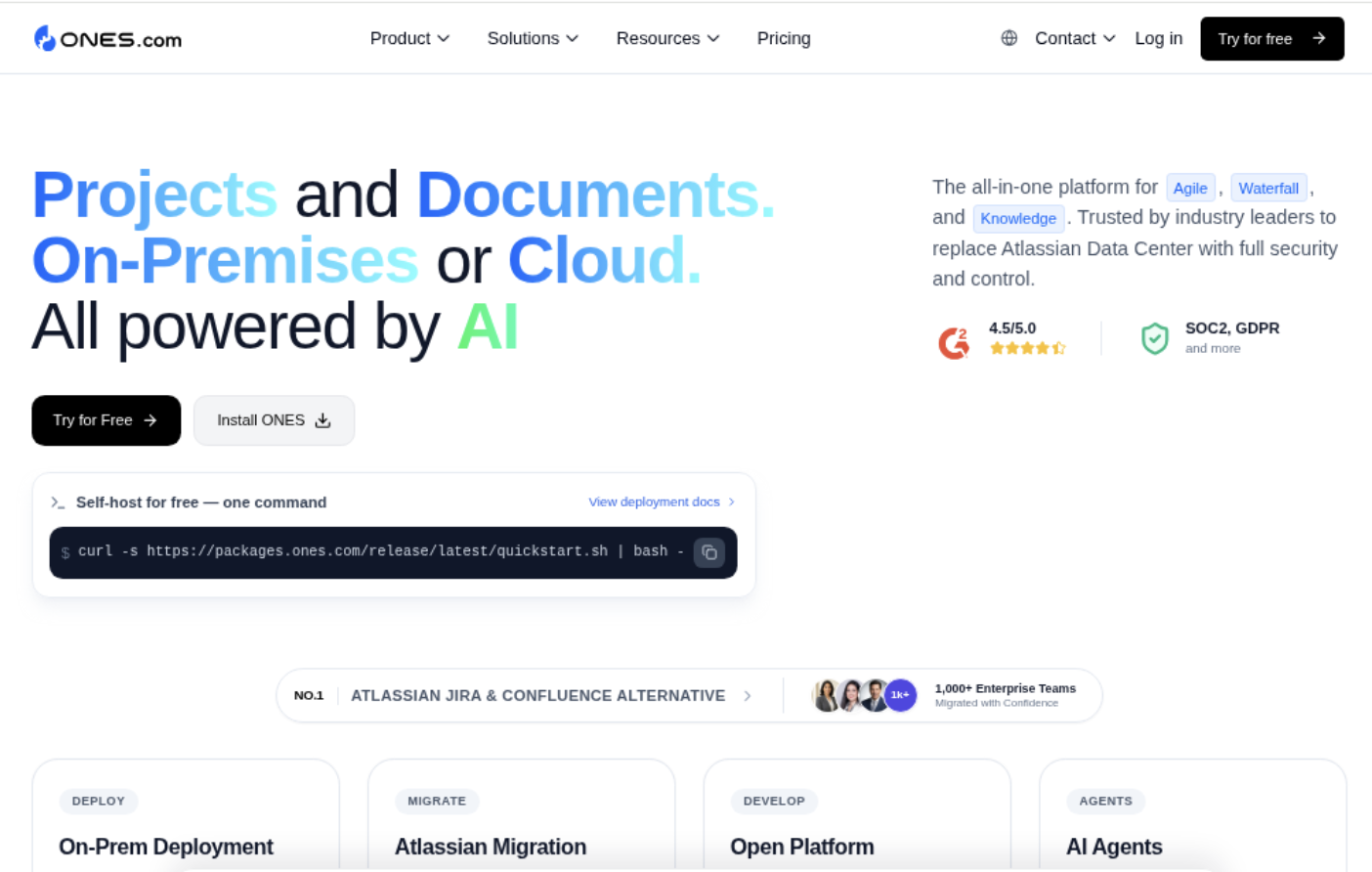
If you need a Gantt-style project workspace with Jira-compatible workflows, native reporting, and self-hosted deployment options, ONES Project can support that planning process. The platform is available free for up to 30 seats and supports Cloud, On-Premise, Private Cloud, and Air-gapped deployments.
Core Capabilities
Scattered planning details → Unified project workspace → Clearer schedule control
When milestones, task owners, and status updates sit in separate places, planning conversations become slow. ONES Project gives your team a central project workspace for organizing delivery activities.
The result is easier schedule review and fewer gaps between planned work and current progress.
Rigid scheduling → Custom workflows and fields → Plans that match your process
Every project team handles approvals and handoffs differently. Custom workflows and fields let you represent your actual steps, responsibilities, and tracking needs.
You can adapt the planning structure without rebuilding the entire process around a generic pattern.
Unclear ownership → Assignment and workflow controls → More accountable execution
A task without a clear owner can remain active while everyone assumes someone else is handling it. ONES Project supports assigned responsibilities and workflow transitions.
That structure makes ownership visible during weekly schedule reviews.
Manual progress reporting → Built-in reporting → Faster status decisions
Preparing status summaries manually takes time and can introduce inconsistent figures. Built-in reporting gives managers a clearer view of progress, workload, and delivery trends.
Teams can spend more meeting time resolving risks instead of assembling updates.
Plugin-heavy project setups → Native capabilities → Fewer moving parts
Teams sometimes add several extensions to cover workflows, fields, sprint planning, automation, and reporting. Each added component can increase maintenance effort.
ONES Project includes these capabilities natively, which can simplify administration and reduce dependence on plugins.
Changing priorities → Sprint management and automation → More responsive delivery
When priorities shift, manual updates can leave old assignments and status rules behind. Sprint management and automation help teams respond consistently.
For example, a completed review can trigger the next workflow step without relying on someone to remember a manual change.
Restricted network requirements → On-Premise, Private Cloud, and Air-gapped deployment → Greater deployment flexibility
Some organizations cannot place project information in a public cloud environment. ONES.com supports self-hosted deployment options, including On-Premise, Private Cloud, and Air-gapped environments.
ONES.com maintains full feature parity between its cloud and self-hosted versions, helping teams choose an environment without giving up core capabilities.
Separate project and knowledge work → ONES Project and ONES Wiki → Connected delivery context
Project tasks often depend on requirements, decisions, and team guidance. ONES.com provides ONES Project for project management and ONES Wiki for knowledge management.
You can keep execution and shared knowledge connected while selecting the products your organization needs.
Application Scenarios
Software release planning: A development team can map epics, sprints, testing activities, release approvals, and launch milestones. Jira-compatible workflows support teams moving from Jira or evaluating a Jira alternative.
Air-gapped delivery: A regulated engineering group can manage dependencies, custom fields, reporting, and sprint work in an air-gapped environment. The team retains core platform capabilities while meeting network restrictions.
Cross-functional launch coordination: Product, marketing, operations, and support teams can coordinate shared milestones through ONES Project. ONES Wiki can hold related guidance and decisions when the separate knowledge management product fits the team’s needs.
Common Challenges When Building a Project Timeline
Challenge: The schedule becomes too detailed
Solution: Keep summary phases visible and move low-value actions into a supporting task view. Track activities that affect timing, ownership, cost, quality, or decisions.
Challenge: Estimates are consistently optimistic
Solution: Review similar completed work, ask the assigned owner for an estimate, and include review time. Add contingency where uncertainty is high.
Challenge: Dependencies are missing
Solution: Review each task and ask what must happen before it can begin. Then identify who controls that prerequisite and when it should finish.
Challenge: People stop checking the plan
Solution: Connect the schedule to weekly planning and status conversations. Update completed work, blockers, and upcoming milestones during the meeting.
Challenge: Stakeholders interpret progress differently
Solution: Define progress rules before work begins. For example, consider a task complete only after its agreed result passes review.
FAQs About Gantt Chart Planning
What is a Gantt chart template used for?
A Gantt chart template helps you plan tasks across a timeline. It usually includes activities, owners, start dates, finish dates, duration, dependencies, milestones, and progress indicators.
You can adapt the structure for product launches, construction work, marketing campaigns, software releases, or internal improvements. A template saves setup time while leaving room for project-specific planning.
How many tasks should a project Gantt chart include?
There is no single ideal number. Include enough tasks to show meaningful work, ownership, dependencies, and progress.
For a small project, ten to twenty tasks may be enough. Larger initiatives can use phases and summary rows, with detailed activities beneath them. If the chart becomes hard to read, split the work into focused views.
Should every task have a dependency?
No. Some activities can happen independently. Add a dependency when one activity’s timing genuinely affects another activity.
Too many dependency links create noise and make the schedule harder to maintain. Focus on relationships that control sequence, handoffs, approvals, or milestone dates.
How often should I update a Gantt schedule?
Weekly updates work well for many projects. Fast-moving teams may review the schedule several times each week, especially near a launch.
Update completed work, remaining duration, blockers, ownership, and milestone forecasts. A schedule becomes less useful when it shows old assumptions instead of current conditions.
Can a Gantt chart replace a task management system?
A Gantt chart is excellent for timeline planning and dependency visibility. It may not cover every need, such as detailed discussions, sprint execution, automation, reporting, or knowledge sharing.
For complex projects, use the timeline as part of a broader project management workflow. Connect detailed execution activities to milestones and delivery dates.
Conclusion
A dependable project timeline begins with a clear outcome, then moves through phases, tasks, estimates, owners, dependencies, milestones, and regular updates.
Use a Gantt chart template to create structure quickly. Keep the plan readable, show the relationships that affect delivery, and adjust dates when reality changes.
But here’s the truth: a schedule cannot prevent every delay. It can reveal risks earlier, clarify responsibility, and help you choose the next action before small problems become major setbacks.
For teams that need connected project planning, native reporting, flexible workflows, and cloud or self-hosted deployment, ONES.com offers a practical platform to support the work.